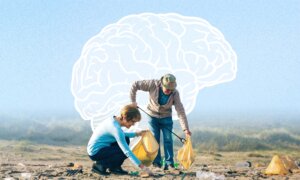
A group of hotel housekeepers lost weight, lowered their blood pressure, and reduced their body fat—all without hitting the gym or changing their daily routines.
The only difference was in what they believed: that their labor was exercise. Their minds believed it, so their bodies responded accordingly.
The study’s findings were first published in 2007 in Sage Journals. Today, a growing body of research demonstrates this scientific discovery: What our minds believe about our bodies can lead to consequential physical changes.
In other words, when we believe that a treatment will work, the brain releases real neurotransmitters that produce real results.
The Role of Belief
Placebo effects are well-researched examples of mind-body connections. They occur when our expectations of a treatment, improvement, or experience—even if the treatment isn’t “real”—trigger actual biological changes. What drives the change, researchers suggest, is a combination of belief with emotional association, a sense of safety, and expectation.
One landmark double-blind study published in 2013 is still referenced across scientific fields today for the surprising nature of its results.
Patients with significant traumatic knee pain, meniscus tears, and knee osteoarthritis resistant to typical treatment were randomly assigned to two groups: one that would receive a meniscus surgery and one that would receive a “fake” placebo surgery, in which they would undergo a simulation of the meniscus surgery.
Both groups improved significantly, and the real surgery group showed no greater improvement than the placebo group.
What patients believed, felt, and expected proved to be the determining factor.
What Neuroscience Tells Us
The placebo effect isn’t the only mechanism at play. Neuroplasticity and the nervous system also play a role.
The placebo effect and neuroplasticity are connected through a shared mechanism: the brain and nervous system’s ability to create physiological change based on expectation and belief.
Neuroplasticity is the nervous system and brain’s ability to form, change, and strengthen neural connections in response to repeated thoughts, behaviors, and experiences. Each time you repeat certain thoughts, associate emotions with experiences, or practice habits, neurons in the brain “fire” along specific pathways, strengthening these connections over time until they become automatic.
This scientific discovery overturned the widely held assumption that people can’t change, opening the possibility of creating meaningful mental and physical growth at any age.
Researchers found that even simple practices such as mental rehearsal, visualization, and thought practice can produce tangible, neuroplastic changes in the brain. Scientific findings have shown that developing more awareness and control over what we focus our thoughts and emotions on leads to measurable improvements: better brain connectivity, reduced fear, improved emotion regulation, and greater stress resilience.
However, physical, neuroplastic changes from meditation don’t stop at the brain. One research study published in Psychoneuroendocrinology found that even a single day of mindfulness practice among experienced meditators produced cellular differences in gene expression, “turning off” genes that cause inflammation.
Meditation has also been associated with positive changes in our gut microbiome that have been linked to lower anxiety, depression, immune dysfunction, and cardiovascular disease.
Research on aging adds another dimension to the physical changes of neuroplasticity’s mind-body connection. People aged 50 and older who held more positive beliefs about aging lived 7 1/2 years longer than those who had more negative self-perceptions.
Don’t Mystify It
As placebo and neuroplasticity research began to hint at the power of belief and expectation to create new pathways of change in our bodies, neuroscientists started to focus more on expectation-driven outcomes—a shift that drew interest in manifestation and goal-setting.
Dr. Tara Swart, a neuroscientist and author who educates on neuroscience insights, cautions against mystifying this process.
“The biggest misunderstandings I find as a neuroscientist in the manifestation space is that manifestation is explained by frequencies and vibrations that are external to us and not by our own agency over the power of our brains,” she told The Epoch Times.
In neuroscientific terms, she said, manifestation is simply setting a goal and taking the necessary actions to achieve it.
The process involves heightening awareness, aligning emotionally with a desired outcome, noticing relevant opportunities, and actively overriding negative neural patterns that work against progress, Swart said. The reticular activating system, a network of brain neurons that filters information and determines mind focus, helps us selectively filter what is important to us and value-tag opportunities to the brain as worth taking health risks for, she added.
Why the Nervous System Matters
The nervous system decides whether change is possible at all by determining whether we view our environment as safe or threatening.
Trauma and prolonged stress can impair this filtering process, leading us to focus on the negative.
Researchers have found that daughters of mothers with depression focused more on negative facial expressions than positive ones. Other studies on negativity bias found that people with histories of childhood abuse were more likely to assign negative emotions to neutral facial expressions when compared with non-traumatized people.
Researchers also discovered that trauma can disrupt the default mode network in our brains, an area critical to emotional processing, self-reflection, mental exploration, and creating new mental narratives.
Our brains and nervous systems reinforce known threat pathways rather than new, unknown possibilities, and can even create nocebo effects.
Nocebo effects are like placebo effects, but result in negative changes and have been found to create negative outcomes, such as pain, when people believed and expected a negative response from an intervention.
Rewiring for better mental and physical health, then, must begin with creating a sense of safety so that the power of neuroplasticity and expectation can spur positive growth.
Cultivating the Conditions for Change
To use the power of thought and belief to rewire our brains, people can employ a few simple strategies to find what works best for them:
- Breathwork: Conscious breathing exercises are simple and effective for resetting the nervous system. People can try different methods—such as box breathing, the physiological sigh, or the half salamander exercise—or use apps such as The Breath Space, Swart said.
- Spend Time in Nature: Being in nature reduces stress and improves cellular functioning and emotional processing.
- Engage in Exercise or Body-Based Practices: Yoga and other forms of movement allow your body to move through negative emotions and create new neuroplastic pathways in the brain.
- Repeat Positive Affirmations: Affirmations or reminding yourself of Scripture passages can rewire negative self-beliefs.
- Practice Gratitude: Gratitude rewires the brain and communicates a sense of safety to the nervous system.
- Engage in Social Connection and Play: Two of the most powerful nervous system regulators, social connection and play, return the body to a condition of openness, curiosity, and engagement.
Our cells are constantly responding to the belief and emotional meaning we create. When we cultivate safety, coherence, and hope, our thoughts can become powerful biological signals with real consequences for our health and lives.