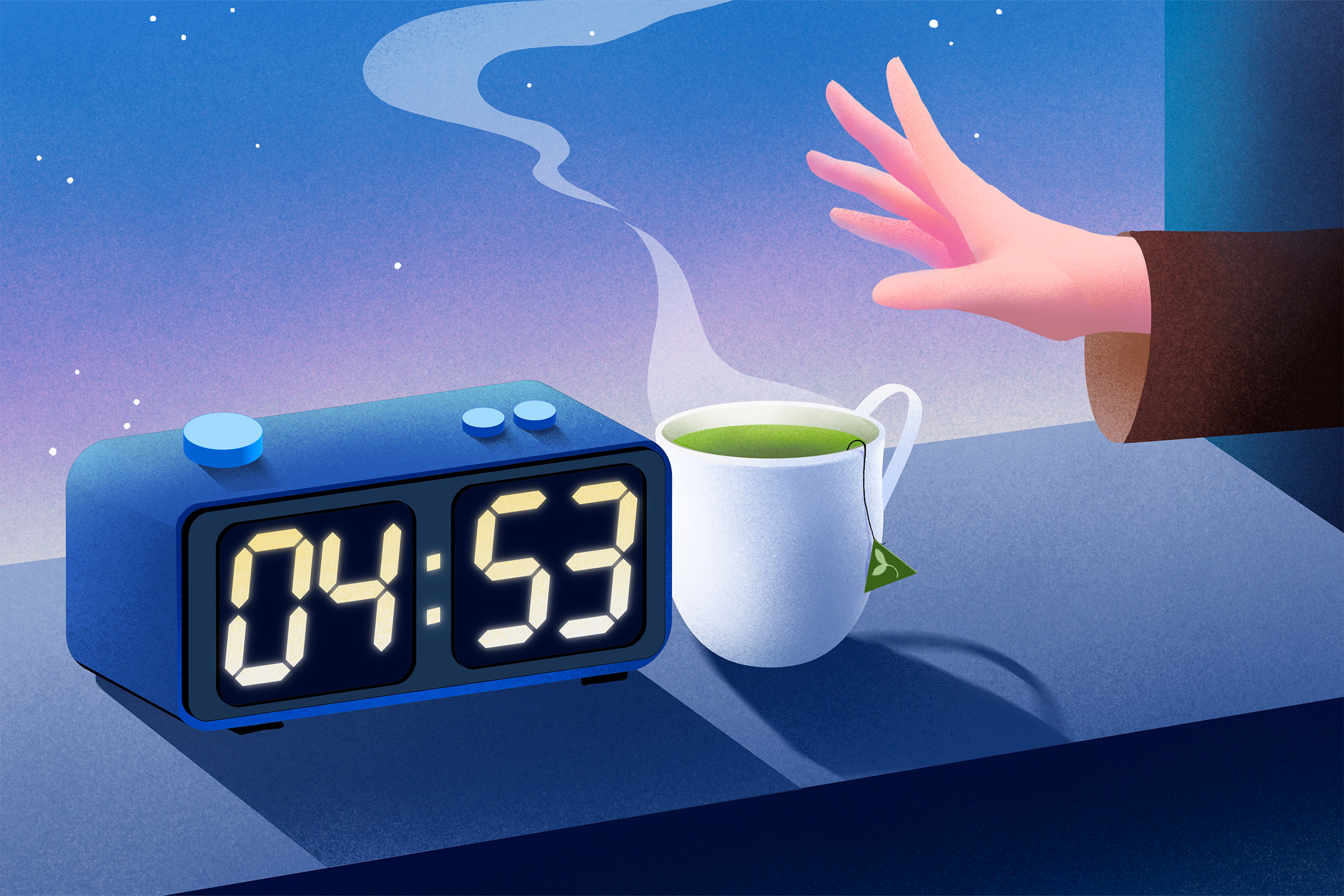

It is 4:53 a.m. on a Monday in January. My room in upstate New York is frigid; I dread opening my eyes, let alone leaving my bed. The alarm hasn’t gone off, but I know what’s coming.
I sit upright, drag a jacket over me, and reach for the bottle I set on the table the night before.
Eighteen ounces of water spiked with my favorite electrolytes, followed by a cup of hot tea. This is the first of many small traps I’ve laid to outsmart the version of me that, in about four seconds, will want nothing more than to disappear under the cozy blanket.
But I don’t disappear, at least not today.
That was day three of my 30-day experiment of waking up at 5 a.m. By then, I had already learned the first rule of early rising: Morning you is a different version than the one who set the alarm the night before. One is idealistic; the other is guaranteed to hit snooze. Thus, you have to build systems to outplay your drowsy self, because at the crack of dawn, you fall to the bottom of your habits.
For me, my systems included: phone far from the bed, water ready, and gym clothes laid out. First, run on autopilot until you’re vertical, then it’s somewhat downstream from there.
If you leave anything to decision-making, you will end up choosing the pillow. Every time.

Why I Did It
Part of my reasoning was journalistic. I wanted to test the 5 a.m. gospel that fills the productivity space—the promise that if you just wake up earlier, life will have no choice but to bow at your feet.
However, my motivation for rising early was more personal. Back in high school, I used to wake up at 3:50 a.m. daily. I still remember how days felt fuller then. Mornings were supremely ample and tranquil—but somewhere between then and adulthood, I’d drifted into waking up between 7 a.m. and 8 a.m. with two or three snoozes, and a consistent morning routine: bathroom, coffee, more coffee, and scramble to work by 9 a.m.
I wanted to see if forcing a 5 a.m. anchor could reorganize my life and bring back that pre-dawn serenity.
I set a few simple rules: wake at 5 a.m. or earlier, no snooze—okay, maybe one—sleep by 10 p.m. for at least seven hours. Most importantly, I had to use the hours I had gained for something meaningful, which meant no phone, no scrolling, basically no digital input.
I tracked my everyday mood, productivity, and sleep time, and journaled about my subjective experience.
The Numbers
Over 30 days, I hit the 5 a.m. target 27 times—about a 90 percent success rate. My average sleep came in at 6 1/2 hours, less than the seven-hour minimum most sleep researchers recommend, and the goal I had set for myself.
I also self-assessed multiple metrics on a scale from one to 10. I self-rated my energy levels in the morning, afternoon, and evening, then averaged the results. At the end of the 30 days, energy averaged 6.9 out of 10. Mood: 7.3. Productivity: 6.7. They are not perfect measurements, but good enough to see a pattern.
OK, but averages flatten the story. It all seems pretty good, but the real texture is in the swings—the highs and the lows.

The Soil for Self-Control
Day one, I scored a nine in productivity, really not too bad.
Day three, my mood hit a perfect 10, the only time in the next 30 days that would happen.
There’s a reason for that spike. On day three, I woke up, read for an hour, meditated for another hour, then went to the gym at a time I’d never been before. It was an entirely new and exciting experience. Different staff at the front desk, new faces on the machines, and I saw the sunrise on the way there, a cold January pink I hadn’t seen in months because I was always still in bed when it happened.
The novelty was frankly intoxicating.
I wrote in my journal that day: “By the time I clock in for work, it feels like I’ve already had half a day. By the time I’m having dinner, I have a hard time remembering whether I really did go to the gym that same morning.”
This experience tracks with what neuroscientists know about time perception. New and unique experiences activate the sensory cortex and hippocampus, forming richer, more durable memories. The result: Time feels expanded.
As I wrote in a previous piece on the psychology of time, introducing novelty is one of the most reliable ways to slow the clock down.
Those first mornings lasted what felt like entire afternoons.
Something else happened that week. Waking up early, I realized, wasn’t really about the goals I had in mind but what it took to achieve them.
5 a.m. became the soil on which I could plant seeds of self-control, discipline, and action. But as any farmer knows, you can’t just plant seeds into the ground and expect them to grow. You have to fertilize the soil the day before. For me, that was the phone far from the bed, water ready, and a book waiting for me.
There’s also a chicken-or-egg question I kept wondering about: Do you need self-control to feel good, or does feeling good lead to self-control?
It turns out that the research leans heavily toward the second direction.
Professor of psychology, Barbara Fredrickson’s broaden-and-build theory, one of the most cited frameworks in positive psychology, argues that positive emotions such as joy, interest, and contentment don’t just feel good in the moment. They broaden and build enduring reserves that you can draw on later.
Well-being, in other words, isn’t only a byproduct of discipline. It’s also a precondition for it.
A series of studies tested this theory directly. Researchers depleted participants’ self-control through cognitively demanding tasks, then tried various interventions to restore it. Rest helped a bit, but participants who watched a short comedy clip or received a surprise gift—anything that spiked positive affect—went on to self-regulate, as did people who had never been depleted in the first place.
That was what I felt on day three. The morning feel-good rush of starting on the right foot helped me stay disciplined all day long.
Soon, I would learn that the inverse was also true.

The Drain of Self-Control
Days 10, 20, and 27 on the chart—those are the crashes. It is when my body simply refused.
Day 10, I woke to 4-degree weather. My room was so cold I needed a jacket just to sit in bed. “I’ve done so well,” I thought, “Can’t I just get two more hours?” I slept until 8 a.m. that day, and I wrote plainly, almost disappointedly, in my journal, “Completely failed; body crashed, very tired.”
Days 20 and 27 were both Saturdays. That’s not a coincidence.
It makes sense when you know how those two Fridays looked: I work most of the week remotely, but Fridays meant commuting into New York City, nearly a four-hour round trip on the train, followed by a full day of meetings and shooting The Upgrade, under studio lights with full hair and makeup.
By Saturday morning, there was not much left to draw from. The well-being that fuels self-regulation had been totally spent.
Sleep deprivation added another layer. Although my time spent in bed was comparable to before the experiment, I was actually sleeping less than usual, and I felt it. Research has found that lack of sleep shifts the brain from goal-directed control to habitual control, mediated by the ventromedial prefrontal cortex–the region of the brain that evaluates choices. When you’re sleep-deprived, your brain stops making intentional decisions and starts running on autopilot. It is more likely to succumb to “impulsive desires.”
But again, I didn’t need a study to tell me. On under-slept days, my body would override my mind on the train commute, pulling me under.
On well-rested 5 a.m. days, it was still a challenge, but it felt different. Meditate for an hour, read for an hour, go to the gym for the other hour, shower, and work.
By 9 a.m., it already felt like I’d won. What I didn’t yet realize was that I’d signed up for a game in which the score resets at midnight.
The Productivity Debt Trap
Once waking up at 5 a.m. became the baseline, anything less felt like falling behind. I’d wake up at 6:30 a.m. on a Saturday, a perfectly normal time, and feel guilt—as though I was already in debt for the day. Like, half the morning had to be spent paying back what I owed before I could even begin to feel okay.
Writer Oliver Burkeman has a name for this: “productivity debt.”
“I observed that many people (by which I meant me) seem to feel as if they start off each morning in a kind of ‘productivity debt,’ which they must struggle to pay off through the day, in hopes of reaching a zero balance by the time evening comes.” Burkeman wrote on his website.
“Few things feel more basic to my experience of adulthood than this vague sense that I’m falling behind, and need to claw my way back up to some minimum standard of output.”
I couldn’t have phrased it better. On the days I didn’t hit 5 a.m., the debt felt twice as much and compounded with interest. On the days I did, it was a race to zero. Even when I reached it, I didn’t dare celebrate. I was haunted by the knowledge that the clock would reset at midnight.
Paying off your imaginary productivity debt completely, as Burkeman warns, is “literally impossible.”
“In the modern world of work, there’s no limit to the number of emails you might receive, the demands your boss might make, the ambitions you might have for your career … so there’s no reason to believe you’ll ever get to the end of them,” he wrote.

The Internal Tyrant Looks in the Mirror
In the one month of experimentation, perhaps the most important lesson came from a conversation with my fiancée.
She kept telling me I needed rest. I kept saying no.
For one, I wanted to complete the challenge; secondly, I didn’t feel I was worthy of it.
Matthew Hussey articulated the feeling perfectly in his book “Love Life”: “I struggle to believe I’m worthy of moments of joy and peace without first putting myself through a brutal schedule, monitoring my productivity levels down to the minute. Mine is a mutation whereby joy and self-compassion are regularly outlawed by an internal tyrant who decides when I’ve been flogged enough for one day.”
Yet, when my fiancée stayed up late or pushed through exhaustion at work, I would plead with her to take care of herself.
“Sleep in, recover, and do it without guilt,” I said.
The hypocrisy hit me one morning at about week three.
What I was missing was something I often prescribe but rarely take—self-compassion.
Kristin Neff, an associate professor in the Department of Educational Psychology at the University of Texas at Austin, has conducted research on self-compassion spanning more than two decades and 4,000 published studies, showing that self-compassionate people don’t lose motivation.
They set more personally meaningful goals, handle setbacks with balance, and maintain their drive to improve even after failure.
The old model—that you need to be hard on yourself to stay disciplined—is what Neff’s research suggests is at best dramatically overstated.
Self-compassion, it turns out, is also a form of fertilizer. The soil on the days I failed needed it more than the soil on the days I succeeded.
So yes, I hit 90 percent—but the 10 percent that I missed weren’t necessarily failures. Those three mornings gave me the opportunity to reflect on my relationship with myself, and that, for me, was a triumph.
What Now?
Am I still waking up at 5 a.m?
No. I’m currently crawling out of bed at about 6 a.m. or 7 a.m., depending on the day. That’s the honest answer. After trial and error, I have found it’s what works for me.
Research shows that productivity improves when people align their schedule with their chronotype, their biological predisposition toward morning or evening activity.
Morning types who wake early are more productive—but evening types who force themselves to get up early actually perform worse. So the answer isn’t a universal wake-up time. It’s knowing yourself well enough to choose.
My chronotype leans toward morning; I’m apparently a “bear.” The experiment confirmed that. It also showed me that I value late-night reading and creative work, and going to bed at 10 p.m. stole that part of my life. It’s all well if you understand the trade-off and choose deliberately. You can find your chronotype here, if you are curious.
Sometimes during this challenge, I did nothing.
Some mornings, I would wake up, sit with my thoughts, and watch the dark sky lighten. Those were not the most productive moments—but strangely, those were some of the fullest mornings of the entire experiment.