Everyone’s favorite indulgence is more than just a treat. Dark chocolate is rich in nutrients and antioxidants and has proven benefits for heart and brain health. Its long-standing association with pleasure and Valentine’s Day isn’t merely cultural, but also biological: Research suggests that chocolate can lead to improved mood.
“Think of chocolate as a functional indulgence,” Serena Poon, a chef and nutritionist, told The Epoch Times.
What makes chocolate more than a pleasurable treat comes down to what lies within the cocoa bean. Much of chocolate’s health potential starts with its mineral and polyphenol content.
One ounce, or roughly one square (28 grams), of a 70 percent to 85 percent dark chocolate bar contains:
- Fiber: 11 percent of the daily value (DV)
- Iron: 19 percent DV
- Magnesium: 15 percent DV
- Copper, which supports energy formation and brain function: 56 percent DV
- Manganese, which plays a role in insulin sensitivity and bone health: 24 percent DV
Cocoa is also rich in
antioxidants, especially
flavonoids, and contains higher levels than many fruits, including apples, and red wine. These compounds are responsible for cocoa’s bitterness and rich flavor.
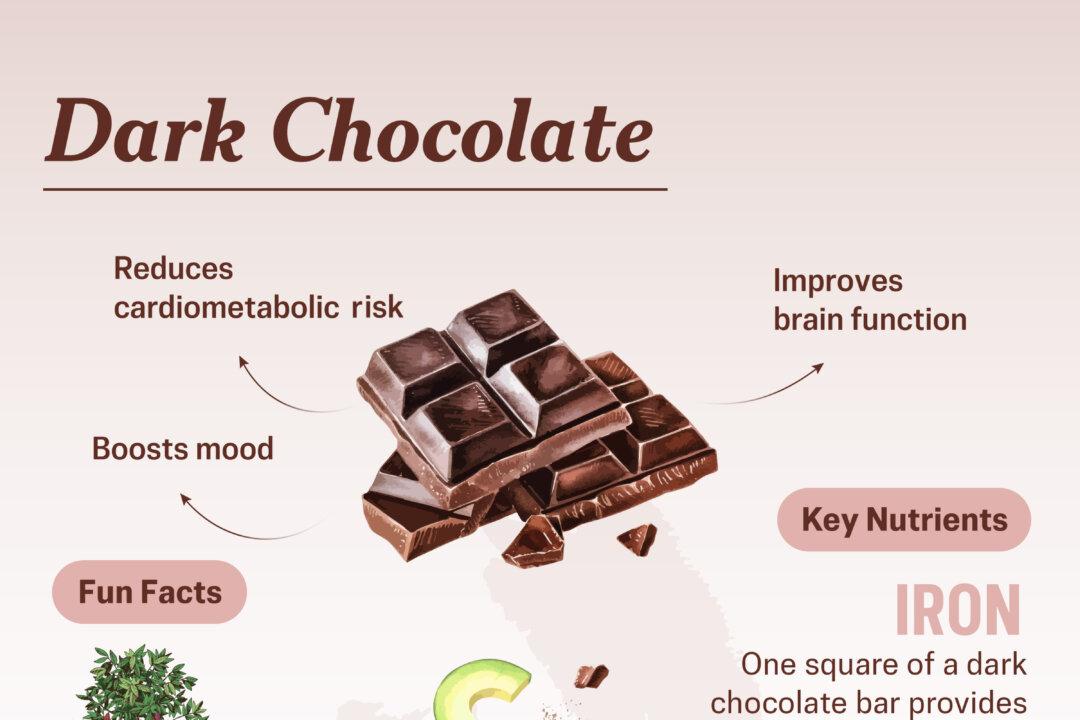
(Illustration by The Epochtimes, Shutterstock)
“When sourced thoughtfully and enjoyed mindfully, cocoa-rich chocolate can support cardiovascular health, cognitive function, metabolic balance, and emotional well-being—while still feeling joyful and satisfying,” Poon said.
Reduces Cardiometabolic Risk
Dr. Will Haas, board-certified in integrative medicine, told The Epoch Times, “Where the evidence for dark chocolate gets compelling is its effect on vascular function, the endothelium, and nitric oxide.”
Flavanols in cocoa stimulate the endothelium to produce nitric oxide, which relaxes blood vessels, improves blood flow, and may help prevent platelet clumping.
It’s estimated that 100 grams of 70 percent dark chocolate produces an effect on platelets comparable to that induced by a standard dose of aspirin.
A 2017 meta-analysis published in Nutrients found that eating more chocolate was associated with a 10 percent lower risk of coronary heart disease and a 16 percent lower risk of stroke. The findings suggest that the most substantial cardiovascular benefits are achieved at up to about three servings of about 30 grams per week, roughly one-third of a standard bar. Increasing chocolate intake beyond this level showed a plateau effect, with little to no reduction in risk. The review did not differentiate by cacao percentage or chocolate type.
“The heart benefits of dark chocolate tend to level off after about three servings per week because the body’s response reaches a natural ceiling,” Dr. Elisabeth Anne Plotner, a double board-certified family and lifestyle medicine physician and preventive medicine fellow, told The Epoch Times.
Flavonoids help blood vessels relax and improve blood flow by activating specific pathways, she said, but once those pathways reach a certain point, more chocolate won’t offer additional benefits.
Moderate dark chocolate consumption may also help lower low-density lipoprotein cholesterol (so-called “bad” cholesterol) and total cholesterol by reducing absorption and production, although it doesn’t significantly raise high-density lipoprotein cholesterol (so-called “good” cholesterol).
The relationship between chocolate and metabolic health becomes more nuanced in the context of diabetes. There is an established link between higher chocolate intake and a reduced risk of developing Type 2 diabetes. However, this doesn’t necessarily mean that one should eat chocolate to prevent diabetes, especially for people who already have high blood sugar.
“Dark chocolate has calories and sugars that are problematic in the context of prediabetes,“ Haas said. ”It is easy to overdose on chocolate in this population.”
Improves Brain Function
A 2020
study published in Nutrients found that cocoa flavanols may act as neuroprotectors.
They help protect the brain and support focus, memory, and learning. Benefits were seen after just a single dose and with regular intake over weeks, likely because of improved blood flow to the brain and an increase in the level of a protein that boosts neuron growth and plasticity.
A longitudinal study found that more frequent chocolate consumption was associated with better cognitive performance, including memory, attention, processing speed, and reasoning. Participants who ate chocolate at least once per week performed better on cognitive tests than those who rarely or never ate it. Cocoa extracts can interfere with the formation of plaques linked to Alzheimer’s disease, according to an animal study, suggesting that cocoa flavanols may have protective effects against cognitive decline.
Boosts Mood
Beyond physiology, cocoa may influence how we feel—partly through the gut.
A randomized controlled trial found that three weeks of daily consumption of 85 percent dark chocolate significantly reduced negative mood, while 70 percent dark chocolate had no effect. The researchers found that the higher-percentage cocoa acted as a prebiotic, increasing gut microbiome diversity and elevating levels of a specific bacterium linked to positive mood regulation via the gut-brain axis.
“Polyphenols might act as a type of ‘microbiome fertilizer’ to some degree because they get converted into substances with the potential to affect inflammation or neurotransmitter-related processes via the gut-brain axis,” Haas said.
Other research found that daily intake of at least one-third of a dark chocolate bar over 30 days significantly improved self-reported calmness and contentment. There is also evidence that chemical compounds in dark chocolate can help stabilize mood swings.
“It’s a small effect for some people, yet noticeable if they replace a more processed dessert with dark chocolate,” Haas said.
Additional Benefits
Chocolate’s gut health benefits offer more than just a mood boost. A 2025
study found that eating dark chocolate can improve constipation and support gut health. Cacao proteins are resistant to digestion and act as a prebiotic, increasing bowel movement frequency and stool volume. Dark chocolate also enhanced gut microbiota diversity and raised the amount of butyrate-producing bacteria.
Your favorite treat may also keep you glowing. Regular consumption of high-flavanol cocoa has been shown to act as a “photoprotective” agent, doubling the skin’s resistance to sunburn and reducing roughness and scaling. It has also been shown to improve elasticity, density, and hydration, while slowing signs of photoaging. These benefits are likely due to cocoa’s antioxidant and anti-inflammatory properties.
You may also want to try some chocolate pre-workout. Research suggests that dark chocolate may act as a natural performance enhancer for athletes. Daily consumption of about 1 1/2 ounces of dark chocolate enhanced short-term cycling performance, likely by improving nitric oxide bioavailability, allowing the body to perform the same amount of work using less oxygen.
Although dark chocolate comes with a litany of health benefits, Haas noted a correlation that is often overlooked.
“The so-called ‘healthy user effect’ also comes into play, as those consuming a small amount of dark chocolate may lead a different lifestyle from those consuming a larger amount,” he said.
Not all chocolate delivers the same benefits, and how you eat it matters.
- Choose High-Cacao Dark Chocolate: “Seventy [percent] to 85 percent cacao offers the best balance and provides a meaningful concentration of cocoa flavanols while still being enjoyable enough to eat mindfully,” Poon said.
- Pair Dark Chocolate With Healthy Fats: Not only do the flavors and textures of fats work well with chocolate, but they also up the nutrient boost. “Foods rich in fiber and healthy fats, like nuts, seeds, berries, avocado, and olive oil, slow glucose absorption, enhance satiety, and may improve absorption of fat-soluble polyphenols,” Poon said.
- Time It Right: Eat dark chocolate on an empty stomach or with a light meal.
- Enjoy With Vitamin C Foods: Foods rich in vitamin C such as berries or citrus may help improve absorption of its flavonoids, Plotner said.
Even high-quality chocolate can lose potency if it’s not stored properly. Chocolate should be kept in a cool, dry environment, ideally between 60 degrees and 70 degrees Fahrenheit, away from light and strong odors.
“Temperature fluctuations can affect cocoa butter crystallization and flavor stability, while excessive heat can degrade polyphenols,” Poon said.
Keeping chocolate in a low-humidity environment can help prevent white streaks, known as bloom. Avoid refrigeration unless in very hot climates, as chilling may blunt flavor.
To ensure that you’re getting the best dark chocolate for your health goals, be a label sleuth.
Haas highlighted the fact that it’s important to avoid assuming that high cocoa solids and high processing alone indicate superiority; 85 percent chocolate is not necessarily superior to 70 percent.
Poon said, “From a nutrition standpoint, the ingredient list should be short and recognizable—ideally cacao or cocoa mass, cocoa butter, and a minimal sweetener if needed.”
She said that from a culinary perspective, quality cacao should deliver depth, complexity, and natural bitterness without relying on additives.
“Added vegetable oils, hydrogenated fats, artificial flavors, excessive emulsifiers, and high amounts of refined sugar are all red flags,“ Poon said. ”These ingredients can displace cocoa solids, which are responsible for most of chocolate’s health benefits.”
Haas recommended using natural cocoa powder or cocoa extracts for concentrated flavanols and avoiding Dutch-processed cocoa.
“Processing, especially ‘Dutching’ or alkalization, can significantly reduce flavanol content,” he said.
When cooking or baking with chocolate, high heat can also significantly reduce cocoa flavanol content. Poon recommended gentle methods, such as low-temperature baking, double boilers, or no-bake preparations, to help preserve these compounds. Research has shown that higher processing temperatures and longer roasting times can reduce cocoa flavanol levels by more than 50 percent.
For the average adult, Haas said, the magic number is small, rather than half a bar every day. Consistent consumption trumps high doses, and eating small amounts regularly is in harmony with its benefits.
Enjoy an indulgent, no-heat dessert that preserves the nutrient benefits of dark chocolate while adding a healthy dose of fat from avocado and coconut milk to boost absorption.
Chocolate Avocado Mousse
Serves 4Ingredients
- 2 ripe avocados (about 8 ounces each)
- 1/4 cup cocoa powder
- 1/4 to 1/3 cup coconut milk (or milk of choice), using more for a lighter consistency and less for a thicker mousse
- 4 tablespoons maple syrup
- 1/2 teaspoon vanilla extract
- Pinch of salt
- Optional toppings: cacao nibs, raspberries, sliced strawberries, blueberries, torn mint, chopped nuts
DirectionsPulse all ingredients except toppings in a food processor until smooth.
Best served chilled.
Like most functional foods, dark chocolate’s benefits depend on the amount, source, and individual sensitivity.
Chocolate may contain heavy metals such as cadmium and lead, as cacao plants can naturally absorb trace amounts from soil, depending on the growing region and processing methods. Levels vary widely by brand and sourcing. Choosing reputable brands that test for contaminants can help limit exposure.
Cadmium and lead are concentrated in cocoa solids, so the higher the percentage, the higher the exposure. Daily consumption of high-percentage dark chocolates over long periods of time can result in cadmium levels that pose potential health risks, particularly if the chocolate is coming from certain Latin American regions that have naturally high levels of cadmium in the soil, Plotner said.
Pregnant women, children, or anyone consuming large portions should be extra cautious, according to Haas.
“Lead and cadmium buildup in the body is cumulative, and bars may contain more of them due to higher cacao content,” he said.
Dark chocolate naturally contains caffeine and theobromine, which can cause jitteriness, palpitations, or sleep disruption in sensitive people—especially when eaten later in the day.
“If the person has insomnia, palpitations, or anxiety issues, it’s a good idea to consume it earlier in the day or every other day,” Haas said.
If you experience migraines, note that chocolate is also a known trigger for some people. Chocolate can also cause reflux in certain people.
Chocolate is dangerous for dogs because of theobromine toxicity. Even small amounts, especially dark chocolate, can cause serious adverse effects.
- The scientific name for the cacao tree is Theobroma cacao, which translates to “food of the gods.”
- White chocolate isn’t technically chocolate—it contains cocoa butter but no cocoa solids.
- Chocolate is the only known edible substance that melts just below body temperature, which is why it feels silky and “melts in your mouth.”
- “Slowing down and allowing chocolate to melt on the tongue also enhances flavor complexity, which improves satisfaction and portion control,” Poon said.
Small portions of chocolate are enough for kids to enjoy the benefits without overdoing it. Choosing dark chocolate with a higher cocoa content provides more antioxidants than milk chocolate, while avoiding options with excessive added sugar helps protect teeth and prevent energy crashes.
Chocolate works best as a fun addition—not a replacement—for balanced meals, especially when paired with foods such as nuts, fruit, or yogurt to boost nutrition.

(Illustration by The Epochtimes, Shutterstock)
It can also help with teaching children mindful eating.
“Encouraging kids to savor chocolate slowly helps establish a healthier relationship with sweets, which research shows can influence long-term eating behaviors,” Poon said.
For a simple, kid-friendly treat, try chocolate-dipped frozen pineapple pops. Insert popsicle sticks into fresh pineapple rings, dip them in melted chocolate, and freeze on a parchment-lined tray for a sweet treat.