Many of us believe that effective exercise requires sweating and panting. However, exercise intensity depends on both the cardiorespiratory load and the tension exerted on the muscles to achieve their control and stability. Eccentric exercises, which involve slowly lengthening muscles, help strengthen tendons, improve flexibility, and increase strength. They require no special equipment and can be done at home.
Three main types of muscle contraction:
- Concentric: Muscles shorten to generate force, such as lifting dumbbells.
- Eccentric: Muscles are stretched while maintaining tension, such as in slowly lowering dumbbells.
- Isometric: Muscle length remains constant while tension is maintained, such as in the plank exercise.
Most people focus on concentric contractions when exercising to significantly increase muscle size. However, the key to improving control and stability lies more in eccentric contractions. For example, descending stairs is a classic eccentric exercise—muscles lengthen as you support your body weight. When descending stairs, the quadriceps (front thigh), gluteal, and calf muscles must coordinate to prevent the body from falling. This delicate control strengthens our muscles and teaches the nervous system to react and regulate force more responsively.
Benefits of Eccentric Contraction
In addition to strengthening muscle control and stability and improving balance through long-term practice, eccentric contraction also offers the following health benefits:
1. Maintains Fast-Twitch Fibers, Slowing Sarcopenia
Eccentric contractions primarily activate fast-twitch fibers, which are responsible for speed and explosive power—capabilities that are prone to decline with age. Eccentric training can thus help middle-aged and older adults maintain muscle function, reduce sarcopenia, and reduce the risk of falls.
2. Promotes Fascial Elasticity, Reducing Stiffness and Pain
As we age, our fascia (connective tissue) gradually stiffens and shortens, leading to decreased range of motion and pain. Eccentric training lengthens muscles and reshapes the fascia structure, restoring its elasticity and mobility. This is particularly helpful for those who sit for prolonged periods or suffer from fascial tightness.
3. Improves Muscle Toughness, Reducing Injury Risk
Eccentric training simultaneously enhances flexibility and strength, helping to prevent knee, hamstring, and calf strains. For runners, dancers, and older people, eccentric lower-limb exercises are especially practical and preventive.
4 Home Eccentric Training Tips
Want to enjoy the benefits of eccentric training at home? The following four exercises require minimal space and can be performed safely with just a chair.
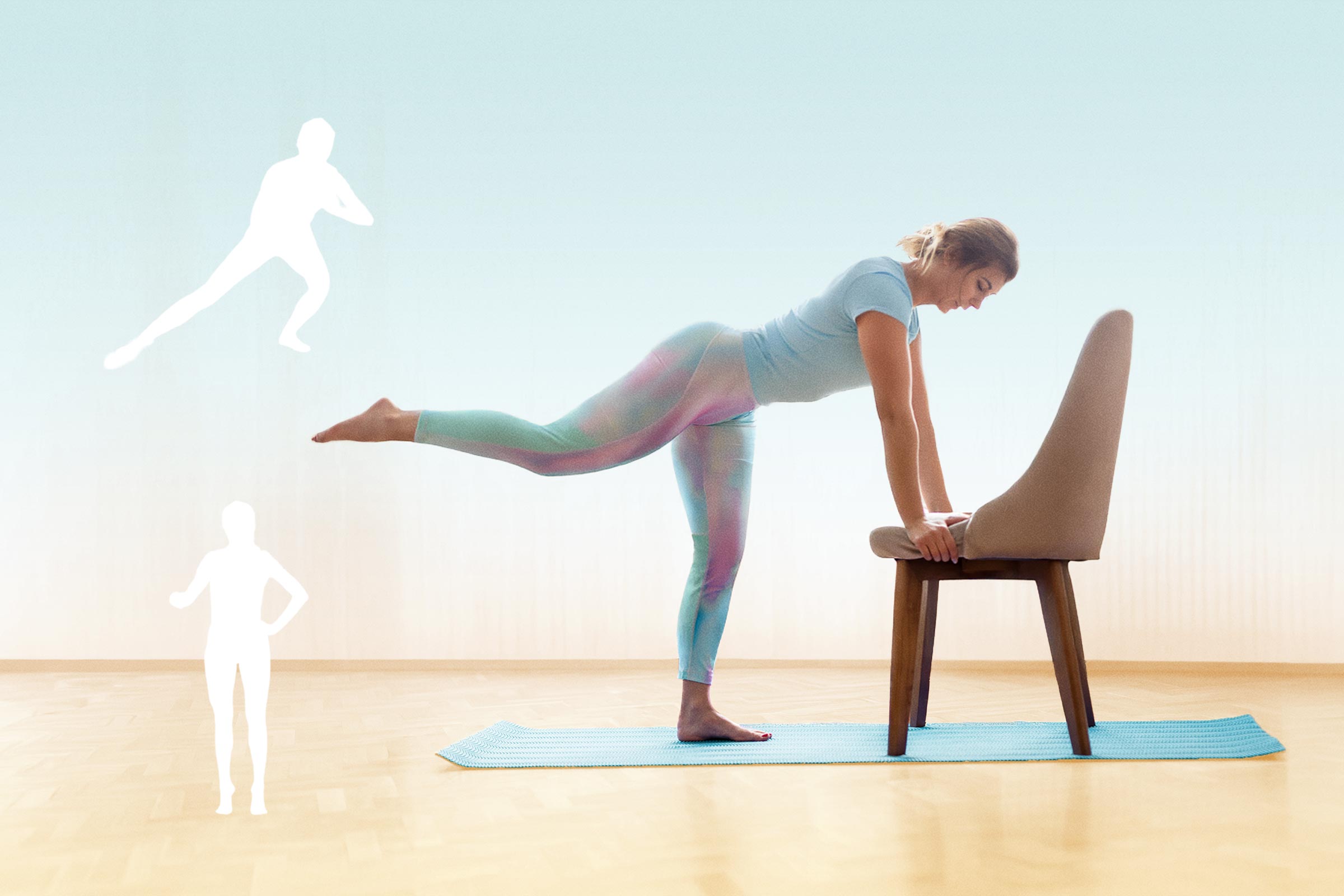
1. Single-Leg Deadlift
Target muscles: Gluteus maximus, quadriceps, and hamstrings
Step 1: Stand up straight, with your knees slightly bent, and hold the back of a chair with one hand.
Step 2: Lift one leg back while slowly leaning forward. At the same time, lower your standing leg slightly into a squat.
Step 3: Feel the tension in your buttocks and hamstrings on the standing leg. Hold for five seconds, then slowly stand up, and return to the starting position. Alternate between legs. The slower the movement, the more effective the exercise.
2. Single-Legged Hip Thrust
Target muscles: Glutes and quadriceps
Step 1: Place a chair behind yourself for support.
Step 2: Stand up straight, reach one foot forward and lightly touch your toes on the floor, while supporting about 90 percent of your weight on the other foot.
Step 3: Slowly lower yourself into a squat, rising just as your hips touch the chair.
Single-legged hip thrusts simulate the eccentric load of walking downstairs, training lower limb stability and strength.
3. Side Lunges
Target muscles: Glutes, quadriceps, and adductors
Step 1: Stand with your feet wider than shoulder-width apart.
Step 2: Extend one leg straight out to your side, using the other leg as support. Bend your knees and squat down, allowing your extended leg to slide out.
Step 3: Lift up using your hips and thigh muscles to bring your legs back together. Alternate between left and right sides.
4. Tiptoe and Slow Release
Target muscles: Calf and plantar (on the sole of the foot)
Step 1: Stand upright, quickly raise onto your toes, and then slowly lower your heels.
Option: If available, you can practice this exercise on the edge of a staircase, which allows you to lower your heels even more. Hold the railing or wall for extra support.
The tiptoe and slow release exercise strengthens calf muscle control and prevents calf cramps and plantar fasciitis.
Eccentric exercise is not just for the legs. For example, when performing a biceps curl, slowly lowering the dumbbells trains the biceps brachii muscle for an eccentric contraction. The technique is particularly effective for women looking to improve arm lines appearance and eliminate “bye-bye sleeves”—the flabby or loose skin on the upper arms.
Other common eccentric exercises for the upper body, are the slow descent phase of a push-up and the slow lowering phase of a sit-up. By controlling the tempo and slowing down the pace, you can effectively train your muscles.