


Some 600 miles from Earth, a satellite constellation circles, ferrying data at the speed of light.
This is Declan Ganley’s vision for Outernet, a self-sustaining data ark in space that promises to host the most vital global digital communications—a backup internet.
Every existing global communication network, including Starlink, currently passes through the internet—a porous “public highway” rife with malicious threats, according to Ganley, CEO of telecom firm Rivada Networks.
The Outernet, on the other hand, is “completely self-contained”: The signals stay in space, traveling through laser-linked satellite networks directly to users, bypassing traditional ground infrastructure.
It’s a “game changer,” the fastest network in existence, with data sovereignty assured, he told The Epoch Times.
To conquer the sky, Ganley has been fighting a fierce legal battle on Earth.
His adversary is the Chinese Communist Party, which has identified outer space as a new frontier for global dominance.
Three years in and about 160 legal exchanges later, Ganley said he’s pressing on.
“We will fight every lawsuit that the Chinese bring, as we have done,” he said. “We will win them all, as we have been doing.”
Backed by tech billionaire Peter Thiel and with a contract to serve the U.S. Navy, the Outernet is set to deploy 600 satellites in early 2026, and Ganley said the Chinese regime is working hard to ensure that doesn’t happen. He said his opponents have hinted that the lawfare decision “goes right to the top.”
Ganley has a vested interest in having the Outernet adopted far and wide. But the case for a second internet backbone is also real. The undersea cables that thread together modern civilization are inherently vulnerable. Should a bad actor decide to cut those cables, the internet goes down.
In such a global emergency, a data network that survives would be beyond value.
If the Chinese authorities can’t own that network, “they want to make sure that nobody else has it,” Ganley said.
And so for Beijing, the best strategy is to kill it in the cradle.

Rivada Space Networks at the Asia Tech x Singapore show in Singapore in May 2024. (Courtesy of Rivada Networks)
A Prized Spectrum
The battle began in the small European country of Liechtenstein.
Ahead of major international rivals such as Starlink, in 2018, a small company there secured hard-to-get radio-frequency permits, giving it priority access to the Ka-band, a frequency spectrum coveted for its wider bandwidth, essential for high-speed satellite communications.
German-based satellite startup Kleo Connect contracted the rights for a project to put up 300 to 600 satellites in polar orbits. In doing so, it courted China’s state-owned Shanghai Spacecom Satellite Technology (SSST), surrendering a 10 percent stake in exchange for funding.
But a split quickly emerged before the project got much further. The Chinese entity proceeded to grow its stake to 53 percent within a year. The SSST launched two test satellites in China without consulting the German side, fueling suspicion that the Chinese partners were exploiting the licenses to advance interests in China.
Rivada entered the picture in 2022. By then, the quibbles between the two parties had escalated into a geopolitical dispute.
Banding together with the Germans, Ganley bought the Liechtenstein company, thus wrestling the spectrum permits from Chinese control. Building on the German founders’ constellation design, his team conceived a business plan and technical innovations for what’s now the Outernet.
Ganley said he offered to redeem the Chinese shareholders.
They didn’t just refuse, he said, but “went nuclear with their lawfare in response.”
SSST plays a critical part in China’s space race ambitions.
Founded in 2018 with funding from the city of Shanghai, the company is a rising star in China’s satellite industry. It’s currently developing the SpaceSail, or Qianfan, China’s answer to Starlink.
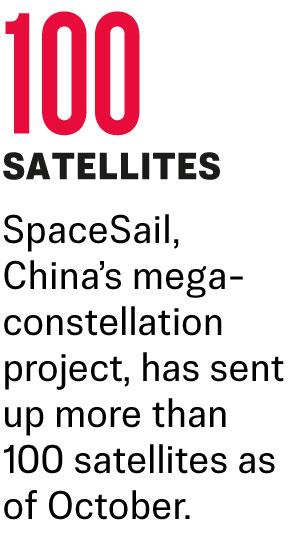
The mega-constellation project, featured prominently in Chinese state media, has sent up more than 100 satellites as of October, inking deals in emerging markets from Kazakhstan to Brazil.
China has listed constructing a satellite internet as a national priority in the current five-year plan. Authorities expect 2026 to 2030 to be a critical window for expansion. And SSST is now a major player in making that happen.

A Kuaizhou-1A carrier rocket carrying two satellites takes off from Jiuquan Satellite Launch Center in Gansu Province, China, on May 12, 2020. (China Daily via Reuters)
A Meeting in Paris
Months after clinching the frequency licenses, Ganley was approached by a senior Chinese business figure at a satellite show in Paris. The man had flown from China to see him, he said.
The two met up at Place Vendôme three days later. As they walked around the neoclassical square, the man justified the legal actions they had taken against Rivada, telling him it was nothing personal and that, in fact, he considered Ganley a great inventor—an “unusual talent,” Ganley recalled.
Rivada was raising money at the show. The man offered $7.5 billion for Ganley to become their partner.
Saying yes to the proposal would give Ganley 50 percent equity with more than enough for the Outernet project.
The man laid out his terms. The project would launch from China using satellites manufactured there. The service would immediately cover China, Asia, Latin America, and Europe. Ganley could keep some operations in Germany; the rest would happen in China.
The man didn’t say it out loud, but Ganley said there was an implicit message: “If you don’t do this, your life will be miserable. The lawfare will increase, and we are going to make sure that this project will not happen.”
Ganley chose to walk away.
Carrots and Sticks
What followed was a “a tsunami of lawsuits that were baseless, that were unwinnable, that were almost cartoonish in their flakiness,” Ganley said.
Ganley recounted that one complaint accused Rivada of intellectual property theft.

Declan Ganley (R) speaks at the Satellite Show in Washington in March 2025. (Courtesy of Rivada Networks)
“It is the inverse and direct opposite of the truth,” he said.
The accusers are tenacious, he said. The litigants filed appeal after appeal until the judge closed the case, and they once sued over an issue involving a few thousand dollars, even though the cost of filing the complaint was many times higher, according to Ganley.
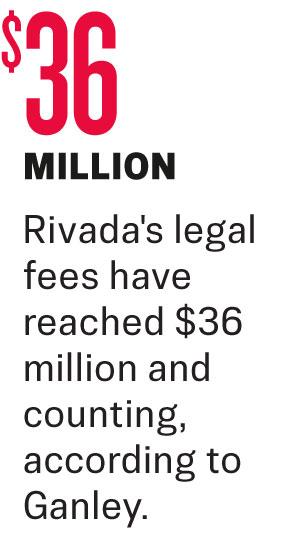
The legal costs to fight the lawsuits against Rivada, himself, and individual staff members now total $36 million and counting, he said.
Unidentified individuals who look Chinese and often wear sunglasses have followed Ganley and colleagues.
It’s the classic carrot and stick game, Ganley said.
“This stick that is beating you on this side can be massively outweighed by this carrot that we’re dangling in front of you. Take the carrot and the stick will stop,” he said.
“We’ve had $36 million so far of stick, and we’re not taking the carrot, and we will never take the carrot, and they don’t like that.”
A Global Blackout
The $36 million spent would be a “drop in the bucket” compared with the real value of the Outernet as a backup to the current cable-connected digital infrastructure, Ganley said.
Like blood flowing through arteries, more than 95 percent of all international data traverse approximately 500 fiber optic cables on the ocean floor, according to the U.S. government. Thanks to those cables, people can communicate from anywhere on the planet.
But these information lifelines are also fragile. Mislaying of heavy equipment, dragging of an anchor, or snagging of fishing gear can break them.

Declan Ganley (C) speaks at the World Satellite Business Week in Paris in September 2022. (Courtesy of Rivada Networks)
Let alone malicious actors intentionally causing sabotage.
For more than a decade, civilian- and military-run institutions in China have been perfecting precise, cost-efficient ways to locate and sever undersea cables. One university filed a patent for a cable-cutting solution for emergencies.
In the past two years, a myriad of cable-cutting incidents have been attributed to China. Among them was the crippling of Taiwan’s telecom cables, damage to communication lines in the Baltic Sea, and the wrecking of a gas pipeline and two nearby fiber optic cables connecting Finland and Estonia.
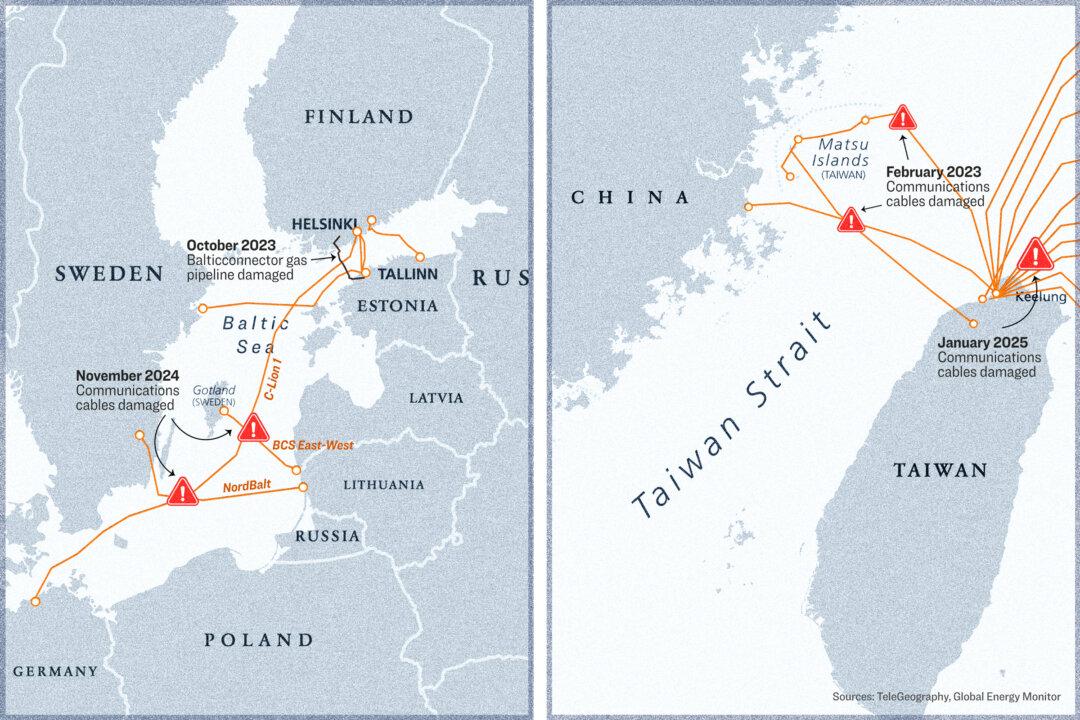
Undersea communications cables and natural gas pipelines that were allegedly sabotaged by the Chinese regime and Russia in the Baltic Sea (L) and the Taiwan Strait (R). (Illustration by The Epoch Times, Shutterstock)
It doesn’t take a state actor such as China to wreak havoc, but “China could absolutely do this,” Ganley said.
As subsea cables stop working, everything connected to them—smartphones, televisions, flights, food supply—will fail.
Ganley argues that the regime is ready for that. Beijing would stockpile whatever is needed and keep a continental terrestrial network before cutting the world off.
“Sixty million dollars will do that job to take out the global subsea cables,” he said. “That’s how pathetically vulnerable the global subsea cable infrastructure is because it’s just so big, it’s so vast, you cannot protect it all.”

The bulk carrier Chinese ship Yi Peng 3 is anchored and being monitored by a Danish naval patrol vessel in the sea of Kattegat, Denmark, on Nov. 20, 2024. Denmark's navy said on Nov. 20, 2024, that it was shadowing a Chinese cargo vessel in the Baltic Sea, a day after Finland and Sweden opened investigations into the suspected sabotage of two severed undersea telecoms cables. (Mikkel Berg Pedersen/Ritzau Scanpix/AFP via Getty Images)
‘A Soul to Be Accountable For’
Ganley said he made up his mind early on to never do business in communist China.
“I have a soul to be accountable for,” he said.
Now 57, the UK-born Irish telecommunications entrepreneur has been in the wireless industry since age 19, when he went to the Soviet Union in search of business opportunities.
“My university was watching communism collapse in Eastern Europe and the Soviet Union,” he said.

He worked all over the territory—Moscow, Latvia, Lithuania, and Siberia—and saw firsthand the result of 70 years of Soviet communism, from Potemkin villages to churches turned into prisons.
“It was the evil empire, and the source of that evil was Marxism—and was communism—where to be at the top of those organizations, you had to sell your soul,” he said.
In the years since, Western companies have flocked to China. By partnering with local entities, they hand over technology in exchange for a slice of the Chinese market.
Rather than capturing China, Ganley said, these businesses were turning themselves into captives.

Declan Ganley, chairman and CEO of Rivada Networks, in Washington, on Nov. 14, 2025. (Madalina Kilroy/The Epoch Times)
“The capitalists will sell us the rope with which we shall hang them. That’s what Lenin said. And we have been set not just selling the rope, but giving the rope to the Chinese Communists with which they are hanging us and our economies,” he stated.
“We have transferred our industrial base to China. We have made our energy prices way more expensive than energy prices in China. We have absolutely handed them data network dominance on a plate, and now they want this Outernet.”
Ganley said he’d “rather burn it down” than give the project to China.
“It’s a lonely place sometimes,” he said. “The cavalry aren’t coming for a long time—if it comes at all, and you are on your own.”
Still, Ganley said he’s betting on the long-term value of courage.
“I’m a Roman Catholic, and I think ultimately I will be accountable to the final judge for what I do or do not do,” he said.