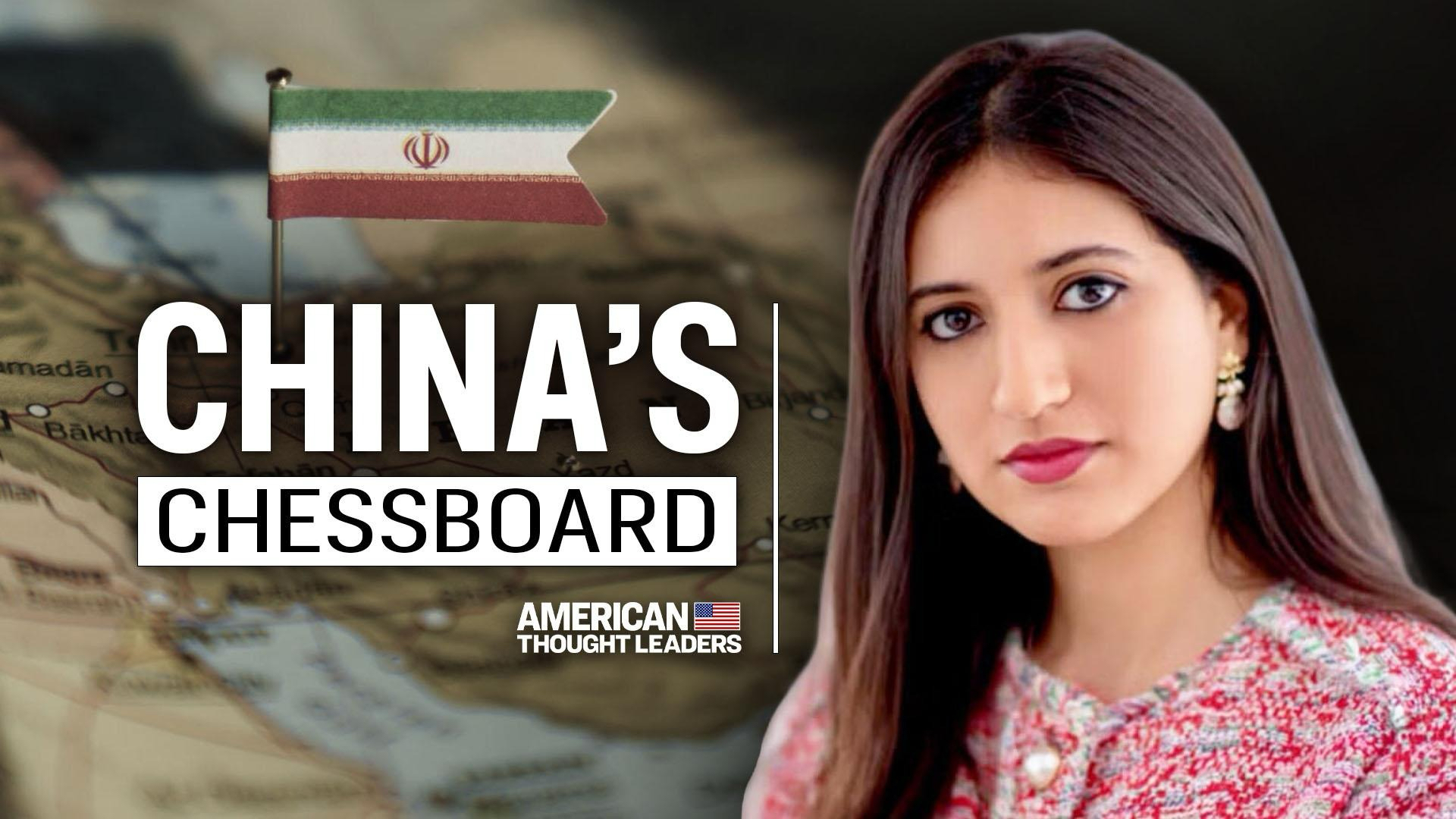

[RUSH TRANSCRIPT BELOW] “The U.S. went to war in Iran because Iran made itself a Chinese weapon,” argues policy analyst Zineb Riboua, a research fellow at Hudson Institute’s Center for Peace and Security in the Middle East.
Riboua is the founder of the “China in MENA Project,” which tracks communist Chinese expansion and influence across the Middle East and North Africa (MENA).
Is there a bigger dimension to the Iran war that people are missing?
“We have this tendency to just look at the countries involved ... but there’s a big player, and the big player here is China,” she says. “China has been investing immensely in the region in the last two decades, in courting, in coordinating, in cooperating with Gulf countries, with Iran itself, and also with its proxies.”
And why, I ask her, has China been so keen on gaining strategic influence over the Middle East?
It’s because the Chinese Communist Party (CCP) understands that “China cannot rise without having the United States weakened in one of the most important regions in the world,” she said.
“Iran has been that tool. China has built Iran’s military arsenal. It has collaborated extensively with Iran’s proxies, especially the Houthis.
“And reversing that calculus is what Operation Epic Fury is doing.”
In our interview, we delve deep into the symbiotic relationship between the two countries—why China needs Iran and why Iran needs China:
- Which role does Iran play on China’s geopolitical chessboard?
- Why did China turn Iran into one of its strategic allies, and how did the Islamic Republic benefit?
- How dependent is the Iranian regime on China’s military support and surveillance infrastructure?
- How dependent is China on Iran’s oil?
The goal of America’s military operation, Riboua believes, is to dismantle the whole structure of the Islamic Republic. “The United States is destroying ... every single launcher, every single missile facility. Their whole Navy has been absolutely crushed. ... It’s 2,000 targets so far, and they’re hitting even more.”
We also discuss what the Chinese regime will do if the Islamic Republic disappears.
How will its geopolitical strategy be impacted? What will happen to the CCP’s Belt and Road initiative, in which Iran played a central role? And how will China’s economy and its relationships with its Middle Eastern and North African proxies be affected?
Views expressed in this video are opinions of the host and the guest, and do not necessarily reflect the views of The Epoch Times.
RUSH TRANSCRIPT
Jan Jekielek:
Zineb Riboua, such a pleasure to have you on American Thought Leaders.
Zineb Riboua:
Thank you very much for having me. It’s a real pleasure and a great honor. I’m a big fan of The Epoch Times.
Mr. Jekielek:
Well, I happen to have our national edition hot off the presses as we’re filming today, and of course, the front page here, you know, we’re going, we'll show it to our audience. There it is. It’s really all about Iran, the Iran war, but also China fits into it, and this is something you jumped on basically immediately, right? We have here, China seriously misjudged the situation in Iran, sources say, how Operation Epic Fury unfolded. I love the paper. You know, this goes to a million people weekly, so please subscribe if you’re a newspaper reader.
Ms. Riboua:
Yes, I think they should.
Mr. Jekielek:
Here is what your article, which caught my eye immediately and got me to get you to come in here, said. You said the Iran question is all about China; why Operation Epic Fury is the opening act of the Indo-Pacific century. And so, you know, this spoke to a lot of things that I happen to believe in my own analysis. But you did it in such a deep way. Explain to me what you mean here.
Ms. Riboua:
I think that what I meant was that whenever the United States uses its power, whenever it is involved in a region or another, whether it’s Latin America or the Middle East, the consequences of that involvement go beyond the region itself. Whenever there is an articulation of U.S. foreign policy in the Middle East, I think we have this tendency to just look at the countries involved and who is saying what, and it’s usually Middle Eastern countries. But there’s a big player, and the big player here is China.
China has been investing in the last two decades immensely in coordinating, in cooperating with Gulf countries, with Iran itself, and also with its proxies. And so I thought that what the Trump administration is doing is a total break, first of all, with other administrations when it comes to directly tackling Iran and its ballistic missiles, its nuclear program. A nuclear program is not just a military aspect, but there’s also a political aspect to it. And I think that this means not just tackling the Islamic Republic, but also tackling its sponsor, which is China.
Mr. Jekielek:
So another headline that really caught my eye, this was in The Free Press, this was Haviv Rettig Gur, right? His line was, this isn’t Israel’s war, which is one of the popular narratives out there from what I’m seeing. It’s America’s. The U.S. went to war in Iran because Iran made itself a Chinese weapon. What’s he saying?
Ms. Riboua:
His piece is really great, and I completely agree with his assessment; I think it’s the perfect depiction of it. Basically, the Israelis have been fighting since October 7th against Iran’s proxies, against Hamas, against Hezbollah, against the Houthis, and against many others across the Middle East, but also Africa. And so it has always been this discussion about Israeli national security and Israeli involvement.
But behind all of that involvement, as I said, there’s also the sponsor of it, which is China. So obviously, from a U.S. perspective, as I discussed, being involved does not just mean helping an ally. It means reshaping the configuration of a Middle East that has been, for a very long time, I think, a Chinese chessboard.
Mr. Jekielek:
He says that it’s really, you know, Israel is at war with Iran, but it’s the U.S.—this war, this is the U.S. being actually at war with China.
Ms. Riboua:
In a sense, I would say so, because it is China that has helped Iran acquire different components. Their fingerprints are all over Iran’s military arsenal. When it comes to the missiles, I did some numbers, and it’s been basically the Chinese helping Iran get a lot of the chemical components that are very crucial for that arsenal. Iran does not really have the domestic capacity to produce these chemicals because of the orientation of its industry, which is very heavy on petrochemicals. And also, they don’t have the skills and mastery of it. And so the Chinese really just stepped in and helped.
There’s one thing that I thought was very interesting, and I’ve been looking at that since, I would say, 2020, and it’s the Chinese eagerness to export its surveillance model, its technology model. There were already a lot of scandals about Chinese 5G in Gulf countries. For example, how the UAE [United Arab Emirates] chose 5G over American weaponry and American jet fighters. But this also applies to Iran.
If one looks at it, China has helped Iran’s whole telecommunications architecture. They have reshaped it exactly as they would do in Beijing. A lot of those crackdowns that happened in January against the protesters happened in such brutality because Iran was able to use Chinese technology that was absolutely sophisticated, but also made in a way that they could track very easily who wears a hijab or not, who is doing this or that, because they perfected it in Uyghur camps. And I think that there is this digital GPS aspect that is very important.
Mr. Jekielek:
You know, you’re just reminding me, I’m going to comment here a little bit. There’s a case in front of the Supreme Court right now. It’s a case called Cisco v. Doe. It’s been running for about 15 years. And the allegation in the case is that Cisco basically built the prototype for China of what’s called the Golden Shield Project, which is this comprehensive system now that you’re basically describing. On one hand, it’s surveillance. On another hand, it’s censorship. The social credit system fits in there.
But the other part is the persecution aspect. All this is integrated into one system. And I’ve been asking myself, as I’ve been looking at these documents recently, how much of this Golden Shield, a lot of people don’t understand this deeply integrated system that’s being used to persecute the Uyghurs and the Falun Gong practitioners and, you know, house Christians increasingly in China, that, in a sense, they probably just white-labeled it, basically, for the Iranian regime with, of course, control mechanisms on their end, right?
Ms. Riboua:
Yes, that’s exactly what they did. First of all, it’s a great business, right? You have access to an immense market, 90 million people. You get to track them. You get to make your systems much more sophisticated, and you get to export that system under the premise that, okay, you are saving the Islamic Republic, I mean, you as China, and the world is watching that. African states are watching that. They have a huge regime stability issue. They are desperate as well to maintain power. And the Chinese were able to sell that as basically a winning argument as to why doing business with China has immense gains. I think that all of that is really vanishing today.
Mr. Jekielek:
Well, this is fascinating, right? Because yet, you know, this is, Iran is really kind of the strategic fulcrum for Beijing in the Middle East, isn’t it? I mean, they’ve spent an insane amount of blood and treasure. Well, blood, not so much blood, I guess, but treasure to build this. But they’re not actually, it doesn’t seem like they’re particularly good allies right now.
Ms. Riboua:
Yes, even in terms of their diplomatic engagement, there was one Chinese citizen reported killed, and 300, I think, Chinese citizens also evacuated. And they have not really been that eager to engage even in diplomacy to say, hey, we can help deal with Iran or other things. Their foreign ministry, I think, said that it’s a clear violation of sovereignty, but they’re not supporting in any major way. In fact, a lot of their own technology has been proven to just not be that good.
It’s a huge embarrassment when you are trying to depict yourself as a competitor to the United States. And it’s even more interesting in the sense that there was this 25-year cooperation, and I think it happened in 2020, and they pledged to invest $400 billion, and they invested quite a bit. Not the whole total, but it was a discussion, and they’ve been very involved.
The other part here is that Iran is very, very important when you’re planning to invade Taiwan for two main reasons. The first one is that Iran is absolutely key when it comes to sanctions evasion. Xi Jinping looked at Putin as the exact guide of what the things you should not do as a leader are. One of them is that you should make sure that you have a plan B and a plan so that you don’t get suffocated by Western sanctions. You can see the state of the Russian economy.
The Chinese, therefore, have been building this parallel system with Iran through border agreements and other arrangements, making sure they bypass a lot of Western financial channels. They are making sure that Iran can still survive with or without those channels. The Chinese were just perfecting that type of system, and they were very proud of it to the point where it became one of their talking points about this being the start of a non-Western world. This is why they talk about the global South, even though it doesn’t mean much, but they’ve been selling that.
The second reason why Iran is so important for China is that, as you’ve seen, for example, with the Red Sea, how the Houthis were able to do this huge blockade that is costing US allies, but also Europeans, thousands and thousands of dollars every single day. The United States needed to get involved. They were not really successful, and they were really, really stuck. That’s exactly what would help China in case of an invasion.
You want to make sure that you’re able to distract the United States. You want to be able to, first of all, make sure that US allies do not trust the United States’ involvement militarily when it comes to securing their interests. You want to make sure that the Houthis, who have been provided a lot of targeting data from Chinese companies, as has been reported by Reuters, are playing their role in opening another front. I think that closing those fronts is absolutely key for what I envision as the Indo-Pacific century.
Mr. Jekielek:
But just to be clear, right, you’re basically saying the Houthis are just a proxy for Iran. That’s how it plays out.
Ms. Riboua:
Yes, they’re absolutely a proxy for Iran and also, more and more, for China, because actually what happened after the Hezbollah pager attacks made it very clear that the Islamic Republic is not capable of rescuing its own major partner. A lot of the proxies were watching that. The Houthis started thinking about whether the Islamic Republic was even their friend. There was a huge debate at the time, and I think the Chinese stepped in. They do provide them a lot of weapons and support. In fact, I found that 35 percent of the indirect Houthi arms originate from China.
Mr. Jekielek:
35 percent?
Ms. Riboua:
Yes, which is significant.
Mr. Jekielek:
That’s remarkable. So why is the Islamic regime firing on, like, just this morning on Turkey? I mean, it’s sort of the most vocal, I think the most vocal response in support of Iran came from Turkey, from Erdogan, perhaps. I don’t know. I haven’t followed all of them, but they’re firing on all sorts of people that they might be hoping would be an ally at some point. I don’t understand it.
Ms. Riboua:
Yes, they are. They are disparate measures for a disparate regime during disparate times.
Mr. Jekielek:
But like, what are they trying to accomplish? Are these things misfiring? I just don’t understand it.
Ms. Riboua:
Quite honestly, I think that their chain of command has been just completely dismantled. They don’t know what they’re doing. And this is not an understatement. It’s an understatement to say that they don’t know what they’re doing in the sense that a lot of key commanders have already been killed during the 12-day war. They thought that they had it totally under control, so they did a restructuring, but it seems that that restructuring made them more vulnerable. The key commanders were killed in the first hundred hours of the conflict, and so I think that they generally are really desperate. They also are trying to basically trigger a response where other U.S. allies say, you know, you should stop hitting Iran. They’re hitting us.
But what is happening is that everyone is watching them become weaker and weaker. And so the logic reverses itself. Precisely because the Islamic Republic is weaker, we need to just finish it. They’ve been a threat to everyone, every single neighbor they have. Every single neighbor they’ve had a conflict of some sort with. So I think that this is basically what I think is going on.
On Turkey’s side, I mean, they always are playing a double game, a balancing act, because they don’t know how it’s going. They want to make sure that whatever happens, they do benefit from it. And it’s a very logical way to behave as a power. And also, Turkey is a great power. They command one of the largest militaries in NATO. And so I think that now the calculus is really for Turkey to take advantage of whatever openings the fall of this regime will offer.
Mr. Jekielek:
Tell me a little bit about shipping insurance, because this has been kind of a popular topic on the talk shows recently, because I think not a lot of us realize how extremely important it is for the flow of oil or goods or whatever it is. And if that insurance leaves, ships aren’t doing their thing anymore, which is astonishing. And, you know, of course, President Trump has made some guarantees of, you know, U.S. protection to get that insurance back. Just like explain to me that system briefly, how it works.
Ms. Riboua:
Unfortunately, I’m not really an expert on the question, but what I can tell you is that the Trump administration is working very hard to ensure that it regains its total dominance in maritime navigation. And the shock is very hard, obviously, on a lot of producers, a lot of shipments, a lot of businesses, a lot of U.S. companies, and non-U.S. companies. And so I think that here it’s really about providing a signal that this is a very temporary shock. And I don’t think they would have said that if it wasn’t the case.
And so I think that, I mean, the Trump administration basically said, Trump himself said that, you know, they’re looking at four or five weeks, a little bit more, but that’s the timeline. And with the pace of the operation, it just tells you how it’s unfolding very, very fast. I think faster than any other U.S. engagement ever. And so I think that they are looking at that from the perspective of really reassuring the market. I can tell you precisely about the insurance, but this is how I look at it from a geopolitical perspective.
Mr. Jekielek:
Right. Well, and one thing I found really interesting, there’s a lot of... I remember President Trump was saying to the Iranian people, help is coming, right? And a lot of people sort of made fun of that, as I remember. It seems to me like the president is showing himself to be highly consequential in his statements, which I think has also kind of a profound geopolitical impact, and I’m curious if
Ms. Riboua:
you have thoughts on that. I think that he, you know, I have been saying since December that Khamenei was over. The moment I saw the protests, I realized that he made a huge mistake. He, you know, there is a cost when you lose a war. Khamenei lost the war last year during the 12-day war? There’s a consequence to that. There is a social aspect, a political aspect, but also a power aspect to it in the sense that he was always able to delay negotiations, to make a mockery out of U.S. presence in the region.
He even started making tweets, I think his team was, of Trump being this maniac, psychopath leader, comparing him to some pharaohs and others. And I think that Trump was just being very patient, waiting for the proper timing for all the military assets to move and to make sure that this operation unfolds rather quickly, but also in a good manner. And I think that he was not joking when he said help is on the way in the sense that, first of all, this military operation is dismantling the whole structure of the Islamic Republic. And it has different components to it.
There is the IRGC [Islamic Revolutionary Guard Corps], there is the Basij, there is the Guardian Council, and other structures. The Islamic Republic is very sophisticated when it comes to its governance, and they are doing a decapitation strategy, going one after the other and making sure that whoever replaces them, if he is obviously hostile to the United States, does not want to cooperate gets killed, and it has been the line.
That in itself provides reassurance to Iranians that when they go and protest or ask their family members who are officers, who are part of the belief that when they defect, they will not be killed or that the loyalists will come back because all of them will have been killed and eliminated. And so I think this is how I’ve been looking at it. And the other aspect is that this is a very different regime change. This is not typical, we are coming, we’re killing every single IRGC commander and officer, and we’re going to install a democracy, all of it transplanted.
Here, they’re trying to basically maneuver an organic uprising, which is why they have been, I mean, Iran is a big country, and we’re talking about 90 million people. And they’ve been hitting targets across all regions,which tells me that they are trying to provoke some sort of organic transition towards whatever the next Iran will be. It will not necessarily be a democracy. It’s going to be a transition. And transition, we don’t really know how long it will take.
Mr. Jekielek:
But what this administration is making sure of is that it’s just not a hostile entity. You know, I’ve seen like the best data that I’ve seen is that, you know, the Iranian people’s position on the mullahs is about an 80/20 issue, 80 percent sort of against, 20 percent for. Is that correct based on your analysis?
Ms. Riboua:
Yes, I think it’s 100 percent correct for a very simple reason. The first one is that when you’re an Islamic republic, you’re not just a theocracy or a dictatorship. They are revolutionaries. They need to send people. They need to train people. They need to teach and educate people, which is why they have so many seminaries across the Middle East, but across Africa as well. And they’ve been trying to have more and more in Europe. And it means that they have always been in the business of creating the next generation of Islamic Republic loyalists and soldiers. A lot of that absolutely collapsed.
All the young people who protested, I think in 2023 during the Mahsa Amini protests, and then more recently, it just shows you that people do not believe in that regime anymore. And you can see that in the capital flight, and you can see that in how the Islamic Republic was completely incompetent when it comes to basic things such as water management. I wrote a whole piece about water management because I think it’s a great indicator when it comes to the health of a governing body. Because it’s really about the allocation of resources to satisfy long-term needs. And they were completely incapable of doing that. The state of water management is absolutely horrifying to the point where I think the president of Iran said that Tehran might no longer be the capital because of how dry it is.
And these things, whether you are pro-Islamic Republic or anti-Islamic Republic, you look at it objectively as a citizen: what is this Islamic Republic giving you? Nothing. And in exchange for what? For hiring Iraqis and Syrians to terrorize everyone in the region. And so it’s a very, I think, basic calculus that people are making even more right now because of its weakness.
Mr. Jekielek:
There isn’t much of an appetite for regime change in the American electorate. That’s very clear, regardless of political orientation. What you described is very interesting. You’re saying this is regime change, this is the U.S. doing regime change, but in a different way where, if I understand you correctly, we heard President Trump speaking to the Iranian people, saying, here’s your chance. I’m paraphrasing here. But there’s a real possibility of further instability.
I’m always looking at things through this geopolitical lens of China. That’s why your article caught my eye immediately. And China using Iran as a tool of massive distraction, creating instability in the Middle East, to keep America’s gaze on the Middle East and not on the Indo-Pacific, right? I mean, that’s, of course, been a major, major piece of their strategy, right? Now, if this happens quickly, if this goes according to plan in the, you know, timeframe that the president and the Secretary of War and Secretary of State have described, that might be fantastic. But, you know, when you do this sort of thing, there’s a lot of instability. You don’t know how it’s all going to play out ultimately, right?
Like, and one factor we discussed, the Iranian people do not like the mullahs in massive amounts, like 80-20, for sure. That’s different from other, you know, scenarios like this in the past, for sure. But, like, what other things does Iran, you know, as a free or, you know, new, more friendly regime, right, that isn’t revolutionary, that isn’t exporting instability throughout the region and the world? What does that vision have going for it, right? How do we know that we’re not going to just get another source of instability that will precisely prevent the U.S. from looking at its greatest adversary, China, right, under the Communist Party?
Ms. Riboua:
I think it’s a very fair question. And I can answer a very simple answer. The United States is destroying everything that would make that possible. Every single launcher, every single missile facility, their whole navy has been absolutely crushed. And you can see that in the loss of military assets that Iran had. I was doing this morning a kind of brief assessment of just looking for where they destroyed, where things are. And you can see that, you know, it’s 2,000 targets so far, and they’re hitting even more. So they are absolutely in the business of making sure that even if the next Iran wants to, it just cannot. And I think that in itself is a very important, I think, premise to work with. And it’s an early assessment and it just tells you where things are going, I think.
But the military aspect and, you know, how they are structurally going to be incapable of launching things at others in the future, in the next few years. I think that’s a very important parameter to evaluate. And the second thing is that there’s the proxy question. Because Iran, the Islamic Republic, is not just, you know, the nuclear program, the missiles. There’s also the proxies. The proxies are also getting hit in this process. They’re hitting their own commanders.
Because for every, for example, Hezbollah unit, you get some IRGC Quds forces getting involved on the Iranian side so that they can train and they can coordinate with proxies in Iraq. They can no longer, by the way, in Syria, but they can still do some damage. And you have Lebanon now absolutely taking drastic measures against Hezbollah. I would have never thought that would have been possible. But the dismantlement of the proxies as well is key to this.
That can be, I think, a very important thing to monitor because you can still have a proxy problem. But it will be of less intensity, I think, than whatever the Islamic Republic was doing. So, the truth is that when people think about how worse it can get, I would say that it has already been worse and that the worst-case scenario, yes, it would be complete fragmentation, you know, maybe a civil war, something of this sort. But so far, this administration is making sure that no one has even the means to fight.
Mr. Jekielek:
You know, you mentioned Iraq and Syria, Lebanon. I mean, it’s a dangerous neighborhood, okay? And so, you know, you’re kind of making the case that the U.S. is eliminating Iran’s ability to project military power, but also probably defend itself if it doesn’t have those things. So, you know, what’s stopping one of these, like I said, it’s a very dangerous neighborhood there, from coming in and doing their thing and installing their own regime?
Ms. Riboua:
I don’t think they will have the capacity. Also, they have to be appealing. As you mentioned, no one believes in those things anymore, at least in Iran, in having a revolutionary mindset. I mean, why? Because they also see how all of their neighbors are modernizing. Azerbaijan is absolutely rising as a power. Saudi Arabia, the UAE, all of the Gulf countries are investing in the youth. They’re investing in modernizing. And so Iranians watch that. Why can’t the government provide that? And I don’t think they will allow the Hezbollah guys or others to insert themselves again. I don’t think they will have the political legitimacy or even the following to install a similar structure.
Mr. Jekielek:
Let’s go back to the broader geopolitical perspective, okay? I see the U.S. having, you know, decapitated two major CCP proxies, Venezuela and now Iran, very consequentially. There are a few things that come from that. One of them is it’s a showcase of American power. If they pull off the plan, so to speak, in the middle, you know, in Iran, that'll be kind of an amazing, again, expression of what the U.S. can do when it decides to act. So that’s one thing.
And I think, you know, Russia and China are watching very carefully how these things unfold. On the other hand, there’s also kind of a message being sent here, isn’t there? Like, you know, we can do this if we want to. What, you know, what is the significance of that for, you know, these, you know, belligerent powers, let’s say?
Ms. Riboua:
Yes, it’s absolutely what you just said, that the United States can assert absolute dominance in its own spheres of influence. The Middle East is a sphere of influence. And it’s even more than that. I mean, Beijing has been selling to its own people, 1.4 billion people, that America is in decline. And America is just not it anymore. That the East is rising, that the West is in total decline and collapse, that Americans cannot do much.
Mr. Jekielek:
It’s not just Beijing that’s been selling this. There have been a lot of Americans that have been selling this.
Ms. Riboua:
Oh, but I am sure that Beijing would agree with them. And the United States has proven them wrong. I mean, Trump has proven them wrong. That the use of military power does not have to be erratic and without strategic coherence and against America’s interests. It doesn’t have to be about managing problems, but either fixing them or finding a way around them. But playing the game of the Iran threat, this forever threat, and they’re only accumulating ballistic missiles over time. And it’s just I think he’s in the business of restructuring the global system in a way that directly benefits Americans. And also, there is a real coherence, actually.
I haven’t seen people talking about this, but the Iranian market is basically a virgin market. If it opens up and you have a friendly regime, it’s thousands of European businesses back. It’s the whole German industry finding new clients. It’s endless opportunities also for the region. It’s the dismantlement of the Belt and Road Initiative. It’s the elevation of the Abraham Accords as a real framework rather than just normalization agreements. It’s making sure that the Red Sea is not blockaded because it’s Egyptians and Sudanese and Saudis who are paying the price for that. So I think we have to think of also the benefits for this and the cost of if the United States did not do this, it will have to pay a price. And the price of inaction, I think, as stated by Secretary Rubio, was very clear when it comes to the missiles.
Mr. Jekielek:
You just said something incredibly important, right? It’s the dismantlement of the Belt and Road Initiative. I mean, this is the signature effort of the CCP to create this, you know, New World Order around itself with Beijing at the center, the CCP in Beijing at the center.
Ms. Riboua:
Yes.
Mr. Jekielek:
You know what, just tell me a bit more about that.
Ms. Riboua:
It’s very important for China to diversify and to access a lot of markets. It’s a very mercantile mindset, but in doing so, what they are actually trying to do is to get access to more U.S. allies in the process. When you go to a U.S. ally, and it was the case, for example, with Italy, oh, why don’t you join our Belt and Road Initiative? You will get all of these cookies. But in exchange, we get to have access to EU [European Union] frameworks to know about your infrastructure. We will know about every single thing that happens in Europe, but also in the United States, because the United States is also involved in securing the Mediterranean.
And so there were real gains for China, but they were also selling it as an alternative model to the U.S. one. That the United States, whenever it comes, it comes with conditions, with human rights, with all of these things that China never demands any of it. Which is true, by the way, until recently, I think Trump completely changed that. This is why he dismantled a lot of U.S. aid and a lot of these things.
And so China was really trying to court a lot of U.S. allies and make sure that the Belt and Road Initiative is a very attractive alternative to countries that think they can get a better deal by going to China. And the fact that they invested a lot in it, I think the valuation estimate is a trillion dollars. And they’ve been trying very hard to sell it as an alternative model.
The thing is, yes, these countries will still deal with China. They will still sell oil to China. But it just will not be the same. The Chinese will no longer have the upper hand. They can no longer just storm a place and say, we give you, you give us. And it’s the end of the discussion. I think that recalibration will cost China a lot.
Mr. Jekielek:
Just one comment. You were talking about Trump and the administration changing how it interacts with other countries. It may have sounded like you were saying that they’re dismantling the human rights requirement for having a relationship, things like that. And just my own observation has been that it seems to me like these institutions, I mean, I think the administration’s view was that this institution was being used in a significant amount to kind of launder money through a system and export ideology, not human rights and things like that. Do you think that actual human rights requirements are going by the wayside with this new approach the U.S. is taking?
Ms. Riboua:
I think I should have been a little bit more precise in saying that actually going after the Islamic Republic is the best way to protect human rights. And it’s very clear. The other thing is a lot of these countries, they don’t even have the capacity to go for big questions on social issues, political ones, because they’re not satisfying their basic economic needs. And they want more cooperation. They have terrorist problems. You can see that in Mali, Burkina Faso, and Niger. These countries are suffering when it comes to terrorism.
They want, first of all, to make sure that their youth do not join terrorist organizations. And that cannot really happen just with ideological messaging. It needs to happen with real structures and real economic cooperation, which is why the critical minerals, for example, industry is great news for a lot of these countries because they can finally use their resources and get a good deal out of it. But the whole campaign, the messaging, communications, and public relations approach did not work. In fact, China has been rising because of it. Recalibrating a little bit, I think, is a very good thing.
Mr. Jekielek:
So this has been a fantastic conversation for me. As we finish up, I’m going to get you to go, let’s go back to the beginning and ask this question, right? Your contention is that this whole Iran thing is all about China and the rise of the Indo-Pacific century. Give me that thesis as succinctly as you can as we finish.
Ms. Riboua:
I would say that China cannot rise without having the United States weakened in one of the most important regions in the world, namely the Middle East. Iran has been that tool. China has built Iran’s military arsenal. It has collaborated extensively with its proxies, especially the Houthis, who are doing this blockade in the Red Sea, and reversing that calculus is what Operation Epic Fury is doing. I think that this is absolutely crucial when watching the next events unfold.
Mr. Jekielek:
Well, Zineb Riboua, it’s such a pleasure to have had you on.
Ms. Riboua:
Thank you. A real pleasure of mine as well.
This interview was partially edited for clarity and brevity.