
In a large shopping mall in China’s Inner Mongolia, hundreds of people recently met for a live-streamed contest. The rules were straightforward: Lie on a mattress for as long as one can without sitting up, taking no bathroom breaks.
Many wore pajamas, wrapping themselves in blankets and pillows. Some brought plush toys. A stream of delivery drivers fetched takeout as the contestants ate or killed time on their phones.
Some 33 hours later, a 23-year-old man took the first prize. His answer to the toilet problem? Diapers.
As a mattress marketing schtick, the event was a wild success, with more than 10 million online watchers. More than a few lamented their missed opportunity to win; they said they practically spent their days in bed anyway.
The attention then turned to the name of the contest: “Tangping,” a popular Chinese slang term that means “lying flat.”
“Finally, lying flat has become the way to win,” one person commented.
Lying flat emerged four years ago as a counterculture movement in response to the Chinese regime’s draconian COVID-19 pandemic lockdowns. Chinese youth, rejecting the grueling rat race, sought a different lifestyle: doing the bare minimum.
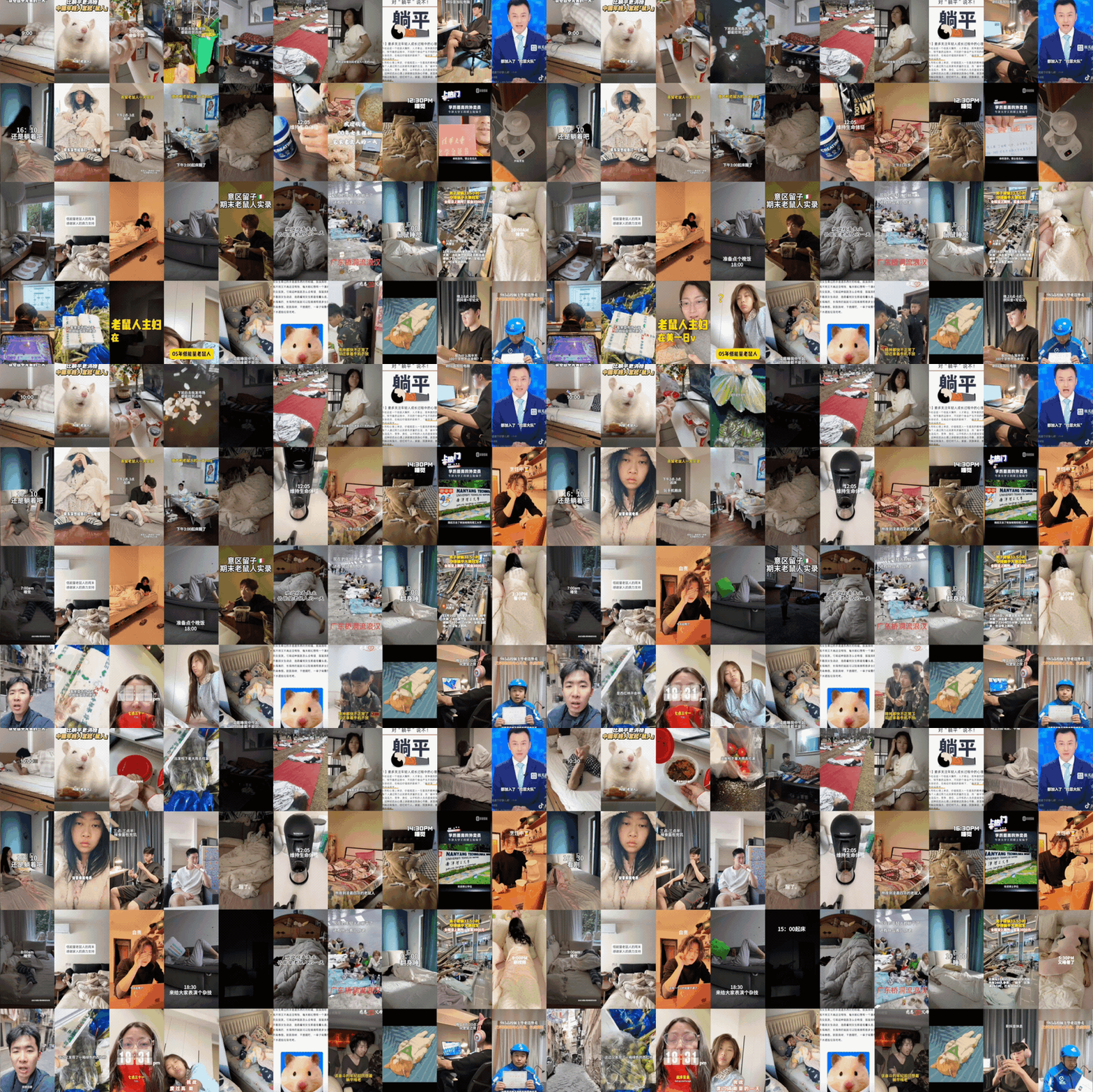
They have since taken it to another level. Ignoring the urging from Chinese authorities to work hard, they call themselves “rat people” and spend their days “rotting” in bed.
The days they document on Chinese social media go something like this: crawling out of bed at about noon or later, showering, cooking or ordering takeout, eating while scrolling on phones, more bed time, then more food and doomscrolling—or gaming—until the wee hours.
Such is how 25-year-old Sherry Yang has lived her life for the past three years while rooming with relatives and friends.
“I don’t have any plans for the future,” she told The Epoch Times. “There’s not much to look forward to.”
Interviews with The Epoch Times and posts across the Chinese internet reveal a sense of gloom infecting China’s youth.
It marks a drastic shift from a decade ago, when young people brimmed with energy, said James Wang, who graduated from college in 2017.
Fresh out of school, Wang said, he and his friends chatted daily about their jobs and dreams. They traded career tips and were impatient to start businesses of their own.
“Now everything is different,” he told The Epoch Times. Gone is the talk of high aspirations; all one asks for is a regular job and the ability to keep it, he said.
The “lying flat” trend, at odds with Chinese leader Xi Jinping’s refrain to “tell China’s story well,” has become a headache for Beijing.
A day after Christmas, the country’s top internet regulator, the Cyberspace Administration of China, issued a 13-bullet directive, banning internet celebrities from promoting the “lying flat” culture. It branded the lifestyle as among “unhealthy ideas” that “violate core socialist values.”
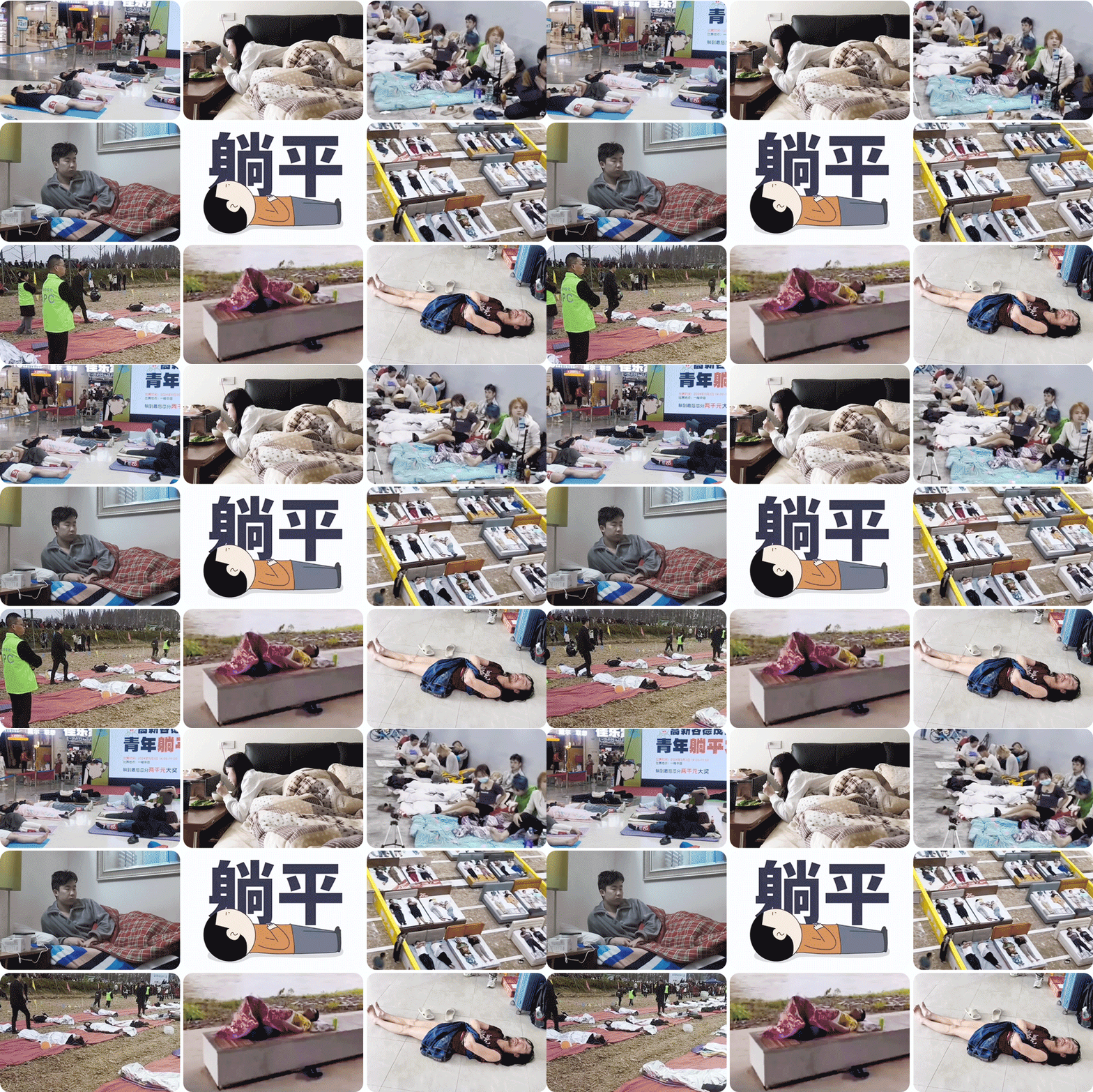
(L–R) A collage shows various aspects of the “lying flat” lifestyle in China; an illustration shows a person lying flat on the ground; on the back are the two Chinese characters for “lying flat.” (Stills captured by The Epoch Times, Douyin)
From Honor Student to Gig Worker
The state of Chinese youth has been a growing embarrassment for a regime that goes to great lengths to project strength and confidence.
In August 2023, as one in five young Chinese was unable to get a job, Beijing stopped publishing related monthly data.
Resuming five months later, officials tweaked the math. Those who are still in school no longer count, Chinese authorities said, because they should focus on studies rather than job hunting. That ruled out roughly 62 million people from the calculation, including students who work on the side and others who struggle to secure work. The change yielded a lower jobless figure, which has hovered in the mid- to high teens.
Cindy Zhang, 24, graduated last summer from Shandong University, a top school in eastern China. With her finance background and rich internship experience, she had been confident that she could land something in banking or securities. A year into job searching, her hope has dimmed. Hiring freezes are the norm and openings are few. Among the offers available, salaries skew “ridiculously low,” she said.
“I’ve sent over 300 resumes so far, only two firms got back,” she told The Epoch Times.
She is now selling drinks at the small storefront of a relative, making less than 100 yuan ($14.30) per day.
Faced with a scarcity of work opportunities, many young people are grabbing whatever gigs there are. Often, that means delivering takeout.
This segment has been expanding rapidly over the past few years, with 14 million drivers as of July 2025, according to Chinese data aggregator QuestMobile. About two-thirds are 35 or younger.
Among them is 24-year-old actor Shu Chen, who began night delivery runs in August after fruitlessly chasing auditions while the bills stacked up. His longest shift lasted more than 10 hours and netted him close to 200 yuan (less than $30).
Another is Ding Yuanzhao, a straight-A student who studied at China’s prestigious Tsinghua University on scholarship and later earned a master’s degree at the University of Oxford in England.
Ding generated a buzz in China in June 2025, during the consequential college entrance exam season that remains the single deciding factor for one’s school placement.
Appearing in front of bicycle racks, Ding donned a bright yellow uniform and helmet, showing he worked for Chinese delivery platform Meituan. He told high school graduates to “keep a level head” no matter how they fared.
Whether students score high or not, “our work won’t be all that different,” Ding said in video footage posted on Chinese social media platform WeChat. Food delivery, he said, is a “decent job.”
Nineteen-year-old delivery driver Anna Huang was more frank.
The job is appealing because it is readily available, she told The Epoch Times.
“You can get on it right away,” she said.
‘Too Much Pressure’
In certain aspects, many have stopped trying to progress.
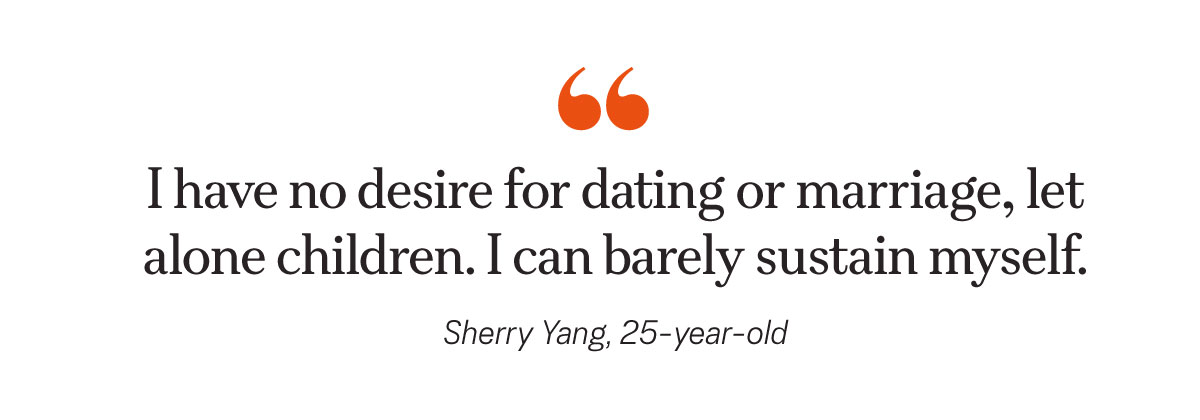
China’s marriage rate has been falling for a decade. Although cash bonuses and shopping vouchers appeared to have driven an uptick in recent months, many young people such as Yang said they have no plans for a family in the immediate future.
“I have no desire for dating or marriage, let alone children,” Yang said. “I can barely sustain myself.” She said most of her friends are in the same boat.
Alan Li, 22, has been in the courier service for three years in the southeastern city of Suzhou. To save money on rent, he lives in a tent under a bridge.
“Marriage is for rich people,” he told The Epoch Times. “Do you have a house, car, or savings? What will our children eat after marrying? Will there be money for baby formula?
“It’s way too much pressure.”
The pressure might explain why Chinese youth appear to be retreating into childhood.
This past summer, adult pacifiers briefly became a trending product in China. In video after video, young people raved about the bigger silicone device, saying that they found in them a sleeping aid and stress reliever. Some wore it in public as a fashion accessory. “Baobao,” or baby, has become a universal way of addressing perfect strangers in cafes or online; quirky toys and plush bag charms are popular comfort items.
Social expectations for the young appear to be lowering, too. Parent-teacher meetings, which typically occur in elementary school, took place in dozens of universities in 2025.
Top hospitals in major cities drew long queues last year for new mental health clinics dedicated to students “who hate school.” Some had month-long waitlists and as many as 10,000 visits over a 10-month period.
Zero Cost Survival
In Nanning, a southern city bordering Vietnam, 25-year-old Anna Huang was jobless for months. On a late September night in 2025, she joined a throng of young Chinese who scour the grounds and dumpsters of a local wholesale food market for discarded vegetables.
She was late to the game and only found a handful. A vendor there gave her some food for free, which sustained her for several days, she said.
“It’s all compelled by circumstances,” she told NTD, a sister outlet of The Epoch Times. “Why else would we come out to pick up vegetable scraps?” She said that in the 20 minutes she was there, her cheeks “were flushed with embarrassment.”
In the southeast, a wholesaler in a key produce market observed the same trend.
“Whenever something gets dumped out, it’s snatched away,” the man, surnamed Wang, told NTD.
“You have to come early,” he said. “As to whether you can find something—that’s all about luck.”
Not long ago, taking discarded food and scavenging for scraps carried the stigma of poverty and low social status. But it has taken the Chinese youth by storm in the latter half of 2025.
“Zero cost survival is now in fashion,” one Chinese news anchor remarked. He said China’s youth have “discovered the simple joys in life.”
But reality is not necessarily that rosy, said Ai Shicheng, a former news editor in China.
Even if there is an element of performance art in the scavenging—for those who film the incursions and post them online—it also speaks to the youths’ tightening purse strings, he told The Epoch Times.
Chinese poet and dissident Jiang Pinchao agreed.
“The Chinese Communist Party used to say that for the Chinese people nothing matters more than the right to live,“ he said. ”Well, what of it now?”
‘Silent Protest’
Discontent from Chinese youth is now a major worry for the Chinese authorities, according to a scholar from the Chinese Academy of Social Sciences, a ministry-level institution under the Chinese cabinet.
Shut out of the job market and needing another outlet, Chinese youth may move from the internet to the streets, he told The Epoch Times on condition of anonymity, relaying concerns raised in a recent internal meeting.
On New Year’s Eve, various Chinese cities called off celebrations and discouraged large gatherings.
Lying flat or becoming “rat people” is essentially a form of self-abandonment, but from another perspective, it is also a form of “silent protest” against the state of things in China, said 29-year-old democracy activist Le Kai’an.

Young Chinese people chat after watching a musician perform at a “youth retirement home” in Dali, Yunnan Province, China, on April 2, 2025. “Youth retirement homes” have appeared as young Chinese adopt a “lying flat” lifestyle and reject the intense work culture once common in China. (Greg Baker/AFP via Getty Images)
China has been investing more in ideological indoctrination, mandating that all college majors study Marxism, Xi Jinping Thought, and Chinese socialism.
China analyst Feng Chongyi said the effort is less about passing down knowledge than about “anesthetizing” the minds of the youth. Although he doubts that the method is working, he said.
“What they preach contradicts reality,” he told The Epoch Times. “If the Party is so great as they claim, then why are people in such a mess?”
Zhang is still looking for a job. Every morning, she opens up the hiring app on her phone and submits applications. She spends the afternoon in the library and clerks for her relative’s shop in the evening.
“I don’t want to lie flat, but trying doesn’t seem to get me anywhere,” she said. “I used to think that people don’t work because they are lazy. Now I know they have no place to go.”
Hong Ning, Yi Ru, and Shen Yue contributed to this report.