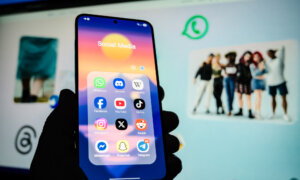

LOS ANGELES—A 20-year-old California woman at the center of a landmark tech trial took the stand for the first time on Feb. 26 in a case to determine whether social media companies engineered their products to addict young users despite known harms.
The plaintiff, identified in court documents as “K.G.M.” or “Kaley G.M.,” said she became addicted to social media as a child and suffered serious harms as a result, including depression, anxiety, body dysmorphia, and suicidal ideation.
“I was on it at a young age and spent all my time on it,” K.G.M. told the jury. “I’d sneak it, watch in class, and anytime I tried to set limits for myself, it just didn’t work. ... I couldn’t get off.”
Baby-faced and dressed in soft shades of pink that contrasted with a legion of dark-suited lawyers in the gallery, the young woman who took the stand on Feb. 26 looked every bit the shy teenager alluded to in court proceedings.
Her highly anticipated testimony, in the third week of a civil jury trial that began on Feb. 9, personalized a case that has thus far centered on theoretical arguments, forensic evidence, and testimony from expert witnesses and tech executives.
“Miss G.M.,” as attorneys refer to her, is an avatar for a generation that came of age in a world in which social media was already deeply embedded—and for what plaintiffs allege is an unprecedented youth mental health crisis that has arisen as a result.
Defendants YouTube (parent company Google) and Instagram (parent company Meta) deny that their products are designed to target young people, and more generally, that clinical social media addiction even exists.
The two tech giants, along with TikTok (parent company ByteDance) and Snapchat (parent company Snap Inc.) are named in thousands of civil product liability cases—brought by children, parents, school districts, and state attorneys general—that have been consolidated into joint actions.
K.G.M.’s case is one of a handful of bellwether trials: high-stakes proceedings that will determine how the others will be argued and what liability and damages may be expected.
TikTok and Snapchat settled privately before the trial began, but they are still named in related cases.
‘That Rush’
Mark Lanier, attorney for the plaintiff, began with a tour of K.G.M.’s young life, noting scrapbook photos capturing favorite memories and happy times: birthday parties, a pet chihuahua, swimming, and theme parks.
She joined YouTube at age 6. To get around the age verification system, K.G.M. said, she “selected a random age.” At 9, she began sneaking out of bed at night in order to scroll Instagram on her phone. At about the same time, she began suffering from anxiety; depression followed soon after.
By age 10, she had posted more than 200 videos to YouTube. She created an additional nine accounts to like her own posts. When she was bullied on YouTube, she continued using it.
“Being off of it bothered me more than the comments and the bullying,” she said.
The same went for Instagram, which at the time she joined it did not require new users to provide their dates of birth. She was on it for three years before her mother found out. By that time, she had 15 accounts. According to K.G.M., her mother started requiring her to keep her phone in the living room at night.
“I’d wait till she went to bed then I’d sneak it,” she said.
Most fights she had with her mother were about the phone; taking it away would often result in tantrums. If K.G.M. could not see who was liking her stuff, it sent her “into a panic,” she said.
She “bought likes” to make herself look popular. She began using beauty filters immediately; at some point, nearly all of her posts had them.
In one video shown by her attorneys, she appeared as a quintessential preteen, slight and still developing. She told her online audience that she had cried “tears of joy” at reaching 102 subscriptions, and she asked them for likes and follows, something she had learned to do from other content creators.
“I’m sorry for my ugly appearance,“ she said. ”I don’t know why I look so fat in this shirt. I look so ugly.”
K.G.M.’s feelings of low self-worth and negative comparison mounted. At 13, she was diagnosed with social phobia and body dysmorphia disorder.
Of particular relevance to the case—which is focused on how the apps are designed and how they function, rather than the third-party content they may host—K.G.M. described her experience with various design features of the defendants’ platforms.
Notifications on both apps, she said, kept her going back to get “that rush,” even in the middle of the night. Once she was there, Autoplay or infinite scroll would keep her entranced for hours. Her therapist at the time noted that she broke down crying when a peer posted photos of her, because she could not stand seeing pictures of herself without filters.
Competing Narratives
Attorneys are fighting to convince jurors of competing narratives: In one version, she is an increasingly common casualty of rapacious companies that have “drugified“ every aspect of human connection for profit; in the other, she is a troubled young woman whose difficult home life has left her with psychological damage that preceded and overshadows her social media use.
Throughout the trial, the plaintiff’s attorneys have used her age to anchor a chronology of what they say were the defendants’ decisions to ignore clear, emerging evidence of wide-scale harms and engineer their products to be increasingly addictive as they raced to capture valuable youth demographics from competitors.
Lawyers for the plaintiff said that a cache of recently unsealed documents—internal presentations, reports, and communications chains totaling thousands of pages—proves that the companies were aware of deleterious impacts their features had on young people’s well-being but that the companies targeted youth anyway.
Instagram, the complaint alleges, targeted K.G.M. with its proprietary artificial intelligence tools, connecting her with “predatory adults” and serving her “harmful, depressive content“ that led ”in at least one instance to sextortion.”
“These are connections and content K.G.M. did not seek out or even want to see; instead they are the types of harms Defendants aimed at her in their efforts to prevent her from looking away at any cost,” the complaint reads.
Executives, including Meta CEO Mark Zuckerberg, Instagram head Adam Mosseri, and YouTube vice president of engineering Cristos Goodrow, have testified that their products are engineered not to be addictive, but to provide a valuable service to users.
Attorneys for YouTube, in their opening statement, suggested that the app has been a net positive in K.G.M.’s life, serving as an outlet for her creativity and passion for video editing.
Although some experts say instances of social media addiction are skyrocketing among young people and causing a litany of real-life harms, the phenomenon is new and there is a lack of consensus about its meaning and implications; diagnosis and treatment are not standardized, and a sense of its true scope is unclear.
The defendants have argued that K.G.M. suffered mental health effects because of bullying and family difficulties, not social media use.
Hindsight
Phyllis Jones, an attorney for Meta, on Feb. 26 attempted to impeach the testimony K.G.M. had given during a previous deposition about her home and family life.
Cross-examining the plaintiff, she suggested that K.G.M.’s anxiety and depression may have stemmed from her relationship with an “absent” father and a “neglectful” single mother, both of whom were at times abusive.
K.G.M. said that although she may have said she felt that way at some point, she did not necessarily think that it was true now.
Recounting difficult junctions in her relationship with her mother, K.G.M. suggested that previous representations were “a dramatization.”
In fact, she said, she often posted dramatized versions of conflicts with her mother on social media to get attention.
Jones played jarring audio recordings taken by K.G.M. of her mother screaming at her. The attorney then asked K.G.M. whether she was scared or anxious at the time.
“I posted this without the full context and this was not frequent,” K.G.M. said. “It’s her yelling about something I did, and most of the time it was about chores.”
K.G.M. said she is working on undoing the damage she claims was caused by an obsessive use of the defendants’ platforms.
She still suffers from social anxiety and body dysmorphia, spending three to four hours getting ready in the morning. To get to court on Feb. 26, she said, she woke up at 3:50 a.m.
Still, she said she hopes to become a social media manager someday.
When asked whether she uses beauty filters now, she told the jury: “I try to avoid using [them] because I know I’ll feel worse about myself. ... But I still do.”