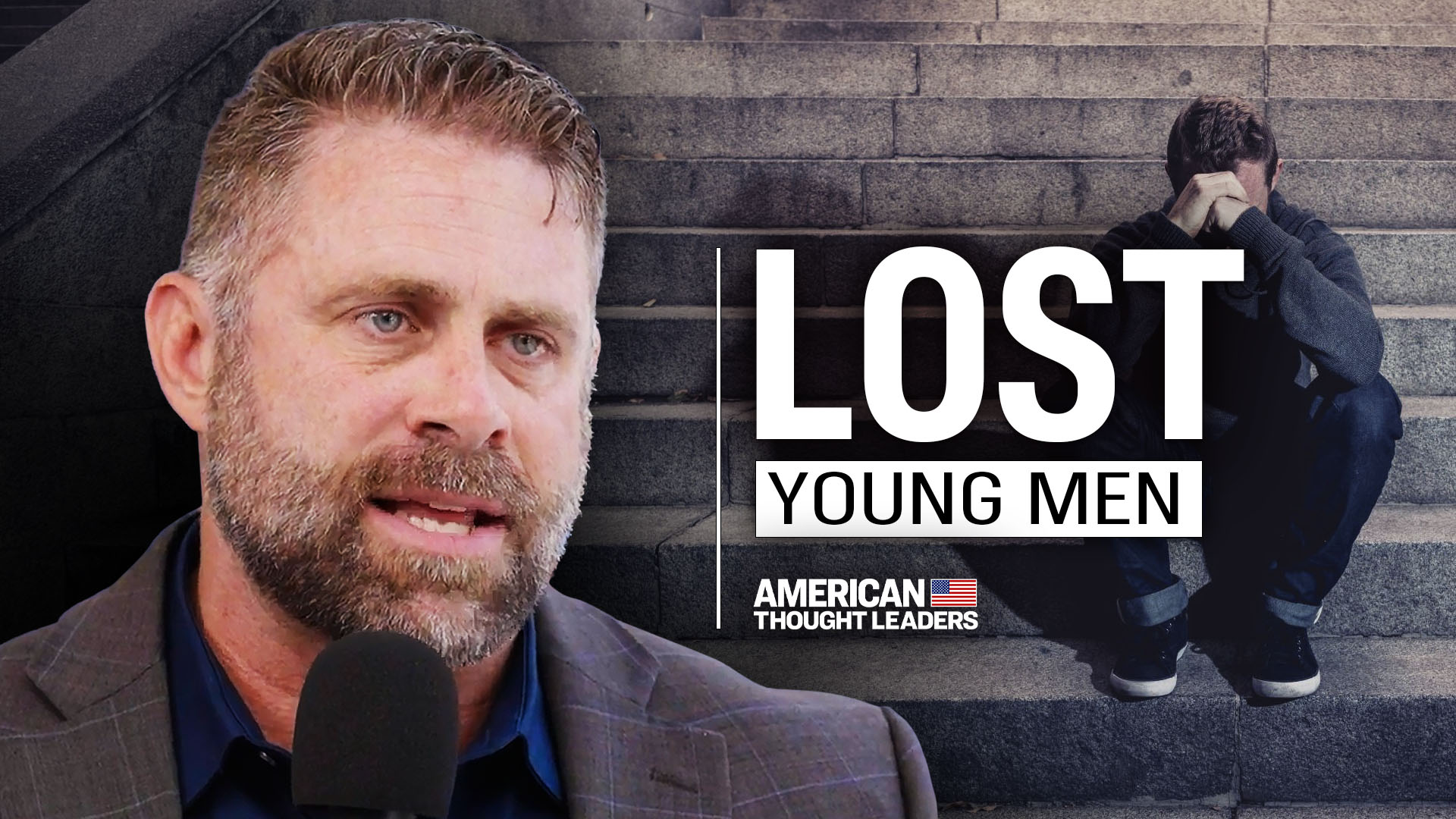

[RUSH TRANSCRIPT BELOW] Young men have been under attack by popular culture for the last 20 years, argues Nick Freitas, a former Green Beret and Virginia state legislator. They have been told that masculinity is toxic, the future is female, that they are responsible for the world’s problems, and that they no longer have a place, he says.
Despite this onslaught, Freitas shares a hopeful message for the young men of today: “God has created men for a particular purpose. We are supposed to be strong. We are supposed to be capable. Why? So we can honor God, protect our families, and protect our civilization.”
Freitas recently wrote a book entitled “The Manbook: A Point-by-Point Guide to Sucking It Up and Getting the Job Done,” where he shares hard-won lessons on how to be a good man despite resistance, or outright attacks, from the prevailing culture.
In this episode, Freitas reveals why a whole generation of men are flocking to radical ideologies—and how to prevent it.
Perhaps surprisingly, Freitas puts the onus on the men of older generations, arguing that young men desire good role models and guidance. Older men, therefore, must live the kind of lives that young men would want to model.
“The best argument you make is not just the one that you articulate through your words,” Freitas says, “it’s the one that you articulate through what you do in your own life.”
Views expressed in this video are opinions of the host and the guest, and do not necessarily reflect the views of The Epoch Times.
RUSH TRANSCRIPT
Jan Jekielek:
Nick Freitas, such a pleasure to have you on American Thought Leaders.
Nick Freitas:
Thank you very much for having me.
Mr. Jekielek:
So you just said something very interesting. This conference we’re at here today, the Alliance for Responsible Citizenship [ARC], it’s all about saving or restoring Western civilization. But you’re saying that when young men hear about this, they’re not thinking about it the same way that many of the people here are. Tell me more.
Mr. Freitas:
So essentially, when most of us say Western civilization, especially in an area like this, we all kind of look at this as a combination of classically liberal values with respect to free markets, private property rights, and representative government. We think about things like John Locke, Montesquieu, Blackstone, and the Founding Fathers of the United States. These are the things that are automatically conjured up when we talk about Western civilization. And therefore, it’s obvious to all of us why it should be saved.
But if you’re a young man that has gone through about the last 20 years where you’ve watched as most of pop culture has told you that you are responsible for all the world’s ills, that the future is female, that you really don’t have a place, that your masculinity is toxic, and therefore the solution is to make you more feminine.
Well, if you’re a young man hearing about, well, we’ve got to save civilization, a young man’s obvious and, quite frankly, logical response to that is, do you mean the civilization that hates me or the civilization that was too weak to protect me from the popular culture that hates me? Because either way, that’s not an enticement.
And so if you want to know why a lot of young men are starting to entertain ideas, philosophies, and ideologies that I think a lot of us thought were left dead and buried in the 20th century, that’s why.The other reason why they’re starting to entertain what we might consider some of the worst philosophies is because for 20 years they’ve been told by what we might call critical theorists or in America what we refer to as woke or feminists that they’re Nazis, that they’re fascists.
So imagine you’re a young man and you don’t really have as much of a frame of reference for these things other than you know that they’re bad. And now you’re being called these things by people who clearly hate you. You’ve never identified with those things. You don’t even know what those things really are on any sort of like base philosophical level. But you know what you do know? You know all of your enemies hate that thing.
Well, if all of your enemies hate that thing and they hate you, maybe it’s time to reconsider that thing. And so the very people that claim to want to stop fascism and Nazism and bigotry and everything else are the ones actually allowing for those things to be reconsidered within popular conversation among young men because they’ve been inappropriately identified as those things.
And so I think it’s critical now more than ever that if we’re going to talk about saving Western civilization, we better do a much better job of identifying it. And we better have the men within that civilization doing a much better job stepping up and defending the young men that have been repeatedly attacked by certain sectors of the popular culture.
Mr. Jekielek:
But, you know, per your book, The Man Book, young men need to suck it up as well, right? As you’re talking about this, part of me is thinking of it as a kind of victimology in itself.
Mr. Freitas:
Actually, that’s a good point. So I’m not calling for anybody to be a victim, but we’ve created within pop culture and within the left, victim status and intersectional politics is how you gain social currency. So the more victim things I can claim, the more powerful I am, and we shouldn’t be surprised because if you look at Karl Marx, right, it’s from each according to their ability to each according to their need. Well, that sort of philosophy prioritizes need over ability. Ability is put upon, it’s punished, need is rewarded with more stuff.
So we shouldn’t be surprised when Marxist ideologies yield to the sort of society that says, I want to accumulate as many victim points as I can get. I’m not telling young men to adopt a victim mentality. What I’m doing is I’m acknowledging that they’re actually facing an onslaught that arguably men throughout time have never faced before. I grew up in the 90s. I went off and I fought for my country. I was in the Army Special Forces.
Mr. Jekielek:
Tell me a little more about that, actually, yes.
Mr. Freitas:
I graduated high school in 1998. I got married in 1999. I joined the military in ‘98. I served in Army Special Forces, better known as the Green Berets. So I did a couple of combat tours over in Iraq, doing a lot of kicking in doors and finding bad guys. And I grew up as probably the last generation where being a strong masculine man was rewarded. Women expected it of you. They appreciated it. They rewarded you for it, and so did society at large.
We respected men who put on a badge, put on a uniform, did dangerous things. We respected successful business leaders. Well, that started to change fairly quickly. It had already been changing within our university system. but it hadn’t actually filtered down into popular culture until, I would argue, after I had graduated high school, married, and had a profession.
And so I think it’s important for men of my generation to understand that we face challenges, right? Yes, at 25, I was at war.
A lot of 25-year-olds now were not at war at 25. My grandfather was fighting the Empire of Japan during World War II at 16 and didn’t expect to be thanked for it. It was just something that you did. Those are incredible challenges. They’re challenges that could potentially cost you your life, but they were also challenges that you were rewarded, appreciated, and respected for. Now I want you to imagine an environment where, yeah, economically in many respects, technologically, there are more creature comforts than we could ever imagine.
So it’s easier for men of my generation to look at younger men and be like, what are you complaining about? You have access to all of this freedom, safety, opportunity. What are you complaining about? And the thing is, is that what they’re complaining about is they want a noble mission. They want to do difficult things. They want to do hard things, but they’ve been told that they need to be emasculated because they’re what’s wrong with society. That is incredibly confusing to young men. So I’m not telling them to be victims.
As you said, the subtitle of my book is about how to suck it up and get the job done because that’s what defines a man. What defines a man, other than the biological traits, what defines a man is your ability to put aside a desire for comfort or a desire to avoid danger in order to fulfill your word, to protect the people that you love, and to protect the things that you love. So, yes, even this generation of men will have to suck it up and be a man and get the job done. But we’re not going to convince them of that if we don’t first acknowledge that for the last 20 years, they’ve largely been told to sit down, shut up, and that they have no place. So we need to acknowledge this problem—society is not going to reward them.
Now, if they choose to be victims as a result of this, if they choose to say, well, I don’t care. I’m going to give up on civilization. I’m just going to play video games and watch porn. Well, then I’m going to tell them they’ve adopted a victim mentality and they’re weak because that’s accurate. What I’m telling them to do is that, no, we need them. We need them to actually stand up. And if they don’t like what’s going on in society, they need to be a part of the solution for that.
Mr. Jekielek:
Well, and what I hear you saying is that we need to communicate aggressively to them that we need them for that.
Mr. Freitas:
We need to do a couple of things. We need to communicate it aggressively. We need to stick up for them when culture is trying to push them down. Men my age need to say, back off. He’s doing the right thing by trying to be a man. And the other thing we need to do is model it. I have watched for too long within the Western church, within Western society, within Western politics, we’ve all had this idea, even as men, like, oh, yes, you know, we’re so crappy and the women are so wonderful.
And you see the same thing. The Mother’s Day sermon is all about how women are great. And the Father’s Day sermons are all about how you need to work harder. Well, no, what we need is to understand that God has created men for a particular purpose. We’re supposed to be strong. We’re supposed to be capable. Why? So we can honor God, protect our families, and protect our civilization. If you want it, men want that.
There’s an interesting phenomenon that I like to talk about, and it almost seems silly to bring up in a place like this, but it’s really important to understand on a cultural level. There was this series of videos that were going around on the internet for a while. And it was this symphony orchestra version. The music was a symphony orchestra version of Madonna’s song, Like a Prayer, which seems like a ridiculous song for the video that accompanied it, but it worked.
Every single video that accompanied this song was some character from a video game that is predominantly played by young men. And it was always them engaged in some sort of valiant last stand. It was them, either by them, it was either the crusader that was fighting against the barbarian horde and knew he was going to die, or it’s the space marines that are all gathered around a single flag and a rock, and they’re being overwhelmed by enemy forces, and they’re just sitting there defiantly standing to the end. And when you see this music, and you see this imagery, and you see that it has 10 million views and that the various offshoots of this video have millions upon millions of views themselves. Why?
Because every young boy wants to believe that in that sort of situation, he would be that kind of man. If we actually want to appeal to today’s youth, we do have to acknowledge the struggles that they face and the uniqueness of those struggles. But then we also have to show them how to be the sort of man that other people can depend on. And we need to tell them to stop asking permission from popular culture in order to do it. Just do it. Be the man that God has created you to be. And here, we’re going to show you how to do it. And we’re going to provide you with the rites of passage. We’re going to provide you with discipleship. We’re going to provide you the mentorship that you need to actually become that person.
Mr. Jekielek:
You mentioned a couple of things that I find particularly, I guess, relevant in this context, and that’s just one structural. We live in a culture of screens. And these screens have changed the way we behave among one another. And for example, you know, I was probably one of the last, I’m a little bit younger than you. So I was, you know, when you ever see E.T. the Extra-Terrestrial, right? I like to say this, but the kids in that, they just ride around on bikes alone and the parents sort of tangentially come into the scene once in a while.
But the kids don’t even realize there are parents. I literally lived that life, right? And it’s hard even to imagine you'd get arrested probably as a parent if you let your kid live like that today, right? Today, a lot of kids are just on screens. Maybe part of the reason is because of these narratives. But a lot of boys, they’re incredibly addictive. They suck you in and you spend your time. You see people, you know, I was riding the tube here the other day. Everybody is doing something with their phone. It’s just a complete lack of interaction with humans and much more with screens. So there’s that.
And the second thing that I want to mention, so that’s just a structural thing, this impacts this whole question of men wanting to do those physical, active, you know, sort of protection of things versus interacting with this, which obviously is a very different thing, right? In most cases. The other part is porn. I'll tell you the interaction I had. So I was at an event. Some sort of budding politician was explaining how she was going to be running for office. She passed on a website.
I plugged it in, it might have even been this iPad. And before I knew it, there were some serious not-safe-for-work things going on on the iPad, right? So I quickly tried it. I’m in the middle of this room, right? Anyway, but what it made me think about was ubiquitous, you know, this was some sort of trap. I obviously misspelled the the the the the
Mr. Freitas:
Dot net vs. dot com.
Mr. Jekielek:
Or something, and somehow this had been probably created to capture the attention of people who put in the wrong URL or whatever, right? Now I imagine there’s a lot of this and so it got me thinking and exploring. And so, basically, for young people right now, there’s ubiquitous, on-demand, instant access to extreme pornography that, who knows, right? You can do this AI now and God knows what.
And I actually think it’s one of these dark forces that’s affecting our society because no one wants to admit that they’re involved in this, especially if they’re older, right? And they have a position of importance and things like that. So, never mind kids, right? So, there are these other dimensions that I think probably have a huge impact on the development of young boys. This is even on top of this, you know, kind of anti-toxic masculinity culture or whatever.
Mr. Freitas:
Jonathan Haidt has, I think, done some of the best work on this in explaining why you should actually prevent your kids.
Mr. Jekielek:
On the screen side.
Mr. Freitas:
On the screen side. And on the interactive screen side. He actually differentiates between watching a movie together as a family vs. an interactive program on a screen, on a phone, social media, etc. And so I think part of the solution to that is that you just, you don’t let your kids have access to that until they reach a certain level of emotional and intellectual maturity where they can handle what it is. It’s the practice that we use with our kids, and it seems to have worked very well. The other thing that I would say is, to your point, it is a perfect storm.
So, at the same time that you’re telling a generation of young men, shut up, sit down, and don’t do anything, there’s no place for you here, there’s never been an easy way to get access to things that men want: entertainment, access to women in one way or another, right? And so it’s all there. And our minds are developed to actually search for efficiencies. So again, if we all want to be, let’s just say we all want to have wealth and we want to have comfort and we all want to have power to some degree, but I no longer feel I can achieve it in the real world.
Well, there are plenty of areas online where I can feel some sense of power, some sense of community, some sense of sexual gratification, even if it’s a perverted form of all of those things. It sits as a stand-in, and before, we really didn’t have that, at least not on those levels. So that’s why I say it’s a perfect storm between those things. But the antidote for that is a couple of things.
One, you need good role models. You need men that are willing to actually stand up and show a different path, and to be able to show the superiority of it. So if I’m going to tell men, you need to put down the porn, and you need to go meet a real woman. Well, they’re going to look at me and say, okay, well, dude, does that guy watch a bunch of porn, or does that guy have the sort of relationship with his wife that I would want to emulate?
I’ve been married since I was 19. I love being married. I have a great relationship with my wife. It'd be very hard for me to tell young men, no, I know, follow my lead, if I had been married for 27 years to three different women. So some of it is about taking accountability for our own actions, because the best argument you make is not just the one that you articulate through your words; it’s the one that you articulate through what you actually do in your own life. If you want them to believe this stuff works, then they have to see that it works in your life.
The other thing that I think is absolutely essential, one of the debates that’s going on here at ARC, and I feel sorry for James Lindsay, because I like James, but I think he’s going to get crushed on this one. He’s got to go up against Os Guinness and explain whether or not a spiritual revival is actually essential to the revival of Western civilization. I think that is a ridiculous question. I can’t believe we’re asking it. Of course, it is.
I said yesterday on stage, I don’t want to just save Western civilization. I'll tell you what I want to save: Christendom. I want to save this idea that once again we recognize that what we call Western civilization didn’t just appear out of the ether. It’s not a result of secular humanism. It is built upon a foundation of Christian moral teaching and Christian thought. Even for the countries that didn’t explicitly state they were Christian countries, like the United States, were heavily influenced by Christianity to the degree that the most common thing quoted by the founders of our country was the Bible. Before you get to Montesquieu, before you get to Locke, before you get to Blackstone, it was the Bible.
So why is that so important? Because Christianity actually provides a framework. It provides a foundation for objective truth and objective morality. I’ve played many roles in my life, but the thing that has always defined my identity is, I’m created in the image of God, and I belong to Him. I’m a part of His story. He’s not a part of mine. And what that means is that when things have been going great, good. I feel blessed, and I appreciate that. And when things go poorly, I don’t anticipate anything else because Christ told me to pick up my cross and follow Him.
And so when I see people who are even high-functioning, maybe they’re incredibly successful entrepreneurs, maybe they were other people in one of the special operations communities, and then all of a sudden something happens in their business, or all of a sudden something happens in their military career and they can no longer serve. And now all of a sudden they have a complete loss of identity. I’ve never experienced that. I’ve lost jobs. I know what it is to go through difficult times. I’ve lost friends. But I don’t know what it is to lose my identity. And I don’t know what it is to lose my meaning or my purpose.
And when you can actually root everything that I’m talking about in something that is transcendental, right? This is transcendent. It’s not something I just made up. It’s not something I believe that is convenient. I’m not offering someone a fad fitness program or a diet. I’m saying that I think these things are universally true. And then when I point to the people that have actually applied them and lived their lives well, lived well and died well. I can actually point young men to something to aspire to. I don’t want to just give them something to avoid. I want to give them something to aspire to.
For me, that started off with my own son. Am I the sort of man that my son can look up to? The thing that I tell young fathers all the time is whether you like it or not, you’re your son’s hero up until the point you prove to him that you shouldn’t be. It’s just so essential that we ground all of this in something far more transcendent than the Declaration of Independence, than Magna Carta, right, than the Bill of Rights. We have to seek something that is universally true and eternally true and moral, and then build from there. If we can do that, then yes, I believe that we can save Western civilization. The people that will save it will be young men that are convinced that it’s worth saving.
Mr. Jekielek:
So what you’re talking about, let’s see if I’ve got this right, is sort of officially saying, you know, Christianity, the Christian way of doing things is the way this country is going to go forward, right?
Mr. Freitas:
So I believe Christianity is true. And so the second question would be, does Christianity have anything to tell us about morality, about civics, about masculinity, about femininity, about marriage?
Mr. Jekielek:
It certainly has a lot to tell.
Mr. Freitas:
Absolutely, right. So if I believe that’s true, then obviously I want to be able to convey that, both with what I say and how I argue it. I want to make an intellectually rigorous argument for those things, but I also want to apply them to my own life. A lot of what my book is about is that my book is not preachy. I don’t sit there and tell everybody the 10-step program to be a man or here’s the 10-step process to have a great marriage. A lot of it is me sharing stories, some things that I got right, some things that I got horribly wrong, but in each step, I learned something because I had a standard that I was applying it to.
Mr. Jekielek:
Right. So the reason I’m mentioning this, as we were talking earlier, I understood you to be saying that as a country—I’m thinking the U.S. here—as a country, we should adopt those values, the Judeo-Christian values, as the standard. Is that what you’re saying?
Mr. Freitas:
I think every country should. But I think what’s important to understand is that what we understand as Western civilization was universally adopted by countries that had adopted those as the standards.
Mr. Jekielek:
Yes, that’s certainly true. Yes.
Mr. Freitas:
Even in the United States, where we didn’t expressly state that we were a Christian country, something like the vast majority of the original 13 colonies had religious tests. Now, we can argue on whether or not that’s a good idea, but we can’t deny that it was a part of the actual social fabric that created the civilization that we now enjoy.
Mr. Jekielek:
No, 100 percent. And I think that’s obvious, personally, right? That’s obvious. But the way the country has evolved, it’s actually a very interesting system because it’s pro-faith in its structure. It doesn’t single out particular types of faith. It’s supposed to be open. In fact, that was the idea. There were all these different faiths, and they were being persecuted by another variant of that faith. So they set it up so that no one faith could basically dominate the others, right? Yes, go ahead.
Mr. Freitas:
Please keep in mind, I’m not advocating theocracy in the sense that we’re now all going to be...
Mr. Jekielek:
That’s not where I’m leading with this, but no, please continue.
Mr. Freitas:
I don’t think that a particular denomination or priest or pastor or bishop should be running the place. It’s more that when you have a high-trust society that agrees on certain fundamentals and the standards for objective truth, well, there has to be a moral code.
Mr. Jekielek:
I think that’s what you’re saying, right?
Mr. Freitas:
Absolutely. Well, John Adams said it. John Adams, who, by the way, was a Unitarian. He wasn’t a Christian in the sense that I’m a Christian. He didn’t believe in the divinity of Christ, right? John Adams said that our Constitution was written for moral and religious people and was totally unsuited to the governance of any other. And so I think it’s about getting back to understanding that if you remove the foundation of anything, you essentially destroy it.
In Western civilization, we have dabbled with this idea that we could essentially make secular humanism the moral foundation of representative government, property rights, and free market economics. What I hope we have discovered is, no, we can’t. It’s not a firm enough foundation. And so my hope is that Western civilization will once again recognize its origins and the importance of those origins, and then individuals will freely adopt it. Because one of the tenets of Christianity is, I cannot compel you by force to become a Christian.
Mr. Jekielek:
Right. One could say, though, that natural law in the way that Aquinas described it could be that foundation.
Mr. Freitas:
Well, Aquinas believed that natural law came from God.
Mr. Jekielek:
Well, sure, yes.
Mr. Freitas:
And every time we do this, every time we say, okay, I like these moral principles. I like the moral law, but I don’t like the moral lawgiver. I want a different moral lawgiver, you run into problems, right? Because then the question is, why does it have the force of law? Why does it have authority? Because if it’s just something that we all kind of generally agree on, well, we can just as easily generally agree on something else.
And I think what people are looking for, I think what young men are looking for, is universal principles. What is my place? What is the hierarchy? What is the structure? And where do I fit into it? And again, it’s one of the reasons why I think it’s important to recognize those origins. And it’s not because, like, for instance, people will commonly say, I don’t need Christianity to be moral. I would argue that in order to use moral definitions, you need a moral lawgiver, but let’s set that aside for a second.
I don’t need knowledge of the internal combustion engine to drive a car. I can drive a car very effectively while denying the existence of the internal combustion engine. The problem is going to arise when the car breaks down. And now we’re trying to fix it. And I’m saying, well, I don’t believe in the internal combustion engine. Like, well, okay, but that’s what’s been making your car run. I don’t believe I was able to drive that car all day long without acknowledging it. How dare you suggest that the internal combustion engine was necessary to be driving this car? I have years of driving it to prove that that’s not the case, so you can automatically see the absurdity.
The moment that we recognize that, yes, you can apply moral teachings without adopting the moral law giver until, of course, there’s a real problem, and then you’ve got to find a better way to explain it. We‘ll see if Os Guinness uses that argument. I don’t think Os Guinness requires any assistance from Nick Freitas in anything; he is a brilliant mind. The reason why that conversation is going to be interesting is I also believe James is a brilliant mind. So we’ll see how it works, but I think truth is on Os’s side.
Mr. Jekielek:
It’s one of the conversations I’m excited to check out myself, yes. So what brought you here?
Mr. Freitas:
You know, I was doing a podcast with Konstantin and Francis on Trigonometry, who I love. If the audience has never seen Trigonometry, definitely go check them out. Again, very good minds and some of the best interviewers I’ve ever seen.
Mr. Jekielek:
I'll just comment that, you know, I’ve just written this book on the organ industry in China, and several years back, one of the first deep-dive interviews I did about this issue was on Trigonometry with them. So I’m very grateful for that. I think they kind of helped bring the issue more into the fore.
Mr. Freitas:
I think one of the things they do very, very well is they can have those sorts of conversations in a way that is very accessible for a layman. But I was having this conversation with Konstantin, and we were talking about this issue of masculinity, and they have this tradition at the end of the shows, as you know, where they say, what is the one thing that nobody is talking about that we should be? And I said, young men are about to revolt against the system. The question is, which way?
We fleshed that out a little bit and talked a little bit more about it. And I talked about my concerns that young men will reject this kind of woke progressivism, but they could choose something equally as bad. Konstantin said, I'd love to have you come and speak at ARC. And so I was very honored because you look at the guest list. I made a joke when I got on stage that to speak about such weighty and intellectual issues without even having a British accent seems like having minus two points.
Because as we were talking before, whenever I watch a documentary now, if I don’t hear a British accent, I’m automatically skeptical this is well-researched. But it has been an incredible experience. There are a lot of people here that have done incredible work. Just as importantly, they have had very incredible experiences that they’re drawing from. When they talk about these issues and they talk about potential solutions, you can tell that they’re really invested by not only what they say, but the way they’ve lived their lives.
Mr. Jekielek:
How is it that you ended up doing this? The manhood thing?
Mr. Freitas:
It was interesting. When I got into politics, that’s where I first started to get some recognition on social media. And it was arguing along the lines of the Second Amendment or free market economics or the government’s proper role in a free society. That’s what I was debating about because it was relevant to my occupation. But I started just having more casual conversations with people and talking about things online.
I started talking a lot about being a husband, being a father, raising girls, raising a son. And I ended up connecting with people on those issues, family issues. And there was this interesting moment where I'd been talking a lot about family. And then once again, I was talking about something on the Second Amendment.
I had a woman in Sweden message me and she said, I followed you because I loved what you were talking about with respect to being a husband and a father. Then I was horrified when I saw this talk you gave on the Second Amendment and guns. I was like, I had no idea he was a conservative. She goes, but then I started listening to your arguments and I realized I’m a conservative. We just don’t talk about these things in Sweden. It’s a foregone conclusion that of course you don’t have guns and of course you don’t do these things.
So I’ve been able to relate to people on a variety of things, which I’m very grateful for. But I noticed more and more five years ago when I spoke at a college campus, it was all about politics. Now, when I speak on a college campus, a majority of the questions are about masculinity. How do I be a good man? How do I be a good husband? How do I find a wife? How do I find a husband? So these fundamental questions about faith and identity and existence and what it means to find meaning and purpose, became far more prominent. I just found myself in more conversations where I was talking about that and started to put more of that online.
I was talking to Marissa Streit from Prager University. The first time we met was at the White House. When she came up to me, she didn’t say, oh, Nick the Green Beret or oh, Nick the politician. She said, oh, Nick, my favorite internet dad. And so I didn’t set out to become a coffee mug internet dad, but people have gotten some value from shared experience, and I’m very grateful for that.
Mr. Jekielek:
Yes, and we are in an unusual time where there’s a lot less family than there ever has been, I think, in history. We still, we know through all this research that, you know, kind of the nuclear family model, almost guarantees success in life. There’s a success sequence. There are a couple of things that get you there, right? But it’s at a low point, like it really has never been before. So it’s not surprising to me that there’s this yearning for this.
Mr. Freitas:
I also think that Leftist political philosophy in the West, which is largely influenced by Marx, even if it’s not explicitly Marxist, is rooted in the idea of tearing apart the traditional family. Now, they don’t describe it that way. They look at it as freeing people from the oppressive systems of the traditional family. And so it lends itself to a feminist narrative where, oh yeah, marriage and a husband and a father, that’s oppressive and set up to support capitalist societies. So you’ve seen this trend where there’s been this intellectual argument, this social argument, this economic argument for disintegrating the family.
Well, that doesn’t remove the responsibilities associated with fatherhood or motherhood or raising children. It just transfers those responsibilities over to the state. So it makes a lot of sense if you are a Marxist, if you do have a Left-wing view of the role of government, it makes sense that the traditional family stands in competition with that. And so I think that’s been one move that we’ve seen.
When you also see the things through critical theory and woke culture, those things are also not conducive to the family. But here’s what I find, and we’ve seen this in birth rates, and not just in the United States, all over the West, and now in Asia as well. I think South Korea has the worst birth rate in the world at present. But here’s what’s also interesting.
Politics and representative government is also a numbers game. And if you’re the Left, you’re not having enough kids to win elections. So you either have to import a population, or you have to be responsible for educating other people’s kids. And the Left has advanced a lot of time and effort and money into controlling education, government-run education, higher education. And so even though we have this yearning for this and it’s all-time low numbers, we shouldn’t be surprised because most of the people that are educating our kids are educating them away from this notion of a traditional family, or at least the textbooks are.
Now, here’s the encouraging part. Well, encouraging for maybe us. They asked young men and young women between the ages of 18 and 29 who voted for Donald Trump or Kamala Harris. They came up with 13 different criteria for how they measured success. The number one measure of success for young men who had voted for Donald Trump was having a family. It was number six for young women who voted for Trump. It was number seven for young men who voted for Kamala Harris. And it was number 12 out of 13 for young women who voted for Harris. So the Left is apparently not interested in family structure or having kids. They have prioritized everything and anything but that.
The fact that young men on the right have prioritized family, I’m willing to predict that within three years, it will go from number six for young women on the right to number three. Because I think as young men lead in this, and as young men seek out examples for what it means to be a good man, a godly man, a good husband, a good father, you’re going to see more of a yearning for that among women as well. And the result will be that conservatives will have happier families, more economic success as a result. They'll have more kids. That bodes well for the future if we do want to save Western civilization.
Mr. Jekielek:
And there will be more interest more broadly, of course, as well.
Mr. Freitas:
Absolutely. We will, without a single law and without a single fight or a war, win more people over to that way of thinking. Because when things work, it attracts people to it.
Mr. Jekielek:
100 percent. That’s the thing. It’s successful, and some people will always want that, no matter what their ideology. Well, this has been a fascinating conversation. A final thought as we finish?
Mr. Freitas:
I would just say that one of the most heartbreaking and also moving things that have happened in recent history was the murder of Charlie Kirk. And if you want an example of someone who was desperate to help people and save people. Charlie Kirk did not hate his enemies. He was not animated by hate. He was animated by love for the things that he believed were true. And then he personified it in his marriage. He personified it in his fatherhood. And that’s what attracted so many people to it. And when he was murdered, there was a record number of young men and young women who were saying, I’m going to church for the first time. I’m opening my Bible for the first time.
What I would tell the men of my generation is that when you have an opportunity, where young men who are now exploring this and giving you a hearing for the first time in their lives are walking into your churches, walking into your institutions, what sort of men are they going to find there? Because they better find men that are willing to be strong, that are willing to be capable, that are willing to lead. Because if they find that there, they‘ll stay, and they’ll listen to you, and they'll give you an audience because you have something that they want.
But if they walk into those institutions and they find weak, feckless men, they’re going to turn right around and walk out, and they’re going to try to find strength somewhere else. And you don’t want the other options where they find that strength. So be that sort of person and understand that you have a responsibility to be that kind of man, both to God, both to your own families, but to a future generation of men that are looking for discipleship and mentorship. Well,
Mr. Jekielek:
Nick Freitas, it’s such a pleasure to have had you on.
Mr. Freitas:
Thank you very much.
This interview was partially edited for clarity and brevity.