
News Analysis
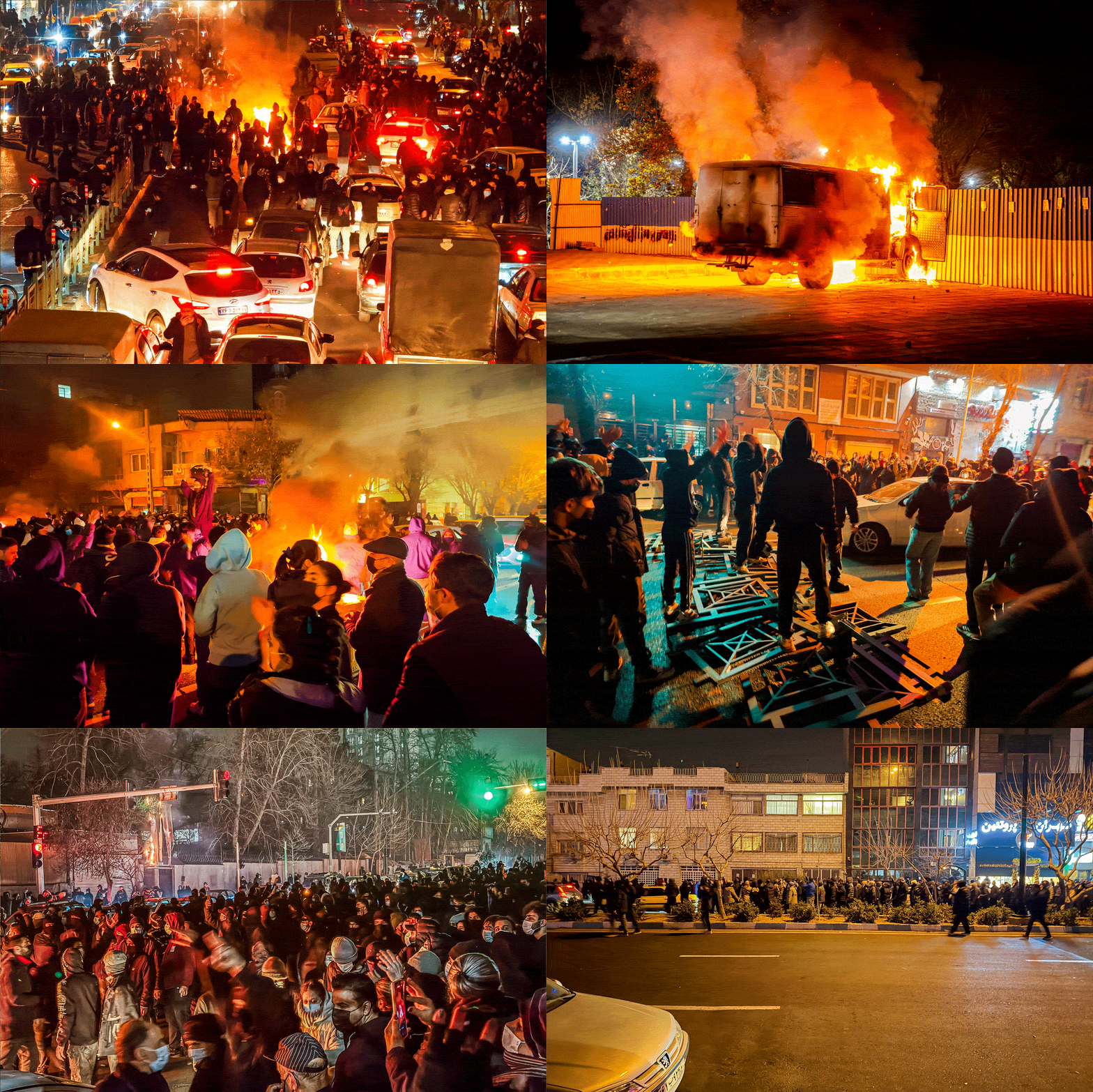
The Iranian regime appears more fragile than ever. What began as an economic protest by business owners in Tehran quickly escalated into a nationwide anti-regime movement by the end of last year.
On Jan. 17, U.S. President Donald Trump called for “new leadership in Iran,” after the Iranian supreme leader, Ayatollah Ali Khamenei, acknowledged that “several thousand” protesters had been killed during the unrest and accused Trump of being “guilty” of causing “both the casualties and the damage.”
Trump has repeatedly warned Iran that the execution of protesters would trigger U.S. military action. Speaking with reporters onboard Air Force One on Jan. 22, Trump said the United States had deployed the Navy in the direction of Iran.
“We have a massive fleet heading in that direction, and maybe we won’t have to use it,” he stated.
Tune in to China Watch, a podcast on Chinese politics, technology, and business.
Although the protests seemed to have died down for now, Steven A. Cook, a senior fellow at the Council for Foreign Relations, said in an interview with Foundation for Defense of Democracies on Jan. 19 that the moment is “definitely not over.”
“It may very well be that we’re at the beginning of an actual social uprising revolution that could overthrow this regime,” Cook said.
The three outcomes for the Islamic regime include regime change, partial transformation, and muddling through, according to Michael Doran, senior fellow at the Hudson Institute, a Washington-based think tank.
“No matter what happens next, there is no scenario in which the Islamic Republic survives 2026 with its power intact,” he wrote on Jan. 9.
A source in China’s Ministry of Foreign Affairs told The Epoch Times that Beijing has been assessing detailed evacuation plans for Chinese diplomats and managers of state-owned enterprises operating in Iran.
The prospect of Tehran seeking accommodation with Washington threatens to expose China to new constraints on its global ambitions, experts say. And Iranian oil is not the central issue.
While the oil trade offers an entry point, the core value of the Sino–Iranian relations to Beijing lies elsewhere, analysts say. Iran allows Beijing to position itself as a balancing power in the Middle East, securing influence in a regional market crucial for the U.S.–China artificial intelligence (AI) race, and advancing its de-dollarization agenda.
All of the above hinges on Iran’s anti-American political orientation, which is in question as the Islamic Republic shows signs of erosion.
Unprecedented Challenges
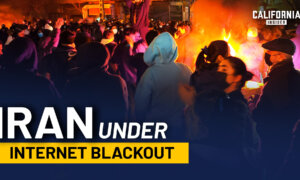
Although Iran has seen cyclic protests in the past 15 years, the current challenges to the regime are unprecedented in scale and intensity. Beginning with shopkeepers and bazaar merchants in Tehran on Dec. 28, 2025, the anti-regime demonstrations have spanned 187 cities, according to the U.S.-based Human Rights Activists News Agency.
The agency reported that more than 2,400 protesters were killed and over 18,400 individuals arrested as of Jan. 13.
The protests stemmed from an economic collapse, marked by the plunge of the Iranian currency, the rial, and rising prices of food and essential goods. The currency lost more than 40 percent of its value last year, from about 817,000 rials per U.S. dollar to over 1.4 million. The official inflation number for 2025 is more than 42 percent.
The economic situation worsened after the 12-day Israel–Iran war in June 2025, which ended with the U.S. military bombing Iran’s nuclear facilities, causing extensive damage. As a result of Israeli strikes, the Islamic Revolutionary Guards Corps, responsible for the preservation of the regime, also lost top leaders and nuclear scientists.
During the Israel–Gaza war that began in October 2023, Israel dealt heavy blows to terrorist organizations—Hamas, Hezbollah, and the Houthis—that all received significant financial and security backing from Iran.
As a result, the threat Iran poses to the West—rooted primarily in its nuclear ambitions and its network of terrorist proxies—appears to have been significantly reduced.
In the meantime, Iranian society has evolved. Less than 40 percent of Iranians identified themselves as Muslim, according to a 2020 survey conducted by the Group for Analyzing and Measuring Attitudes in Iran, a nonprofit research foundation registered in the Netherlands.
Other surveys by the same organization found in 2025 that 89 percent of Iranians favored secular democracy over a theocratic regime, and since 2021, regime change was the most popular option for meaningful progress for Iranians.
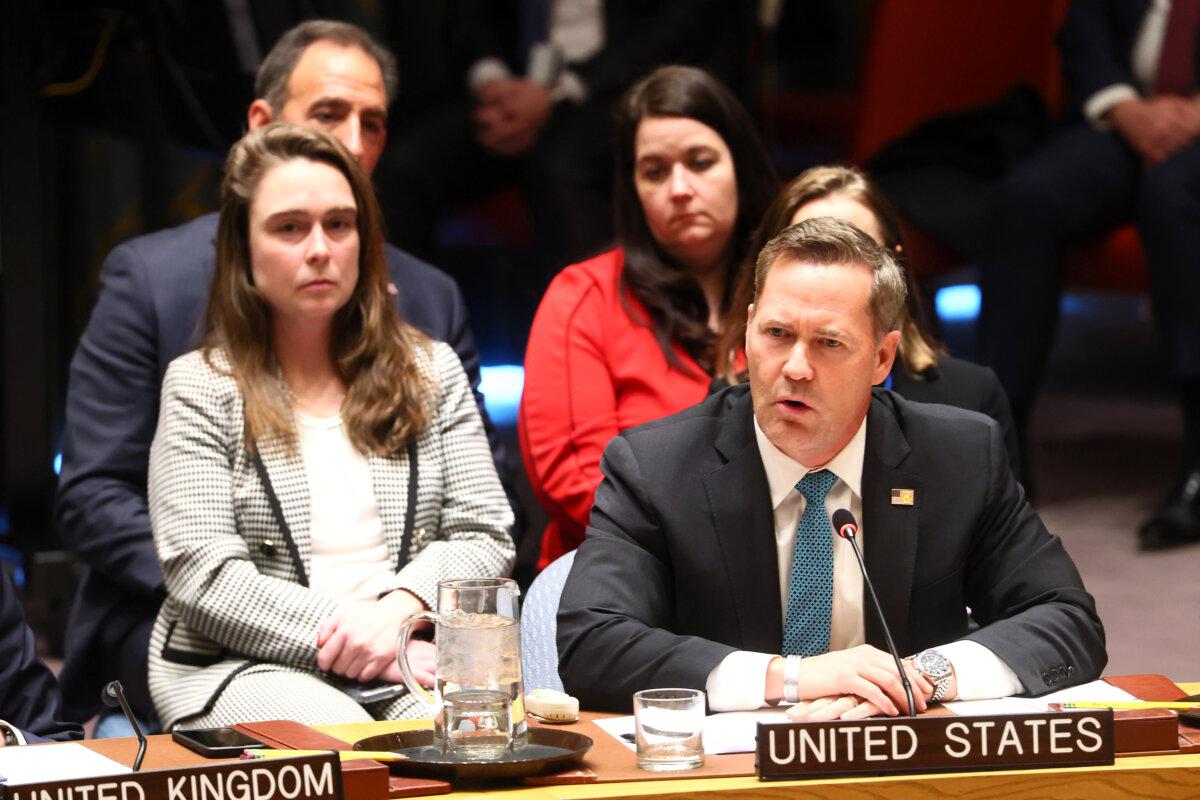
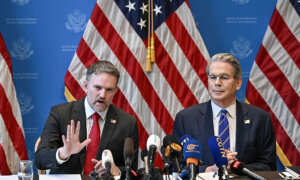
Mike Waltz, U.S. ambassador to the United Nations, speaks during a U.N. Security Council meeting on the situation in Iran at the U.N. headquarters in New York City on Jan. 15, 2026. (Michael M. Santiago/Getty Images)
US and China Reactions
Trump warned on Jan. 2 that the Iranian regime would face military action if it killed peaceful protesters. The president followed up on Jan. 12 by imposing a 25 percent additional tariff on any country trading with Iran; the White House has yet to issue details.
The next day, Trump urged the demonstrators to “keep protesting” and “save the names of the killers and abusers.”
“They will pay a big price,” he said.
On Jan. 14, he said that Iran had halted planned executions of protesters.
At an emergency U.N. Security Council meeting on Jan. 15, Mike Waltz, the U.S. ambassador to the United Nations, said that “all options are on the table to stop the slaughter.”
Meanwhile, the U.S. Navy has redirected USS Abraham Lincoln, a nuclear‑powered aircraft carrier, from the Indo-Pacific to the Middle East region, according to Army Recognition Group, a Belgian-based defense media and analysis company. No reports of any Chinese mobilization in response are available.
China has been a significant enabler of Iran’s sanction evasion and the sustainability of the Islamic Republic. Under a 25-year agreement Beijing and Tehran signed in 2021, China committed to invest $400 billion in telecom, banking, ports, and other infrastructure in Iran. In return, Iran agreed to supply China with oil. China buys more than 90 percent of Iranian oil, which is currently under U.S. sanctions.
A Chinese foreign ministry spokesperson said on Jan. 13 that “China hopes Iran will maintain stability in the country and supports Iran in doing so” and opposed interference in Iran’s internal affairs. Regarding the 25 percent tariff on trade with Iran, she said China would protect its own rights without elaborating.
Balancing Power
Although China buys the majority of Iranian oil, purchases from Iran make up about 13 percent of China’s total oil imports, according to Reuters. Without Iran, China can source oil elsewhere, albeit not at the current deep discount Iran offers to circumvent U.S. sanctions.
However, if the Iranian regime emerges from the current crisis more aligned with the United States, its reliance on sanctions-driven economic arrangements may diminish. Should Tehran no longer need to sell the bulk of its oil to China, Beijing would lose a key lever of influence in the Middle East, according to China expert Alexander Liao.
In his view, the secularization of Iran changes a long-standing Middle Eastern structure underpinned by fear.
“Why do Gulf Arab states still anchor their security in the United States while hedging with China and Russia? One critical reason is their inability to rule out abrupt and destabilizing actions by Iran,” he told The Epoch Times, adding that when Iran is no longer a theocratic system, that uncertainty will decrease.
William Lee, chief economist at Global Economic Advisors, concurs.
“With friendly relations between Iran and the West, what used to be a lever of instability now is a lever of stability,” he told The Epoch Times. “It’ll make the place even more stable if the United States can start to provide Iran with aid.”
He added that when Iran “comes back as a strong economy,” it won’t need China anymore.
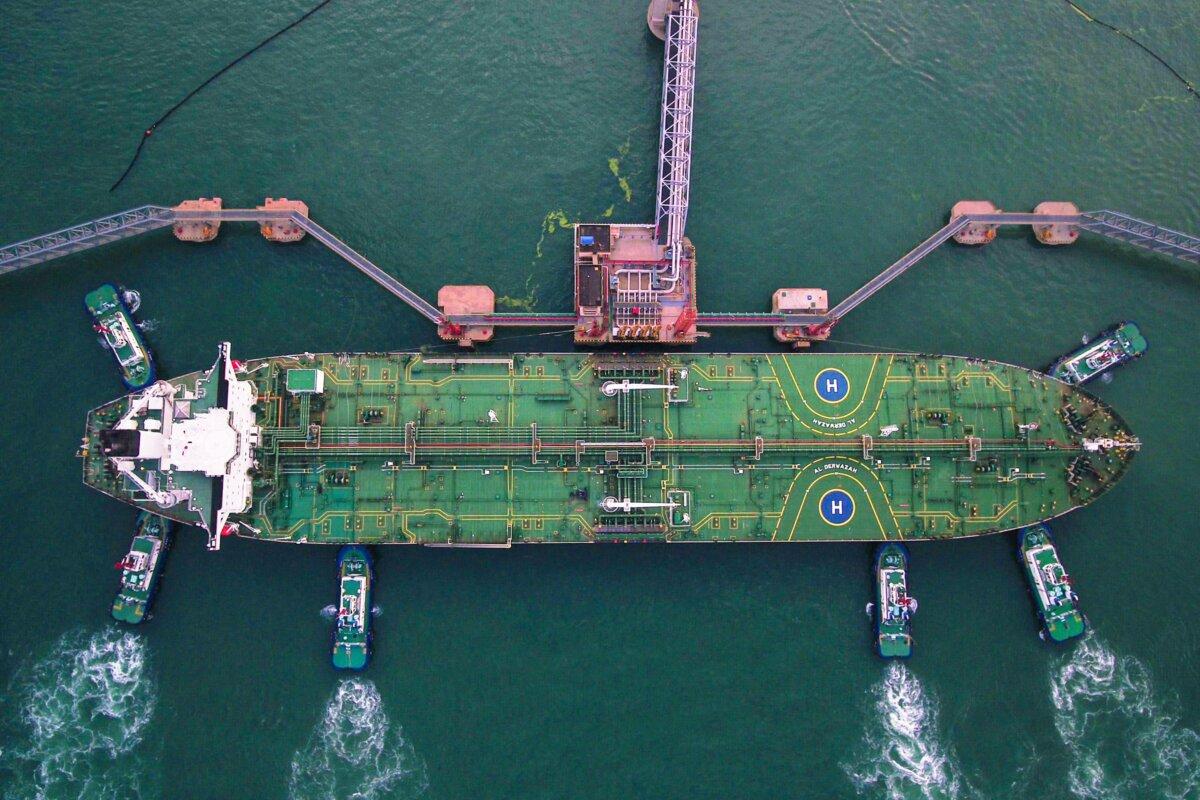
An aerial photo of tugboats berthing an oil tanker at Qingdao port in Qingdao, China, on Aug. 4, 2019. (STR/AFP via Getty Images)
Yuan-Denominated Energy Deals
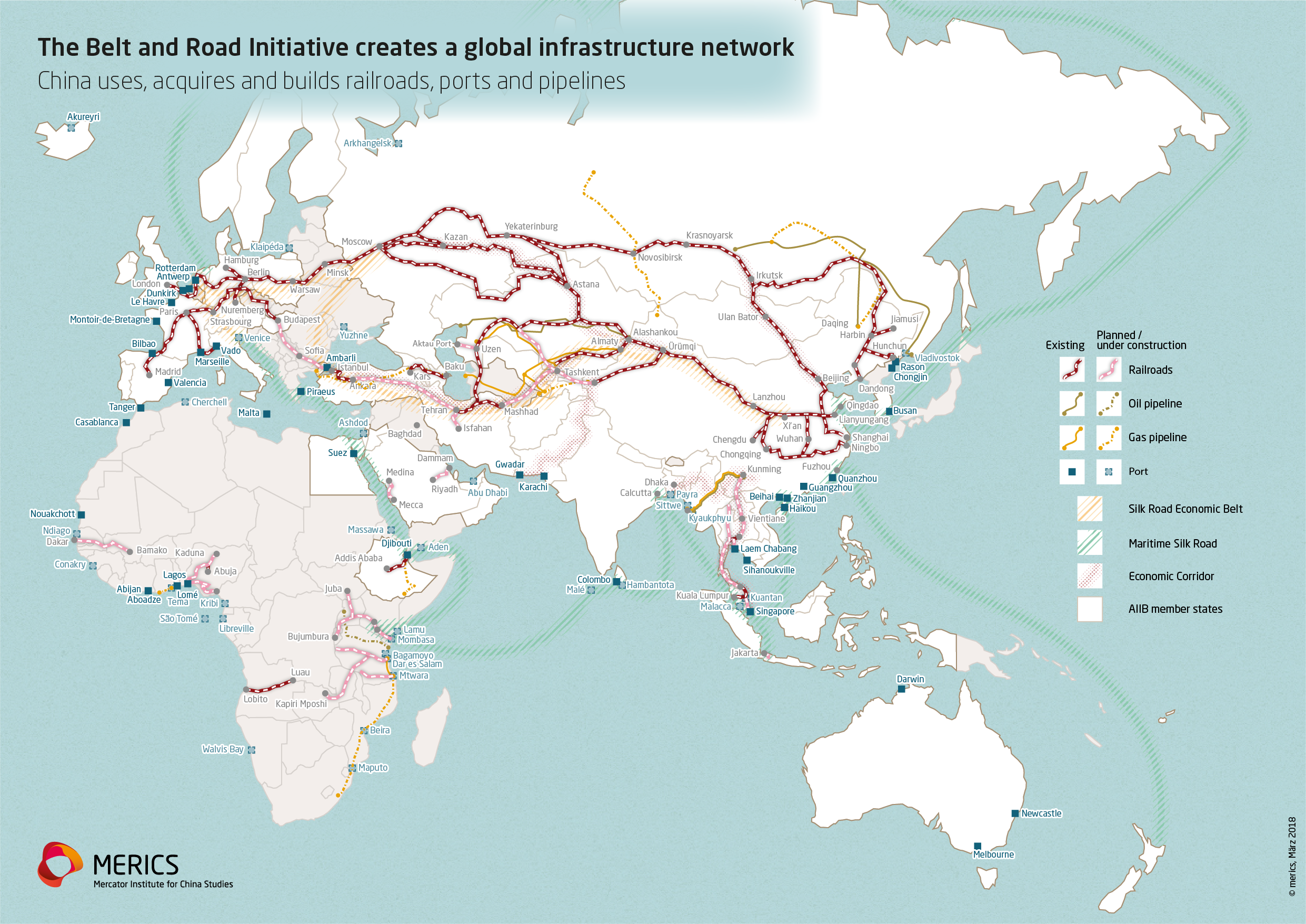
Iran holds high geopolitical value for China. Its location, linking East and West, has made it an important node in Beijing’s Belt and Road Initiative. This foreign policy platform presents itself as a global infrastructure development program.
The Islamic Republic announced joining the Belt and Road in 2016, a move reinforced five years later by the 25-year comprehensive cooperation agreement it signed with Beijing.
Liao described the pact as an “institutional channel for military and technological exchanges to circumvent U.S. sanctions and counter the dollar system.”
“If this channel is severed, that means a major setback to China on a strategic level,” he told The Epoch Times.
According to Liao, a central strategy of the Chinese regime has been to link energy, currency, and geopolitics to advance a yuan-based commodities trade system, with the Belt and Road serving as a primary vehicle for this effort.
He added that the Chinese Communist Party views such a platform as critical to advancing its de-dollarization agenda and challenging U.S. primacy.
The Atlantic Council, a Washington-based think tank, reported that Iran, Russia, and China have “created an alternative market of sanctioned oil, wherein payments are denominated in Chinese currency.”
Iran’s oil trade is estimated at about $40 billion annually in recent years, according to the U.S. Energy Information Administration. The estimate doesn’t factor in price discounts China has received from Iran.
Settling energy trade in Chinese yuan is also contingent on Iran’s anti-Western posture. If that changes, Liao said, “settlement in yuan would cease to be a benefit and instead become a burden,” given that the Chinese currency is not freely tradable.
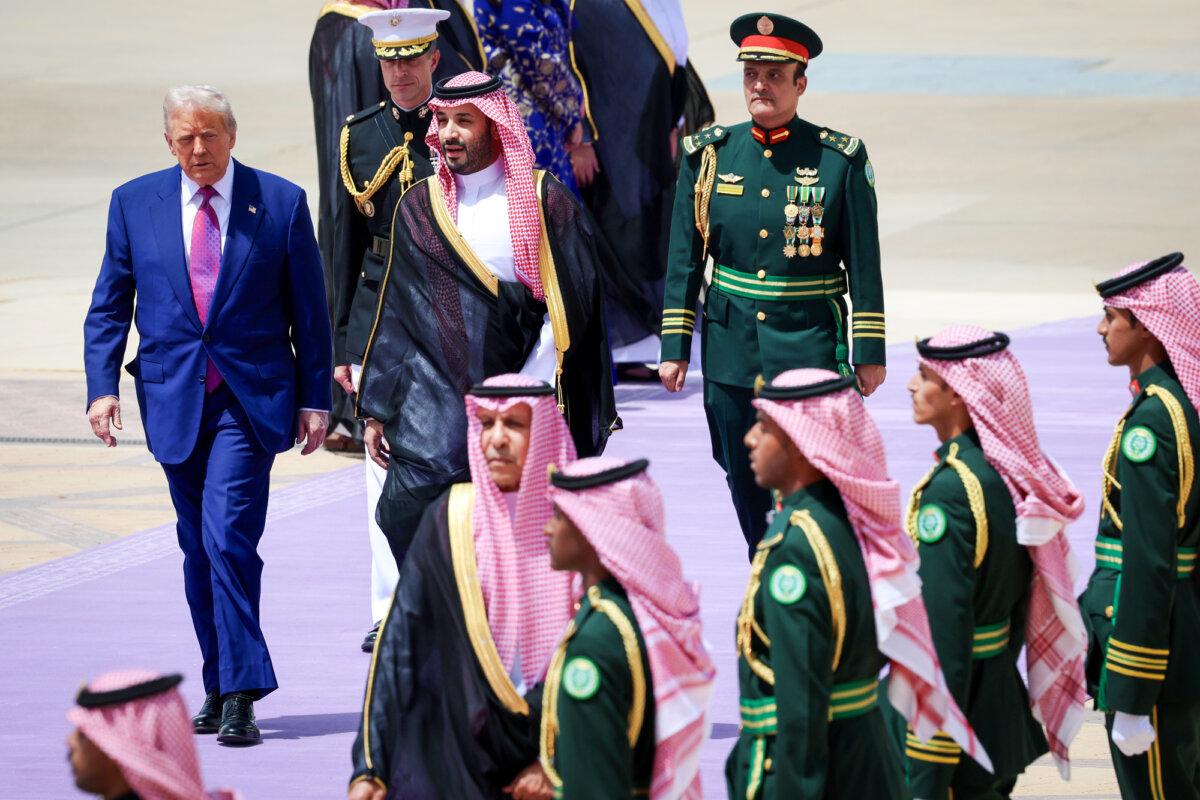
President Donald Trump is greeted by Saudi Crown Prince Mohammed bin Salman as he arrives at King Khalid International Airport in Riyadh, Saudi Arabia, on May 13, 2025. (Win McNamee/Getty Images)
AI Race
The Middle East region is also a crucial battleground for the U.S.–China AI race.
The Trump administration has framed global adoption of U.S. technology as central to winning the competition. Reflecting that priority, Trump made the Gulf states the destination of his first major foreign trip in his second term, visiting the region in May 2025.
The visits yielded sizable investment commitments. Saudi Arabia pledged $600 billion in investment, including major projects to develop AI infrastructure and giant data centers. The United Arab Emirates announced plans to invest $1.4 trillion in the United States over the next decade, focusing on AI infrastructure, semiconductors, energy, and quantum computing.
Beyond promoting the American tech stack, Washington has also turned to the region to diversify the supply chain for rare earths.
Since April 2025, China has repeatedly threatened the United States and the rest of the world with its export controls on rare earths. Beijing holds a near-monopoly over the processing of the critical minerals essential to everything electronic, from cars to advanced weapon systems.
Against that backdrop, the Pentagon has backed a joint venture between Saudi state-owned mining company Maaden and California-based MP Materials to build a rare-earth refinery in Saudi Arabia. MP Materials announced the project in November 2025.
China’s ability to position itself as a balancing power in the Middle East rests heavily on its economic influence over Tehran, according to Yeh Yao-yuan, a professor of international studies at the University of St. Thomas in Houston.
“If Iran is no longer under the heavy influence of China, other Middle Eastern countries might not curry favor with China, including buying Huawei products or Chinese chips,” he told The Epoch Times.
In that scenario, he said, “China’s current efforts to use Iran to access markets in the Middle East will face setbacks.”
If the Iranian regime were to realign with the West, Lee said, China’s resulting loss of political and economic influence would be “much more serious than just the oil trade.”