
The Department of Homeland Security (DHS) has partially shut down after Democrats and Republicans failed to reach an agreement on immigration enforcement changes tied to the agency’s funding.
In the wake of the fatal shootings of two protesters in Minnesota, Democrats have demanded that changes to immigration enforcement practices be incorporated into a DHS funding bill. So far, negotiations between the White House and Democrats have stalled.
Unlike the record 43-day shutdown from late last year, the funding lapse only applies to agencies under DHS’s jurisdiction.
Here’s what happens to DHS agencies in the shutdown.
Coast Guard
The United States Coast Guard is housed under DHS’s wide umbrella, and would be forced to change operations, according to leadership.
The Coast Guard would “suspend all missions except those for national security or the protection of life and property” should the shutdown move forward, according to Vice Admiral Thomas Allan, who is the acting vice commandant for the Coast Guard.
“Although missions like law enforcement, national defense, and emergency response continue, a funding lapse has severe and lasting challenges for the Coast Guard’s workforce, operational readiness, and long-term capabilities,” Allan said during his Feb. 11 testimony before the House Appropriations Subcommittee on Homeland Security.
Some training exercises would stop during a shutdown. Included in those suspensions would be pilot, aircrew, and boat crew training. Scheduled maintenance for some boats and aircraft would also be delayed, and contractors would not be paid.
Allan said that thousands of merchant mariners will be unable to get credentials issued or renewed during the shutdown, and inspections of vessels and regulatory approvals will be delayed. The vice admiral said this alone could cost the U.S. economy billions of dollars per week, potentially leading to higher prices for Americans.
CISA
Acting Director of the Cybersecurity and Infrastructure Security Agency (CISA) Madhu Gottumukkala spoke during the same hearing, telling lawmakers that a DHS shutdown would weaken U.S. defense against threats that target critical infrastructure.
Gottumukkala said that if the shutdown goes forward, his agency would designate fewer than 900 of its normal 2,300 employees to work during the shutdown.
This would force frontline cybersecurity staffers to work without pay, and to halt nonessential activities, including cybersecurity guidance and training.
Processes considered necessary for “the safety of human life or protection of property” would continue. This includes responding to imminent threats.
However, according to Gottumukkala, since much of CISA’s job is focused on prevention and preparedness, it’s more difficult to “cleanly align an imminent threat to an excepted function.”
“Should a DHS shutdown be ongoing, operations would become strained and service delivery delayed in core mission areas such as cyber response, security assessments, stakeholder engagements, training, exercises, and special event planning,” Gottumukkala said.
TSA
A DHS shutdown would also strain airport security due to staffing shortages and potential technology upgrade delays.
Ha Nguyen McNeill, acting administrator for the Transportation Security Administration (TSA), said that about 95 percent of TSA’s workforce would be forced to continue to work without pay.
“TSA’s critical national security mission does not stop during a shutdown,” McNeill said, noting that TSA employees screen roughly 3 million passengers on major travel days. More than 900 million passengers were screened in 2025.
However, Americans will likely experience delays due to higher employee callouts, longer checkpoint lines, and missed flights.
“Many [transportation security officers] work paycheck to paycheck. ... We cannot put them through another such experience,” McNeill said, alluding to last year’s extended shutdown.
McNeill also referenced officer departure after the last shutdown, saying another such lapse could cause major staffing issues ahead of spring travel and the upcoming FIFA World Cup being hosted by the United States this summer.
Secret Service
Secret Service Deputy Director Matthew Quinn spoke to the impact on his agency, saying that agents would not stop protecting the president and other leaders, but this could undermine long-term goals and put a strain on the already overextended workforce.
Quinn told the committee that the agency’s “zero-fail mission” would continue, regardless of Congress’s decision: “There is no pause button on our mission,” Quinn said. “The paychecks may stop, but the work will continue.”
Around 94 percent of Secret Service personnel are considered mission-critical and would remain on duty protecting President Donald Trump, Vice President JD Vance, former presidents, and others.
However, he warned that shutdowns cause far-reaching consequences, including on training, reforms, hiring, and upgrades to communications, among other things.
“The casual observer will see no difference,” Quinn said. “However, gaps in funding have a profound impact on the agency today and into the future.”
FEMA
A DHS shutdown will also impact disaster recovery funding through the Federal Emergency Management Agency (FEMA).
Gregg Phillips, associate administrator of FEMA’s Office of Response and Recovery, said during this week’s hearing that while FEMA will continue to work on lifesaving emergencies during a funding lapse, long-term preparedness could suffer.
“In emergency management, time is always the most important resource,” Phillips said. He went on to say that FEMA workers could be furloughed, diminishing the agency’s ability to coordinate with state and local officials.
“This will hinder communication, planning, and joint operations, affecting disaster relief outcomes and complicating recovery efforts,” he said. “Crippling FEMA’s central operations and recovery-related work will come at the expense of the American people.”
Phillips added that a funding delay “could undermine our readiness for major incidents, including terrorism or large-scale disasters, by disrupting critical preparedness and response activities.”
The agency administrator also said a delayed response due to a lack of funding could harm public confidence in FEMA.
“A government shutdown will erode public trust in the federal government’s ability to respond to emergencies. Even though emergency response activities will continue during a shutdown, communities may feel vulnerable and unsupported during critical times, which could have lasting effects on public confidence and resilience,” Phillips said.
ICE and CBP
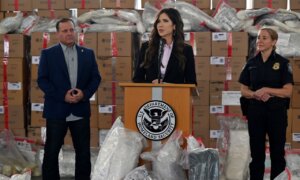
Immigration and Customs Enforcement (ICE) and Customs and Border Protection (CBP) will continue largely uninhibited during the shutdown.
This is a key issue, since the funding debate for DHS has been centered around Democrats’ demands for changes to those two agencies.
The One Big Beautiful Bill Act, passed last year, allotted $75 billion for ICE and around $65 billion for CBP. Both agencies have been involved in immigration enforcement, which has been an issue of contention for Democrats.
DHS responded to an Epoch Times inquiry about ICE operations and a potential DHS shutdown, reiterating concerns from witnesses at this week’s congressional hearing.
“DHS essential missions and functions will continue as they do during every shutdown,” a DHS spokesperson said in an emailed statement. “However, during a shutdown, many employees will be forced to work without pay, putting strain on the frontline defenders of our nation.”