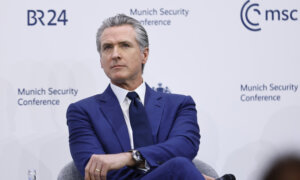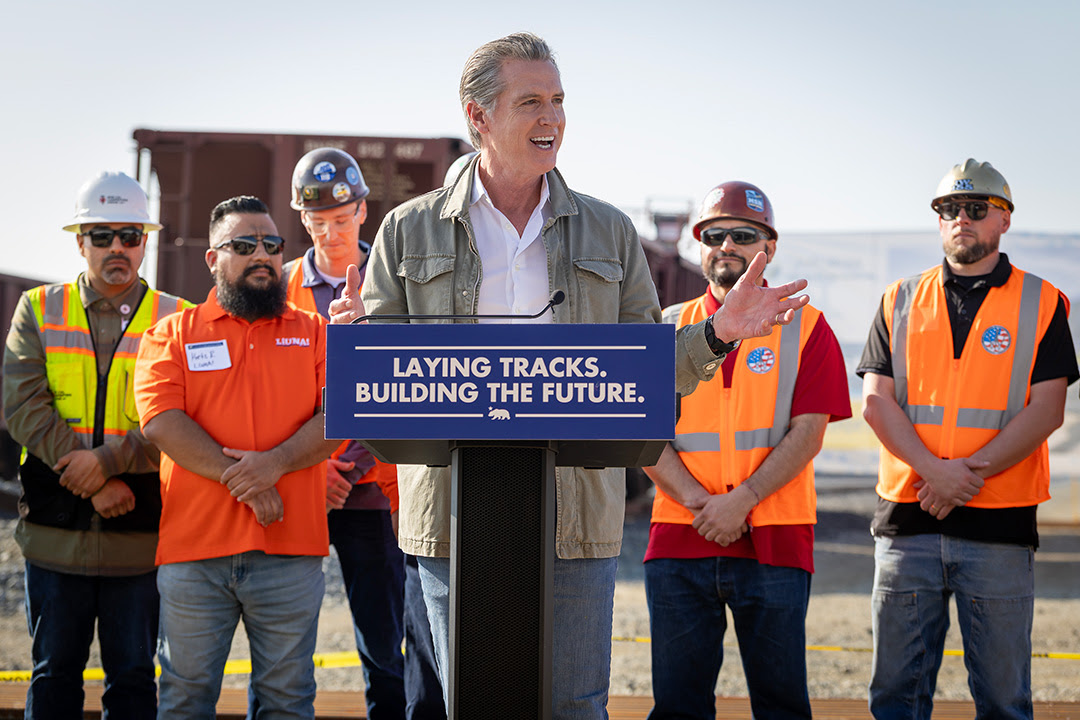

Gov. Gavin Newsom said California is entering the track-installation phase of its high-speed rail project after the state completed a staging facility in Kern County.
In a Feb. 3 announcement, Newsom said the California High-Speed Rail Authority (CHSRA) completed the Southern Railhead Facility, a 150-acre site near Wasco, about 25 miles northwest of Bakersfield. The site will operate as a central logistics hub for the delivery, storage, and deployment of materials to electrify and operate the system.
“With the completion of the Southern Railhead Facility, we’ve taken another critical step in the track-laying stage,” Newsom said in a statement. “California is building the nation’s first high-speed rail system, and we’re proving it can be done.”
The CHSRA said the railhead is connected to the national freight network and includes temporary freight lines and storage tracks, warehouse and storage space, maintenance and operations areas, and infrastructure to coordinate trains, equipment, and personnel. Installation of freight tracks at the site is complete, the state said.
The announcement follows a major shift in California’s approach to federal involvement in the project.
The CHSRA filed a notice of voluntary dismissal on Dec. 23, 2025, ending its lawsuit against the Trump administration over a $4 billion federal grant cancellation. The dismissal was without prejudice, meaning the CHSRA could refile in the future.
The CHSRA sued in July 2025 after the Trump administration withdrew the funding. Newsom said at the time the funding reduction was politically motivated and unlawful.
The voluntary dismissal came two weeks after Judge Dale Drozd of the U.S. District Court for the Eastern District of California rejected a Justice Department request to dismiss the case on venue grounds, according to a report on the litigation. Drozd ruled that the dispute could proceed.
A spokesperson for the Rail Authority told The Epoch Times at the time that the decision to withdraw the lawsuit reflected the state’s view that the federal government “is not a reliable, constructive, or trustworthy partner in advancing high-speed rail in California.”
The spokesperson said that federal requirements have “at times, hindered project delivery by adding cost and delays without adding value—creating inefficiencies, constraining innovation, and slowing construction.”
California Transportation Secretary Toks Omishakin said in the Feb. 3 statement that the recent milestone shows that the state is shifting “from planning to implementation.”
Ian Choudri, CHSRA’s CEO, said the railhead facility is a “critical step” in the track-installation process and said procurements are underway for laying electrified track and systems.
The statement said that over the past year, the CHSRA has invited industry to bid on laying electrified track and systems, secured suppliers for long-welded rail, and begun acquiring key materials needed for installation. It also said it’s working to attract investors.
That effort was already underway before the Feb. 3 announcement. Choudri said on Dec. 19 that the CHSRA started a procurement process that “formalizes efforts to partner with private investors and developers, with the shared goal of delivering California’s transformational program faster, smarter, and more economically.”
The state also pointed to longer-term funding to support the next phase. The Feb. 3 statement said the state Legislature’s renewal of California’s cap-and-invest program secured an annual commitment of $1 billion through 2045.
The governor’s office said 171 miles are under design and construction from Merced to Bakersfield, 119 miles are under active construction, more than 80 miles of guideway are finished, and 58 structures are complete, including bridges, overpasses, and viaducts.
The office also said the project has generated about 121,910 job-years and nearly $25 billion in economic output. It said 98.6 percent of project spending in fiscal year 2024–2025 supported California businesses and workers.
The federal government has designated nearly $7 billion in funds for the project, of which $2.6 billion has been spent so far. The rest is unspent, is tied up in litigation, or has been canceled.
The Trump administration has said the authority had no viable plan to finish a large segment of the project in the Central Valley and has criticized the project as a “train to nowhere.”
The project to connect San Francisco to Los Angeles via high-speed rail was approved by voters in 2008 with an initial $10 billion bond.
The line was initially set at $33 billion for completion in 2020. Costs have risen to between $89 billion and $128 billion, and the opening is now projected for 2033.
Matthew Vadum contributed to this report.