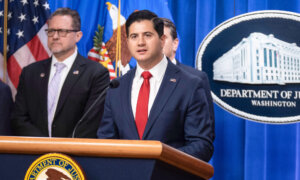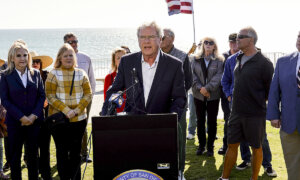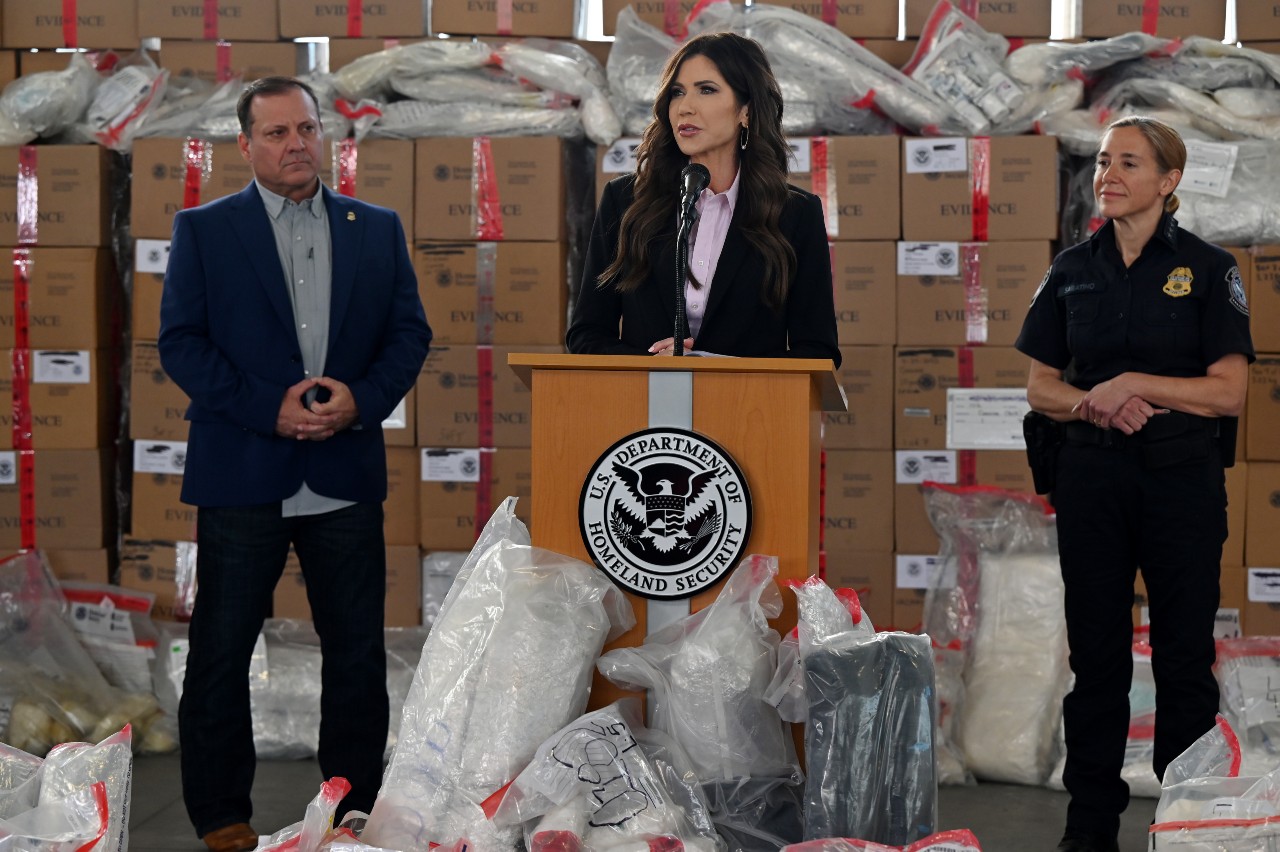
Homeland Security Secretary Kristi Noem doubled down on her demands that California Gov. Gavin Newsom increase cooperation with the Department of Homeland Security (DHS) and Immigration and Customs Enforcement (ICE) at a news conference on Feb. 12 at the Otay Mesa Port of Entry near San Diego.
ICE has lodged detainers on more than 33,000 criminal illegal immigrants in California’s custody, but the state has released 4,500 of them back onto the streets, Noem said.
Acting ICE Director Todd Lyons also sent a letter to California Attorney General Rob Bonta, calling on him to honor the detainers. Crimes committed by these illegal aliens include 399 homicides, 3,313 assaults, 3,171 burglaries, 1,011 robberies, 8,380 drug offenses, 1,984 weapons offenses, and 1,293 sexual offenses, according to a DHS statement on Feb. 5.
In an X post on Feb. 6, Noem called on Newsom not to release the more than 33,000 criminal illegal aliens in custody back onto the streets without notifying ICE.
Newsom’s office responded with a statement and an X post saying that the state of California works with ICE to deport criminals.
“The federal government hasn’t picked up 100 [percent] of the criminals they claim to be going after,“ the governor’s office stated. ”California doesn’t block ICE from getting violent criminals.”
Since 2019, the state has coordinated the transfer of more than 12,000 criminal illegal aliens—including murderers, rapists, and other violent offenders—into ICE custody, the governor’s office stated, noting that “federal immigration officials fail to pick up roughly one out of every eight individuals released from California state prisons who already have ICE detainers placed on them.”
On Feb. 12, Noem toured a vault containing 188,218 pounds of seized drugs, including 100,000 pounds of methamphetamine, 59,000 pounds of cocaine, and 7,400 pounds of fentanyl—equivalent to 1.7 billion lethal doses.
She said the inflow of fentanyl has dropped by 56 percent under the Trump administration and urged California to work with DHS, ICE, and local law enforcement agencies to keep criminals and illicit drugs off the streets “before they poison more Americans,” citing several parents who have lost children to fentanyl overdoses.
“The cartels traffic, they torture, they behead human beings, and they enrich themselves and profit off of American deaths, and that’s why President [Donald] Trump took action and designated them as foreign terrorist organizations on day one,” Noem said.
Although the Trump administration is stopping “threats from coming into [the] country,” she said, “we can’t forget about the ones that are already in [U.S.] borders right now, in prisons and jails across California.”
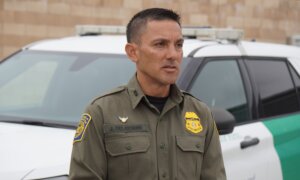
U.S. Border Patrol Chief Michael Banks criticized the Biden administration for its lax border security and “catch-and-release” policies that pulled thousands of Customs and Border Protection (CBP) agents off the line from ports of entry to process millions of illegal aliens.
Seizures of illicit drugs have increased dramatically because those agents have returned to the ports of entry where they can do more inspections and look for more narcotics, Banks said.
Banks said that “not a single illegal alien” has been released into the country in the past nine months of the Trump administration and that the border is the most secure it has ever been.
Diane Sabatino, acting executive assistant commissioner of CBP’s Office of Field Operations, said DHS funding in the One Big Beautiful Bill Act—blocked by Senate Democrats in Congress on Feb. 12 during budget negotiations—would represent “a generational investment” in border security.
The funding would allow CBP to expand capabilities and, “more importantly,” allow CBP to hire more than 5,000 officers at ports of entry to detect more narcotics and disrupt drug cartels, Sabatino said.
“Our border security mission is national security, and our efforts are never going to stop,” she said.