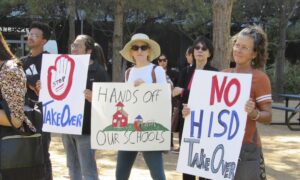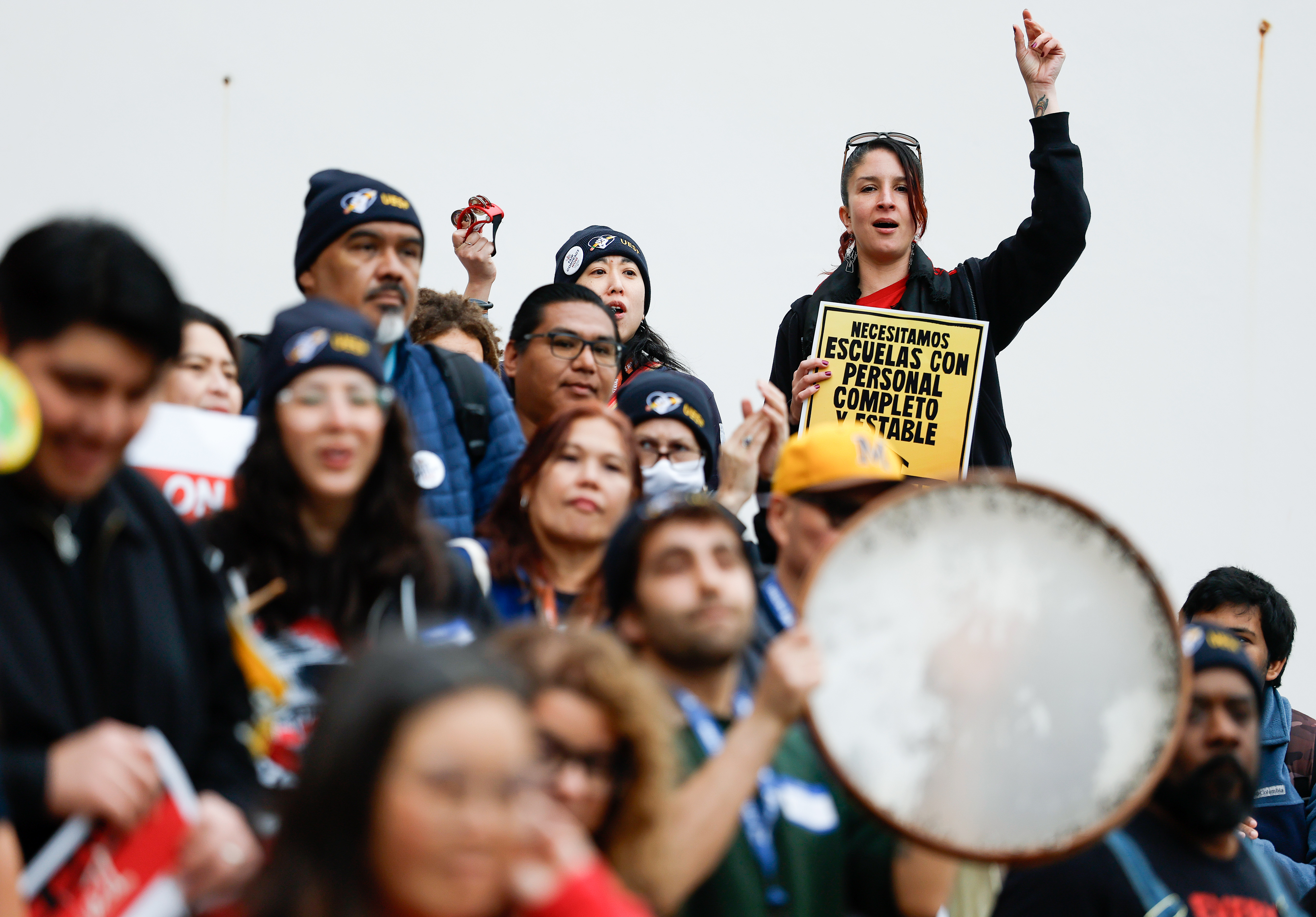

The San Francisco teachers union on Feb. 13 announced a tentative agreement with the district that provides higher wages, full health care coverage, and protections for illegal immigrants.
“We won fully funded family health care, support for special education, equitable classified and certified raises, and sanctuary and housing,” the United Educators of San Francisco announced on its website and social media early on Feb. 13.
More specific terms of the agreement have not been announced yet.
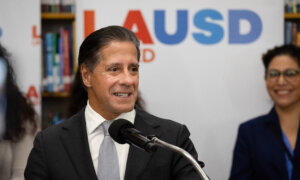
Maria Su, district superintendent, announced that schools will reopen on Feb. 18, following the Presidents Day and Lunar New Year holidays.
“I am so proud of the resilience and strength of our community,” she said in an announcement posted on the district website.
“This is a new beginning, and I want to celebrate our diverse community of educators, administrators, parents, and students as we come together and heal.”
The strike began on Feb. 9.
About 50,000 students across 120 schools got an unexpected week off from class as the union rejected the district’s counteroffer from earlier negotiations.
Administrators maintained that the district could not afford the proposed wage increases, and the state, which previously took over the district because of financial problems, would not accept the proposed contract anyway.
The union’s previous contract, which expired last year, is available on the National Council on Teacher Quality website. It covered about 6,500 employees, including teachers, classroom aides, and security guards.
Wages under that agreement varied by job title, experience, and education levels.
The highest-paid certified teachers, who had more than 25 years of experience and two years of post-undergraduate education, were paid at least $131,653 in 2025, while the starting base salary for new certified teachers with less than two semesters of graduate-level courses was $79,467.
Paraprofessionals (classroom aides) started at about $31 per hour.
The union requested a 9 percent raise for teachers over two years, according to the district, which countered with 3 percent annual increases.
A copy of the proposed contract published by The 74, a nonprofit education publication, shows a 14 percent requested hourly wage hike for paraprofessionals and full health care coverage for all union members and their dependents, meaning that the district and its taxpayers would cover monthly premiums.
Members said a 6 percent pay hike over two years, and the current cost of health care insurance, is not enough to keep up with the high cost of living in the Bay Area.
“The district will see further destabilizing of staffing if they do not prioritize this issue,” Angela Su, a union member involved in the negotiations, wrote in a Feb. 4 response to the district.
The union demanded that immigrant “newcomer families and students” be provided access to housing, health, employment, food, and legal services.
It wanted the district to deem all facilities sanctuary schools and provide training to all union members on “sanctuary policies” such as interacting with law enforcement.
In response to that proposal, administrators said sanctuary for illegal immigrants is not a mandatory subject of bargaining and would “expose the district to significant liability.”
The union also called for the district not to use artificial intelligence to eliminate, reduce, or replace work performed by faculty and staff.
The district maintained that it was considering that request along with a proposal to study the impact AI could have on school labor.
Under the union’s proposal, the 184-day work year and 35-hour work week are maintained.
The past contract also provided union members with 10 days of sick leave per academic year, plus seven days of paid leave for personal, legal, business, religious, household, family, or other matters.
Aaron Withe, CEO of the Freedom Foundation conservative policy center and its Teacher Freedom Alliance program, which helps teachers opt out of union membership, said the strike should not be celebrated, especially since the schools are relied on to provide meals and medical services to students.
“The union claims it’s fighting for students, but when a mother has to beg for three days to get her son’s medication because no one will cross a picket line, the priorities are obvious,” he said in an email.
“This is what happens when unions have monopoly power, zero accountability, and no incentive to put kids first.”
Defending Education, a national parents organization that opposes progressive ideologies and sanctuary policies in schools, was also critical of the strike.
Erika Sanzi, the organization’s communications director, called union members “bad actors.”
“This union, and others like it, are harming students,” she said in an email response to The Epoch Times. “They are a far-left organization that works tirelessly to find ways to keep kids out of school. And when school is open, their top priority is turning staff and students into foot soldiers for causes that have nothing to do with literacy or numeracy.”
The United Educators of San Francisco did not respond to a request for comment.