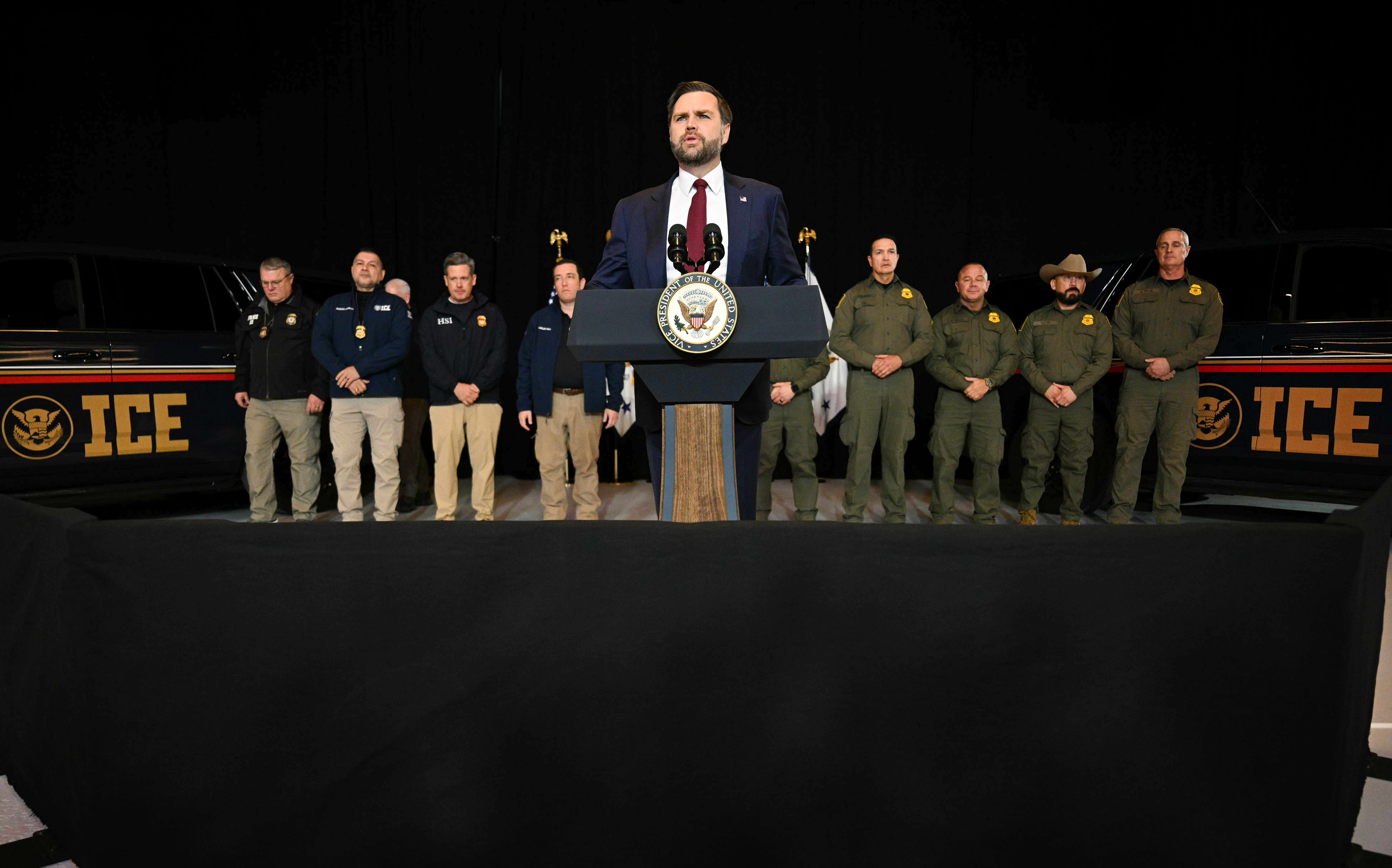


MINNEAPOLIS—Vice President JD Vance told reporters Jan. 22 that he met with law enforcement, community members, and business leaders in Minneapolis in hopes of “lowering the temperature” on the frequent clashes between protesters and federal immigration agents.
That meeting was closed to the media, but Vance said people who oppose the current wave of immigration enforcement were invited to air their opinions, too.
As the vice president stood in front of Border Patrol agents and Immigration and Customs Enforcement (ICE) officers and vehicles, he told reporters that much “chaos” could be avoided if only local police and officials would give “a little cooperation.”
While ICE has been met with resistance in some other Democrat-led cities, Vance said the reaction in Minneapolis has been extreme. Agents have been met with protesters using their bodies and vehicles to attempt to block them from making arrests; one such encounter earlier this month ended with an ICE officer fatally shooting a protester.
“Pretty much every jurisdiction where these guys are operating, you don’t see the same level of chaos, you don’t see the same level of violence, you don’t see the problems that we’re seeing in Minneapolis,” Vance said. “Maybe the problem is unique to Minneapolis, and we believe that it is—and it’s a lack of cooperation between state and local law enforcement and federal law enforcement.”
Vance also addressed an internal memo published by The Associated Press that revealed that ICE officers were being told they could forcibly enter people’s homes based on a warrant from a federal administration official or an administrative law judge, rather than from a federal judge.
In response to a reporter’s question about the use of warrants, Vance, who is an attorney, said The Associated Press story is “missing a whole lot of context.”
Typically, warrants that are issued via the administrative route would need to be served in public places, according to Whistleblower Aid, an advocacy group that obtained the memo. Administrative law judges and immigration judges are considered part of the government’s executive branch. Thus, they are not considered as neutral as a federal judge would be.
In some instances, such as if a gunman were to fire at officers from inside a home, “they don’t need a warrant to go inside that person’s house,” Vance said. This is among the “very narrow exceptions to the warrant requirement” that must be met for officers to legally enter a person’s home.
However, Vance said ICE has proposed that the Department of Justice use administrative warrants to enforce administrative immigration law.
“It’s possible, I guess, that the courts will say no. And, of course, if the courts say no, we would follow that law,” he said. “But nobody is talking about doing immigration enforcement without a warrant.”
Use of warrants from administrative law judges is “consistent with the practice of American law,” Vance said, adding, “I’m sure the courts will weigh in on that, but we’re never going to enter somebody’s house ... without some kind of a warrant unless, of course, somebody’s firing on an officer or they have to do something in order to protect themselves.”
The roundtable discussion and Vance’s remarks were held at Royalston Square, a former industrial building that is being repurposed into an entertainment and event center, in the city’s North Loop neighborhood.
The building is about six miles away from the site where a federal agent fatally shot protester Renee Good on Jan. 7. Officials assert that the officer acted in self-defense and suffered injuries during the encounter with Good and her moving vehicle. The shooting sparked intensified protests against federal agents.
The vice president said that as ICE agents attempt to enforce immigration law, they are arresting criminal aliens, including sex offenders. Without cooperation from local officials, additional officers are needed to fan out across a wider territory to root out the criminals they’re seeking, he said.
Vance added that based on conversations during the roundtable, he learned that cooperation from local officials and police would be “the best way to facilitate reasonable enforcement of the law, but also to lower the chaos in Minneapolis.”
Besides meeting with organized resistance from protesters, ICE agents have faced opposition from Minnesota Gov. Tim Walz and Minneapolis Mayor Jacob Frey. The city and state are so-called “sanctuary” communities with policies intended to shield illegal immigrants.
On Jan. 20, the Department of Justice issued subpoenas to top officials in Minnesota, including Frey.
The Trump administration recently subpoenaed both of those officials over allegations that they illegally interfered with federal officers by encouraging protesters to impede ICE. The state of Minnesota and the Twin Cities—Minneapolis and St. Paul—are suing the federal government, alleging that ICE enforcement tactics violate people’s constitutional rights and must be discontinued.
As of Jan. 19, ICE has arrested 10,000 people, many of whom were “killing Americans, hurting children, and reigning terror in Minneapolis,” according to Secretary of Homeland Security Kristi Noem.
The Department of Homeland Security said in a Jan. 21 post on X that Border Patrol agents in the Minneapolis–St. Paul area were “repeatedly harassed” and blocked by protesters while trying to take bathroom breaks.
According to the agency, officers were blocked at each gas station where they attempted to use the facilities; they were yelled at, stalked, spat upon, blocked from exiting their vehicles, and physically attacked.
The current immigration-enforcement wave operation began along with Trump administration investigations into immigration and government-program fraud focused largely on the area’s Somali population.