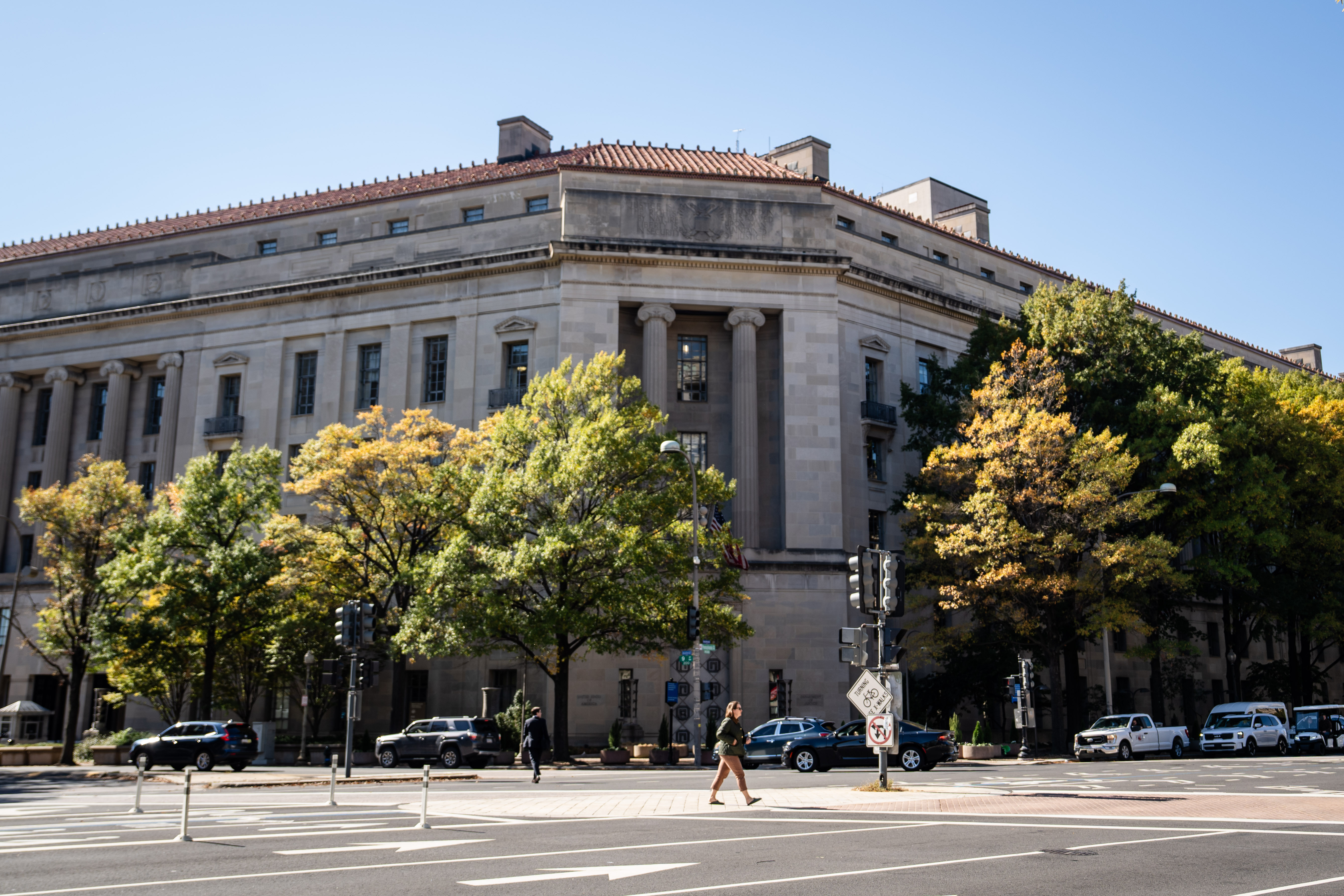

The U.S. Department of Justice (DOJ) is suing 18 states that refused to hand over voter registration information following a series of requests made earlier this year.
The DOJ said it wants to inspect voter rolls to make sure they are clean and up-to-date, while some states said they are worried the government has ulterior motives in requesting the information.
On Dec. 12, the department added Fulton County, Georgia, to that list; there, the government is asking for records related to the 2020 election.
Here’s what to know about the lawsuits.
The Requests
The DOJ’s inquiry began in May with a letter to Colorado Secretary of State Jena Griswold asking for voter information and certification that the state had not destroyed any records it was legally obligated to retain.
The letter said the DOJ wanted to ensure that Colorado was in compliance with the Voting Rights Act 52 U.S.C. 20701, which requires states to retain election information, including voter registrations, for 22 months following presidential and congressional races.
Similar requests went out to at least 40 states, but Maria Benson, spokeswoman for the National Association of Secretaries of State, said the DOJ told her “all states would be contacted eventually.”
The requests were sent out following President Donald Trump’s executive order asking the DOJ to verify that states were checking citizenship status for those who registered to vote, in compliance with the National Voter Registration Act.
A few states, like Minnesota, are exempt from the National Voter Registration Act. In those cases, the DOJ cited the Help America Vote Act, which requires similar preservation of voter records, and requires each state to maintain a single, computerized database of its registered voters.
Notably, the DOJ’s request to Minnesota also asked for other information, such as how the state struck deceased voters from its rolls, and how it dealt with duplicate registrations. It also asked the state to explain its procedures for identifying non-citizen voters.
In Nebraska, the DOJ asked for full voter registration data, including “full name, date of birth, residential address, his or her state driver’s license number or the last four digits of the registrant’s social security number.”
The Fulton County suit is different, in that it follows a July resolution passed by the State Election Board of Georgia “calling upon the assistance of the Attorney General to effect compliance with voting transparency.”
In October, the DOJ responded by requesting “all used and void ballots, stubs of all ballots, signature envelopes, and corresponding envelope digital files from the 2020 General Election in Fulton County.”
Fulton County officials rejected that request, saying the records “remain under seal” and will not be produced without a court order.
The Fulton request is notable, not just because it stems from internal state action, but because Trump narrowly lost Georgia in 2020 by fewer than 12,000 votes.
The Refusal
Only two states, Indiana and Wyoming, fully complied.
Some states, like Washington, responded by giving only part of the requested information, citing privacy concerns or legal prohibitions.
“While we will provide the DOJ with the voter registration data that state law already makes public, we will not compromise the privacy of Washington voters by turning over confidential information that both state and federal law prohibit us from disclosing,” Washington Secretary of State Steve Hobbs said in a statement.
Hobbs, in a letter to Assistant Attorney General Harmeet Dhillon, said Washington state law gave the federal government the right to some information, but not voters’ driver’s license and social security numbers.
Sens. Alex Padilla (D-Calif.) and Dick Durbin (D-Ill.) also issued a public letter to Attorney General Pam Bondi opposing the DOJ’s inspection, calling it a plan “to use sensitive state voter information to create a national voter database, without any direction from Congress or guardrails on how the information in the database will be used.”
“Put simply, it is neither the Department’s job nor its skillset to micromanage how election officials purge voters from state voter rolls,” the senators said.
Among other inquiries, their letter asks Bondi to clarify fully how the DOJ intends to use the information, and what protocols are in place to protect voter privacy.
The Lawsuits
The DOJ has sued 18 states, saying Title III of the Civil Rights Act of 1960 requires states to turn this information over to the attorney general upon request.
So far the Justice Department has sued California, Delaware, Maine, Maryland, Michigan, Minnesota, New Hampshire, New Mexico, New York, Oregon, Pennsylvania, Rhode Island, Vermont, Colorado, Hawaii, Massachusetts, Nevada, and Washington.
Many of these cases were delayed by the government shutdown and are still in the early stages of litigation. Oregon and Pennsylvania have filed motions to dismiss, but most other states have asked courts for extra time to respond to the suit.
Nebraska resident Dawn Essink, backed by voter advocacy group Common Cause, has sued State Secretary Robert Evnen, hoping to stop the information disclosure.
“Under current [Nebraska] law, local and state election officials are prohibited from disclosing a voter’s birth date, driver’s license information, or social security number,” their complaint reads.
A similar lawsuit was filed in South Carolina, and a judge temporarily blocked the state from releasing the records to the DOJ. That block was later overturned by the state Supreme Court.