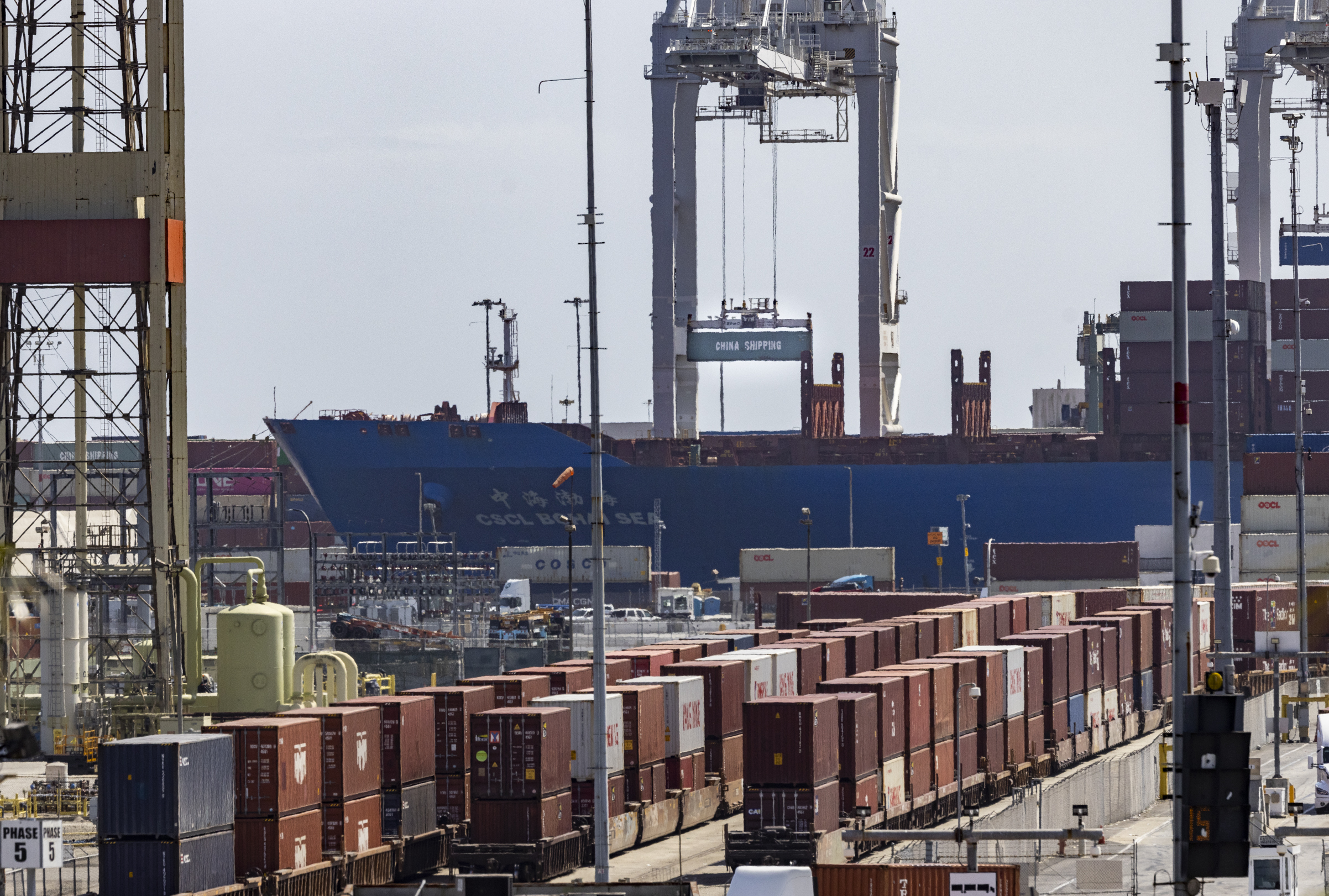

The U.S. trade deficit widened in February after imports rebounded, slightly offsetting continued export growth, according to new data from the Bureau of Economic Analysis released on April 2.
The international trade in goods and services deficit rose by nearly 5 percent, totaling $57.3 billion.
Economists had forecast a $59.2 billion shortfall.
In the first two months, the goods and services trade gap declined by nearly 55 percent, or $136.1 billion, from the same period a year ago.
Exports have increased by more than 11 percent, while imports have fallen by more than 9 percent.
The latest data were released exactly one year after President Donald Trump unveiled his sweeping global tariffs on foreign goods entering the United States. They were struck down by the Supreme Court in February, but the president introduced a universal 10 percent tariff shortly afterward for 150 days.
Although exports continue to remain strong, imports staged a comeback.
February’s imports jumped by 4.3 percent—or $15.2 billion—to $372.1 billion. The increase is likely linked to the buildout of the artificial intelligence infrastructure.
Imports were fueled by a $7.8 billion increase in capital goods, primarily computers and semiconductors. The bureau also reported a $3.1 billion boost in industrial supplies and materials and a $2.2 billion surge in consumer goods.
Exports, meanwhile, climbed by 4.2 percent—or $12.6 billion—to an all-time high of $314.8 billion. Shipments of $10.2 billion in industrial supplies and materials fueled the increase.
“February’s trade data point to solid underlying domestic demand amid heavy investment in AI‑related equipment, but that strength is pulling in imports fast enough to widen the trade gap,” Priscilla Thiagamoorthy, senior economist at BMO Economics, said in an April 2 note.
“In real terms, we are expecting net exports to subtract from [first-quarter gross domestic product] growth as firms continue to source key tech inputs from overseas.”
The first-quarter gross domestic product growth rate is projected to be 1.9 percent, according to the Federal Reserve Bank of Atlanta. Net exports are expected to trim about 0.2 percent from the final reading.
The U.S. economy expanded by just 0.7 percent in the fourth quarter because of the record-breaking government shutdown.
Trade Relations
America’s trade balance with major trading partners improved.
The U.S.–China monthly trade deficit declined by $1.7 billion to nearly $11.01 billion.
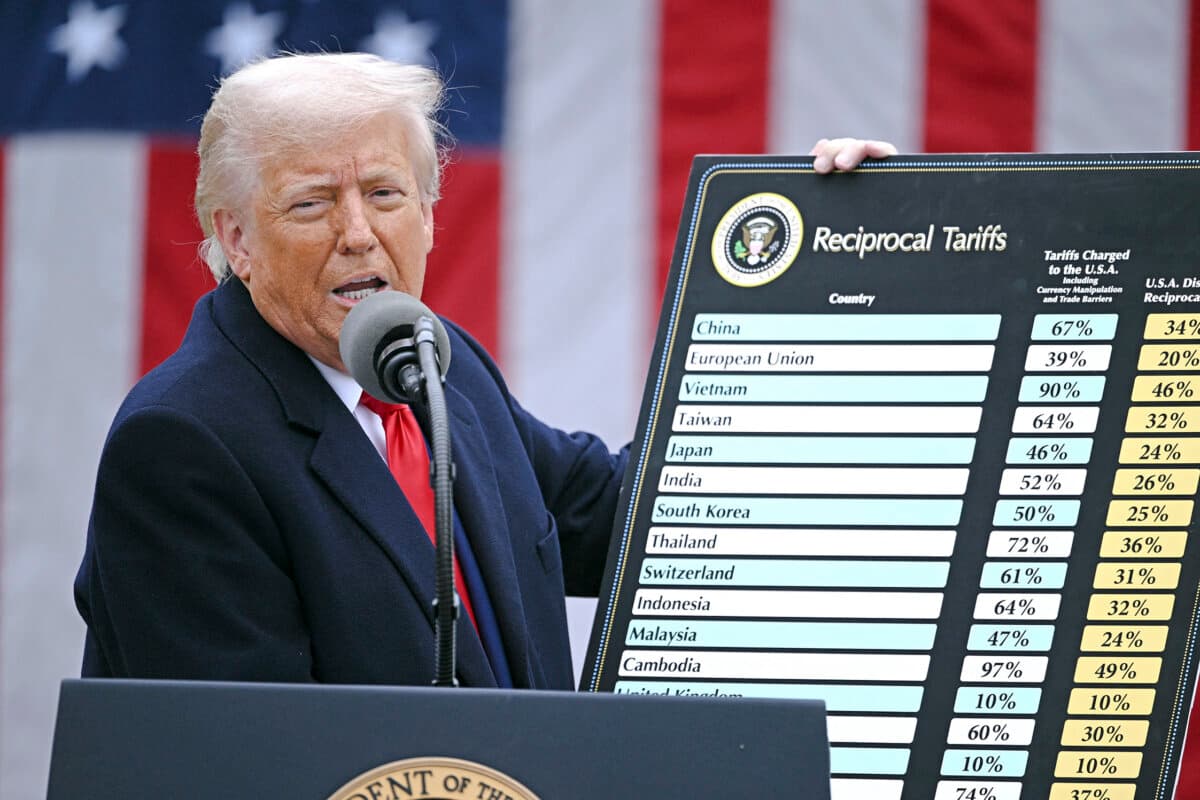
President Donald Trump holds a chart as he delivers remarks on reciprocal tariffs at the White House on April 2, 2025. (Brendan Smialowski/AFP via Getty Images)
Trump will be meeting with Chinese leader Xi Jinping in Beijing on May 14 and May 15, the White House confirmed last month. Later this year, the president and First Lady Melania Trump will host Xi and Madame Peng Liyuan for a “reciprocal visit” in Washington.
“I look very much forward to spending time with President Xi in what will be, I am sure, a Monumental Event,” Trump said in a March 25 Truth Social post.
The trade shortfall with the European Union also fell by $3 billion to $1.68 billion.
European lawmakers conditionally advanced legislation implementing the trade agreement with the United States, although several provisions remain.
One feature includes a suspension clause if the United States backtracks. Another is a requirement that the United States remove the 50 percent duty on steel and aluminum.
Under the current terms, the U.S. tariff rate on most EU imports will be 15 percent.
The surplus with Switzerland surged by $4.8 billion to $7.8 billion.
The two countries have engaged in tense trade negotiations over the past several months.
Despite Bern reaching a preliminary accord to lower U.S. tariff rates to 15 percent, Swiss officials continue to meet with the White House. Talks are expected to linger this year after the United States launched new investigations into major trading partners, including Switzerland.
The gap with Canada plunged to $801 million, from $3.86 billion in January. But the U.S.–Mexico trade deficit widened by nearly $5 billion to $15.4 billion.
This summer, the three North American countries will conduct a joint review of the U.S.–Mexico–Canada Agreement.
In an interview with Fox Business last month, U.S. Trade Representative Jamieson Greer stated that Canada had lagged behind in trade talks.
“We’re having talks separately with Canada, but we’ve moved along with Mexico,“ Greer stated. ”Canada is behind on this with Mexico.”
Emel Akan and Catherine Yang contributed to this report.