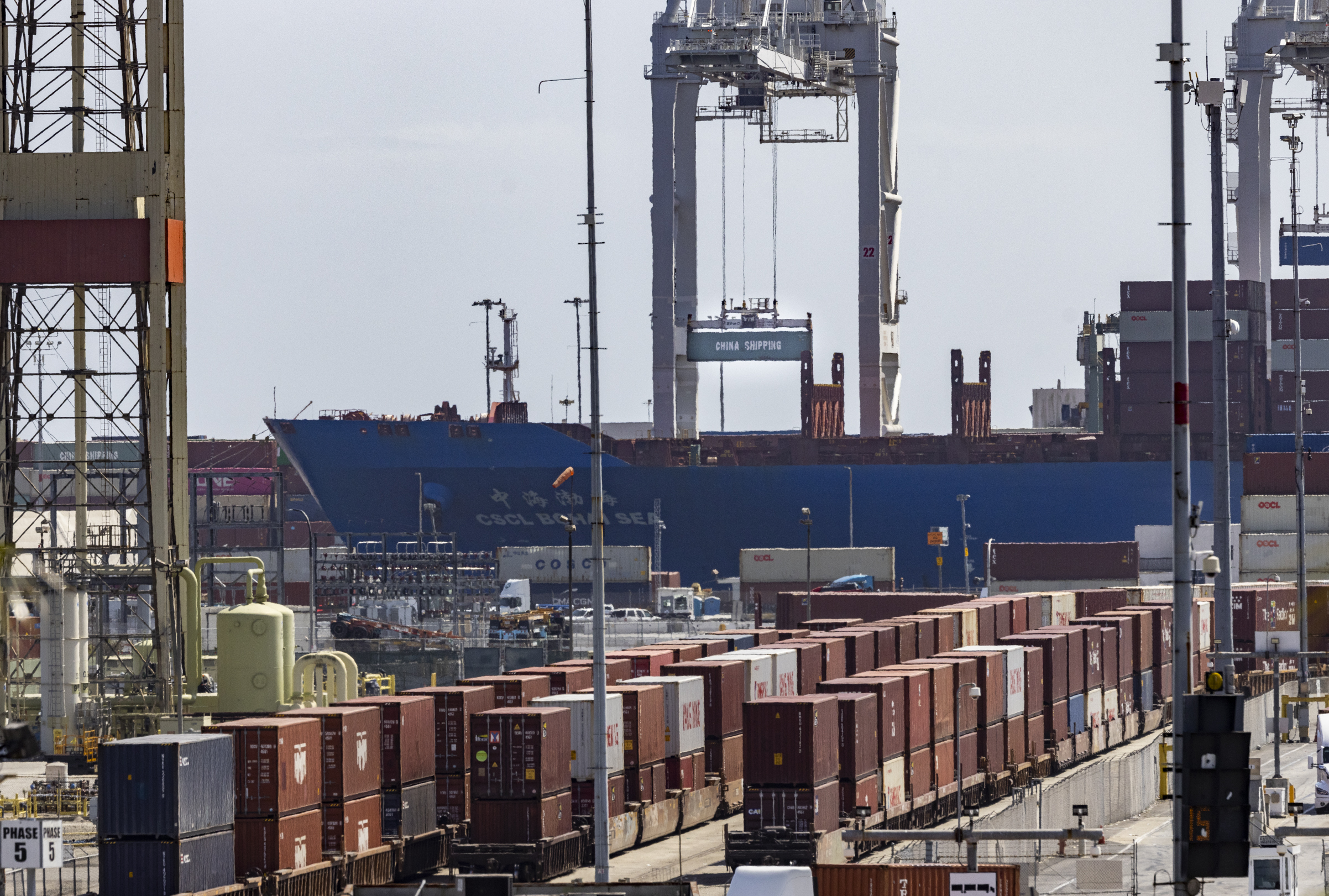

President Donald Trump’s tariffs helped shrink the U.S. trade deficit to its lowest monthly level in more than five years, according to new data released by the Bureau of Economic Analysis on Dec. 11.
The U.S. goods and services trade deficit narrowed by 10.9 percent in September to $52.8 billion—the lowest monthly deficit since June 2020—down from $59.3 billion registered in August.
Economists polled by Reuters had forecast a September trade deficit of $63.3 billion.
Year-to-date, the trade deficit increased by $112.6 billion, or 17.2 percent, as imports and exports rose by 7.7 percent and 5.2 percent, respectively.
Exports increased in September by 3 percent to $289.3 billion—the second-highest level on record—driven by shipments of nonmonetary gold and pharmaceutical preparations.
Imports ticked up by 0.6 percent to $342.1 billion.
Government data revealed a sizable jump in pharmaceutical imports, surging by $3.1 billion. Inflows of capital equipment, autos, and a broad range of consumer goods, including cellphones, appliances, toys, and furniture, continued to weaken.
The real (inflation-adjusted) merchandise trade deficit also fell by 5.6 percent, or $4.7 billion, to $79 billion in September.
This year’s trade activity has been marked by enormous volatility, fueled by the current administration’s tariff agenda, which has also affected gross domestic product (GDP).
Trade plays a role in economic growth prospects because exports add to GDP growth and imports subtract from it.
Record-high imports in the first quarter, for example, trimmed 4.68 percentage points from GDP, leading to a 0.3 percent contraction.
Looking at third-quarter data, the Federal Reserve Bank of Atlanta estimates that net exports will add 0.86 percent to the final GDP reading, which is expected to come in at 3.5 percent.
The U.S. economy is expected to grow by about 1.7 percent in the fourth quarter, according to the New York Fed Staff Nowcast.
Trump’s tariffs helped narrow the trade gap with other major U.S. trading partners, including China and India.
The goods deficit with China tumbled by $4 billion to $11.4 billion in September. Exports climbed by 0.2 percent to $8.8 billion, while imports fell by $3.9 billion to $20.1 billion.
The United States’ merchandise deficit with India also narrowed by about $1.8 billion to $3.05 billion.
U.S. and Indian delegations have been engaged in negotiations to iron out a bilateral trade agreement.
Appearing before a Senate Appropriations Committee hearing this week, U.S. Trade Representative Jamieson Greer said New Delhi has been a “very difficult nut to crack.”
“But they’ve been very forward-leaning,” Greer said. “The type of offers they’ve been talking to us about have been the best we’ve ever received as a country.”
Conversely, the goods deficit with Ireland increased by $15.3 billion to $18.2 billion. The trade deficits with Mexico and the European Union widened to $17.84 billion and $17.83 billion, respectively.
Tariffs
The White House has been betting on tariffs to reshore domestic manufacturing and close the trade gap with the rest of the world.
“I have been very consistent on this, that tariffs are a shrinking ice cube,” Treasury Secretary Scott Bessent said at the 2025 DealBook Summit on Dec. 3. “The ultimate goal is to rebalance trade and to bring back domestic production.”
U.S. officials are also aiming to generate substantial federal revenues that they say could be used to pay down the debt, offer rebate checks, or potentially eliminate the income tax.
Fiscal year-to-date, the United States has collected almost $70 billion in tariff income, as of Dec. 10. Tariff revenues totaled $195 billion in fiscal year 2025.

Congressional Budget Office Director Phillip Swagel testifies before the Legislative Branch Subcommittee of the House Appropriations Committee in Washington on Feb. 12, 2020. (Sarah Silbiger/Getty Images)
Updated projections from the Congressional Budget Office suggest that enacted tariffs this year will generate $2.5 trillion of revenue, excluding dynamic effects. This is down from the August estimate of $3.3 trillion.
There is still uncertainty, Congressional Budget Office Director Phillip Swagel said.
“The United States has not implemented increases in tariffs of this size in many decades, so there is little empirical evidence to guide our estimates of their long-term effects,” Swagel said in a Nov. 20 report. “Consumers and businesses could be more or less responsive to increases in tariffs of this size, which would cause trade and revenues to diverge from projected amounts.”
The overall average effective tariff rate is 16.8 percent, the highest rate since 1935, according to The Budget Lab at Yale.