
Americans turned on their mobile devices and desktop computers and spent more than expected during the key five-day Thanksgiving weekend shopping period, new data from Adobe Analytics show.
Despite economic uncertainty and weaker sentiment, shoppers spent $14.25 billion on Cyber Monday, purchasing a wide range of items, from home furnishings to groceries. They also spent a record $11.8 billion online on Black Friday.
In total, spending increased 7.7 percent during Cyber Week—the five days from Thanksgiving to Cyber Monday—bringing the final tally to $44.2 billion.
Adobe Analytics had initially forecast that online spending would reach $43.7 billion for this period.
On a season-to-date basis (Nov. 1 to Dec. 1), U.S. consumers have spent $137.4 billion, representing a more than 7 percent year-over-year jump.
Shoppers took advantage of deep discounts heading into the Thanksgiving weekend, finding deals on apparel, electronics, and toys.
“U.S. retailers leaned heavily on discounts this holiday season to drive online demand. Competitive and persistent deals throughout Cyber Week pushed consumers to shop earlier, creating an environment where Black Friday now challenges the dominance of Cyber Monday,” Vivek Pandya, lead analyst at Adobe Digital Insights, said in a statement to The Epoch Times.
Mobile and artificial intelligence (AI) were some of this year’s Cyber Monday themes.
Almost 58 percent of online sales occurred on mobile devices. AI traffic to U.S. retail sites soared by 670 percent from the prior year.
“Shoppers have also become increasingly savvy in finding the best deals and locating the right products, embracing generative AI-powered chat services and browser tools for the second season in a row,” Pandya added.
More people also captured the Christmas spirit this year.
A record 202.9 million people participated in the five-day holiday weekend shopping experience, according to the National Retail Federation. This topped the group’s estimates and rose from last year’s 197 million.
‘People Are Still Spending’
Overall, the latest figures suggest that while the consumer sentiment is deteriorating, “people are still spending,” says Ted Rossman, senior industry analyst at Bankrate.
“Some of that is because they have to (because items cost more), but it’s also because they want to,” Rossman said in a statement to The Epoch Times.
“Tariffs haven’t affected holiday prices nearly as much as many feared. If there’s going to be a consumer spending pullback, it’s probably going to wait until 2026.”
The final November University of Michigan Consumer Sentiment Index declined to the lowest level since June 2022.
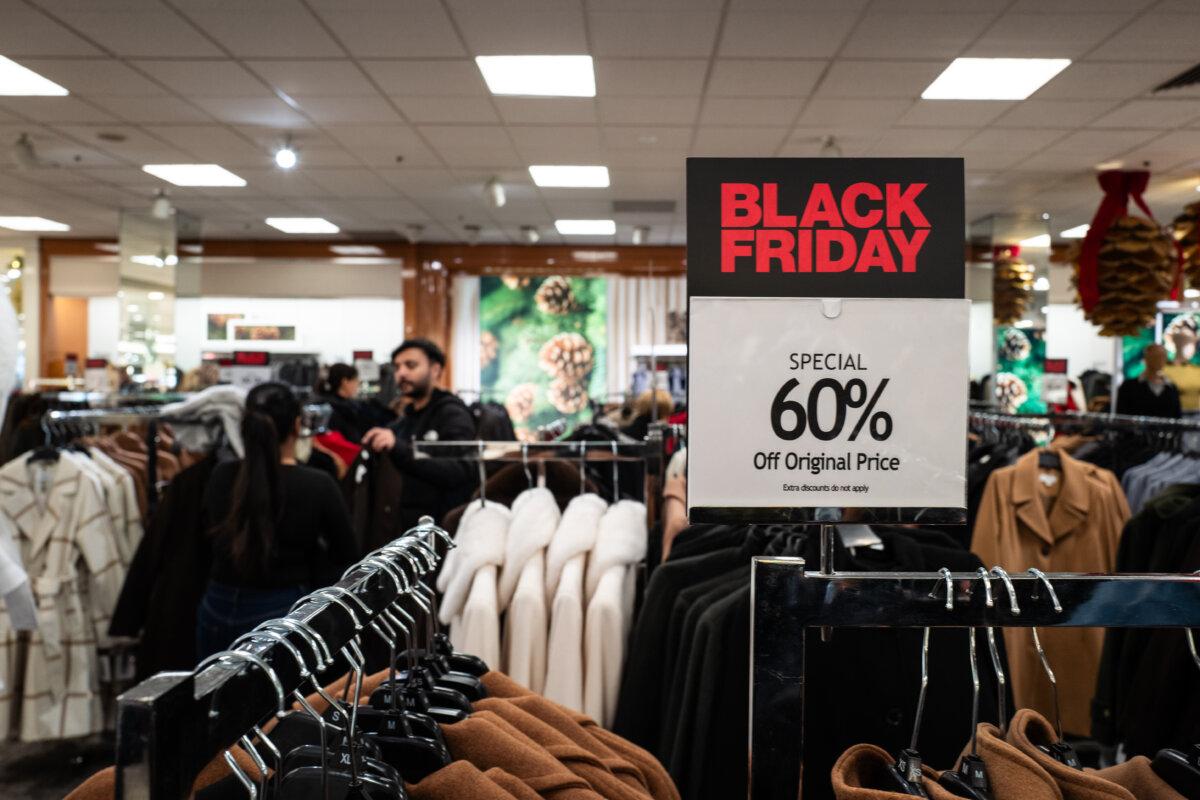
Shoppers on Black Friday at a mall in Bethesda, Md., on Nov. 28, 2025. (Madalina Kilroy/The Epoch Times)
Part of the reason for the lack of significant tariff-driven inflation is that companies rushed to purchase foreign products ahead of President Donald Trump’s global tariffs. As a result, price pressures have not intensified as many had feared.
The annual inflation rate reached 3 percent in September, the highest level since the start of the year, according to the Bureau of Labor Statistics.
But Federal Reserve Governor Christopher Waller believes the 12-month inflation rate excluding tariffs is running between 2.4 percent and 2.5 percent.
“The underlying trend remains more favorable than the headline numbers might suggest,” Waller told Fox Business last month.
The Federal Reserve’s latest Beige Book report—a summary of economic conditions across the central bank’s 12 districts—suggested that while businesses expect upward cost pressures moving forward, plans to raise prices in the near term were mixed.
“The extent of passthrough of higher input costs to customers varied, and depended upon demand, competitive pressures, price sensitivity of consumers, and pushback from clients. There were multiple reports of margin compression or firms facing financial strain stemming from tariffs,” the report stated.
Still, it remains to be seen whether people’s consternation about the economy will prevent them from opening their wallets further as they approach Christmas Day.
The average American plans to spend $990 on holiday-related purchases this year, down nearly 7 percent from last year, according to The Conference Board Holiday Spending Survey, released last month.