
The United States voiced support for the Philippines after Manila reported that a water cannon attack by the China Coast Guard injured three Filipino fishermen and damaged their two boats in the South China Sea.
In a Dec. 14 statement, U.S. State Department spokesperson Tommy Pigott said the United States condemned China’s “water cannoning and cutting of anchor lines of Filipino fishers close to Sabina Shoal in the South China Sea.”
“These aggressive actions endangered Filipinos fishing for their livelihoods,” Pigott said. “We stand with our Philippine allies as they confront China’s provocative actions and increasingly dangerous tactics against its neighbors, which undermine regional stability.”
The Philippines said on Dec. 13 that China’s coast guard vessels and maritime militia ships deployed water cannons and carried out “dangerous blocking maneuvers” against Philippine fishing boats off a disputed South China Sea shoal.
According to Manila’s coast guard, the confrontation took place on Dec. 12, when about 20 Philippine fishing boats were operating in the waters near Sabina Shoal, an uninhabited and disputed feature known as Escoda in Manila and Xianbin in Beijing.
A small Chinese coast guard ship “deliberately cut the anchor lines” of several Philippine fishing boats, putting the vessels and their crews at risk “amid strong currents and high waves,” Philippine Coast Guard spokesperson Jay Tarriela said in a statement posted on X.
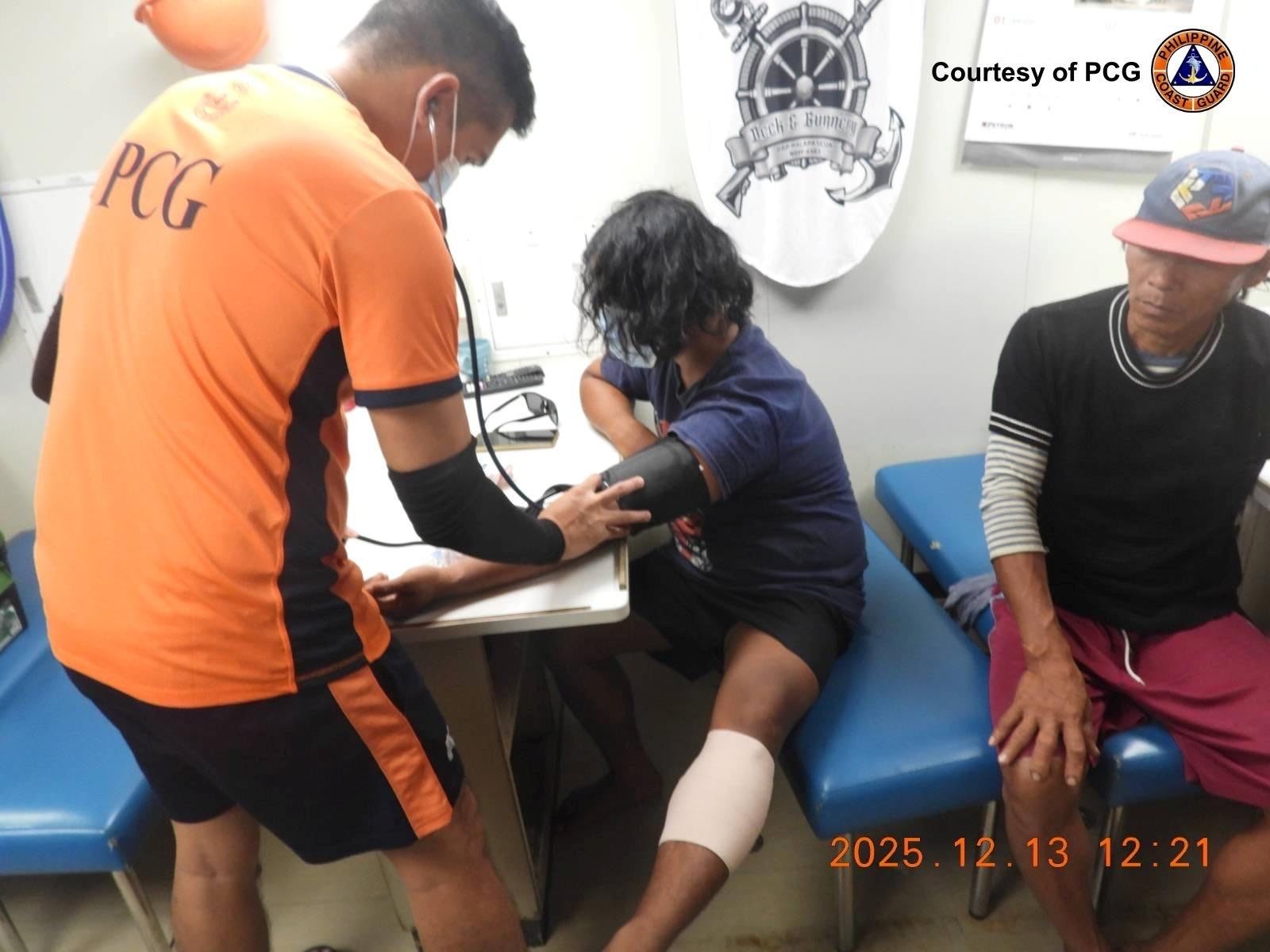
As a result, three Filipino fishermen sustained injuries, and two fishing vessels suffered “significant damage from high-pressure water cannon blasts,” Tarriela said.
Sabina Shoal lies about 75 nautical miles from the Philippines and 600 nautical miles from China. The Philippines asserts that the shoal is within its 200 nautical mile exclusive economic zone, as recognized by international law.
The Chinese regime claims almost the entire South China Sea, including the areas near Sabina Shoal, as its own. A 2016 ruling by an international arbitration court determined that Beijing’s assertion was inconsistent with the U.N. Convention on the Law of the Sea, but the regime refused to recognize the decision.
China’s coast guard has acknowledged the encounter with the Philippine vessels, but it accused Manila of provocation.
Multiple Philippine vessels “deliberately intruded” into waters near Xianbin Reef despite China’s repeated warnings, regime coast guard spokesperson Liu Dejun said in a Dec. 12 statement. The Chinese side took “necessary control measures in accordance with the law and relevant rules,” including issuing verbal warnings and driving them away, Liu stated.
In a separate statement on Dec. 12, the Chinese military said it had warned and “expelled” several small Philippine aircraft flying over Scarborough Shoal, another contested area in the South China Sea. No specific date of the incident was provided.
U.S. War Secretary Pete Hegseth has denounced the Chinese regime’s increasingly “destabilizing” actions in the South China Sea. Speaking to his counterparts from the Association of Southeast Asian Nations (ASEAN) on Nov. 1, Hegseth said China’s provocative actions, such as using its vessels to ram other ships and firing water cannons, threaten the sovereignty of its neighbors and undermine regional stability.
The Pentagon chief urged Southeast Asian nations to work with the United States to jointly respond to threats posed by the Chinese regime.
“We need to develop our joint capabilities to respond, and this includes being able to monitor maritime conduct and develop the tools that allow us to respond quickly ... ensuring that whoever is on the receiving end of aggression and provocation is then, therefore, by definition, not alone,” Hegseth told ASEAN defense ministers in Malaysia.
“No one can innovate and scale like the United States of America, and we’re eager to share those capabilities with allies and partners.”
Frank Fang contributed to this report.