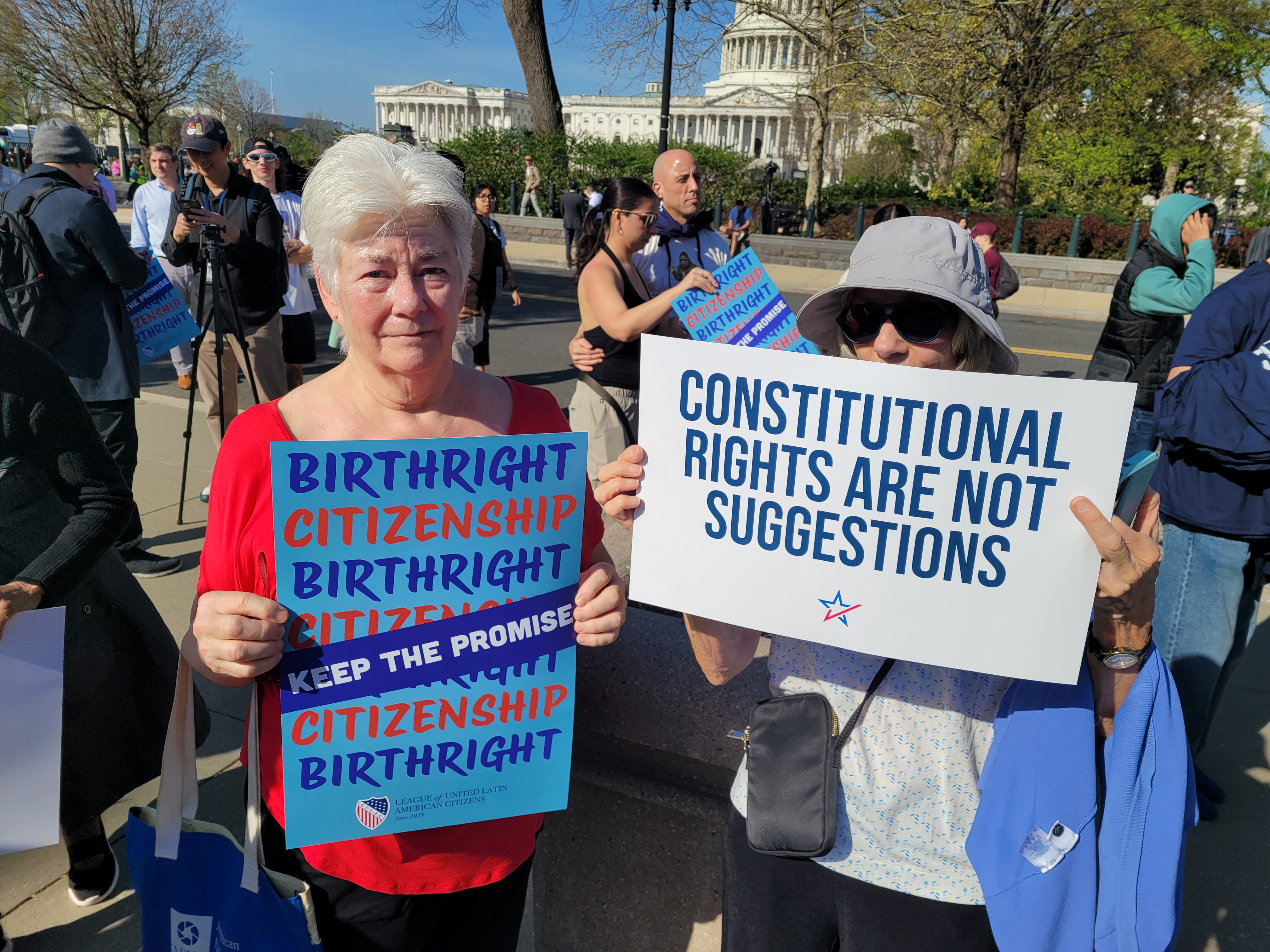

The Supreme Court heard arguments earlier this month over President Donald Trump’s order restricting birthright citizenship, teeing up a decision that could have far-reaching economic implications.
Trump issued an executive order last year to bar the U.S.-born children of illegal immigrants from automatically obtaining citizenship. The order also excluded children if their mothers had lawful temporary status but their fathers were not permanent residents or U.S. citizens.
The order was blocked by multiple federal judges and eventually reached the Supreme Court in the case of Trump v. Barbara.
The justices during oral argument on April 1 wrestled with how to apply the citizenship clause of the 14th Amendment, and their decision could affect state budgets and economies.
Proponents of granting citizenship to the U.S.-born children of illegal immigrants contend that these children will contribute to the economy and workforce. Opponents say that, to the contrary, they cost the federal government and states billions of dollars.
The January 2025 order would apply to newly born children if upheld by the high court.
The number of birthright citizens from illegal immigrant parents has been the subject of multiple estimates, but it is difficult to calculate. About 250,000 babies are born to illegal immigrant parents in the United States per year, based on a 2019 analysis conducted by the Pew Research Center.
Since then, multiple estimates have indicated increases in illegal immigration, creating the potential for more children born in illegal immigrant households.
Taxpayer Burden
During a 2024 House subcommittee hearing, one analyst estimated that more than half of all illegal immigrant households have at least one U.S.-born child.
Steven A. Camarota, director of research at the Center for Immigration Studies (CIS), testified at the 2024 hearing that illegal immigrants can receive welfare on behalf of their U.S.-born children.
He estimated that 59 percent of households headed by illegal immigrants use one or more major welfare programs, compared with 39 percent of households headed by native-born citizens.
Andrew R. Arthur, a fellow in law and policy at CIS, told The Epoch Times that the federal government would save billions of dollars that are currently being spent on U.S.-born children of illegal immigrants and their families if the Supreme Court agrees with Trump.
Those costs would have to be absorbed by the states that want to continue providing such benefits as housing and medical care, placing the burden on the taxpayers of those states, he said.
The Federation for American Immigration Reform (FAIR) issued a 2023 report estimating that the total fiscal burden of services to illegal immigration on U.S. taxpayers at the federal, state, and local levels exceeds $150 billion.
FAIR calculated this burden by subtracting an estimated $31 billion in total tax contributions made by illegal immigrants from $182 billion in government expenditures made on their behalf.
The report detailed specific examples: $1.6 billion for Medicaid births covered by illegal immigrant mothers, $5.3 billion for Medicaid for U.S.-born children with illegal immigrant parents, $1.4 billion for Temporary Assistance for Needy Families, and $900 million for educational programs such as Head Start.
States Criticize Trump’s Order
Critics of the president’s effort to limit birthright citizenship have said it would shift the costs to the states, create an underclass of citizens without a country, and cost the United States more over the long run.
Declarations filed in court by state officials indicated that Trump’s order would force them to choose between receiving and forgoing federal funding for certain social programs. Many said their states would still cover the children no longer considered citizens, but would need to do so without federal funding.
For example, Michigan’s Department of Health and Human Services would lose federal funding for mothers who are in the country unlawfully and their children, who are eligible for the state’s Maternity Outpatient Medical Services (MOMS) program.
In the 2024 fiscal year, 5,500 women were covered by the MOMS program for at least a portion of their pregnancy and postpartum services, and 1,907 babies were born to women covered by the program.
If the pregnant women covered through MOMS became ineligible because of a loss of citizenship for their unborn children, that would result in a loss of $13.2 million in federal reimbursements to Michigan.
Changes in legal status that would make them ineligible for Medicaid would result in a loss of some $11.6 million in federal reimbursements to Michigan.
California Attorney General Rob Bonta said last year that removing citizenship from babies born to illegal immigrants would effectively make them “stateless, lacking a home country to return to.”
Bonta said Trump’s order would jeopardize federally funded Medicaid and the Children’s Health Insurance Program in his state.
“These children would still require healthcare, education, and social services, forcing states to absorb the costs,” he said in a statement.
Economic Impact
Supporters of limiting birthright citizenship have said that it will reduce the appeal of illegal immigration.
“While the second Trump administration has effectively stopped illegal immigration at the southern border, removing the draw of birthright citizenship would help shift the incentives for illegal aliens already inside the country and make remaining in the country in violation of the law less advantageous,” Matt Crapo, director of litigation for FAIR, told The Epoch Times via email.
Arthur noted that illegal immigrants’ children can, at the age of 21, petition for their parents to receive green cards. Even if the parents have been in the country illegally for decades, the child’s legal status can stop the removal process.
“It’s a magnet that draws people to the United States,” he said.
He also said that foreign nationals are exploiting the U.S. immigration system through birth tourism.
Supporters of birthright citizenship argue that its long-term economic and social benefits outweigh the immediate costs.
The Center for Migration Studies of New York found in a 2026 report on birthright citizenship that U.S.-born babies of illegal immigrants are projected to contribute $7.7 trillion to the U.S. economy across a century. The study projected their numbers from 1975 to 2074, adjusted to 2024 dollars.
They are also projected to add 3.1 million workers to the economy. Future birthright citizen children could earn $1 trillion, according to the report.
Additionally, 2.1 million of those workers would work in occupations typically requiring some college education, a level of attainment that would have been highly improbable for these workers without U.S. citizenship.
The report contends that repealing birthright citizenship would significantly grow the population of those without legal status in the decades ahead, “creating an underclass excluded from social membership for generations.”
In an amicus brief filed with the high court, a group of 141 professors and academics argued that participation of this population in public programs ended up saving money.
The brief cites a general analysis of 20 years of data showing that access to public health insurance for children yields $4 in government savings for each $1 spent.
Some argued that ending birthright citizenship could create a chilling effect, discouraging illegal immigrants who have not returned to their countries of origin from accessing public food and medical safety net programs.