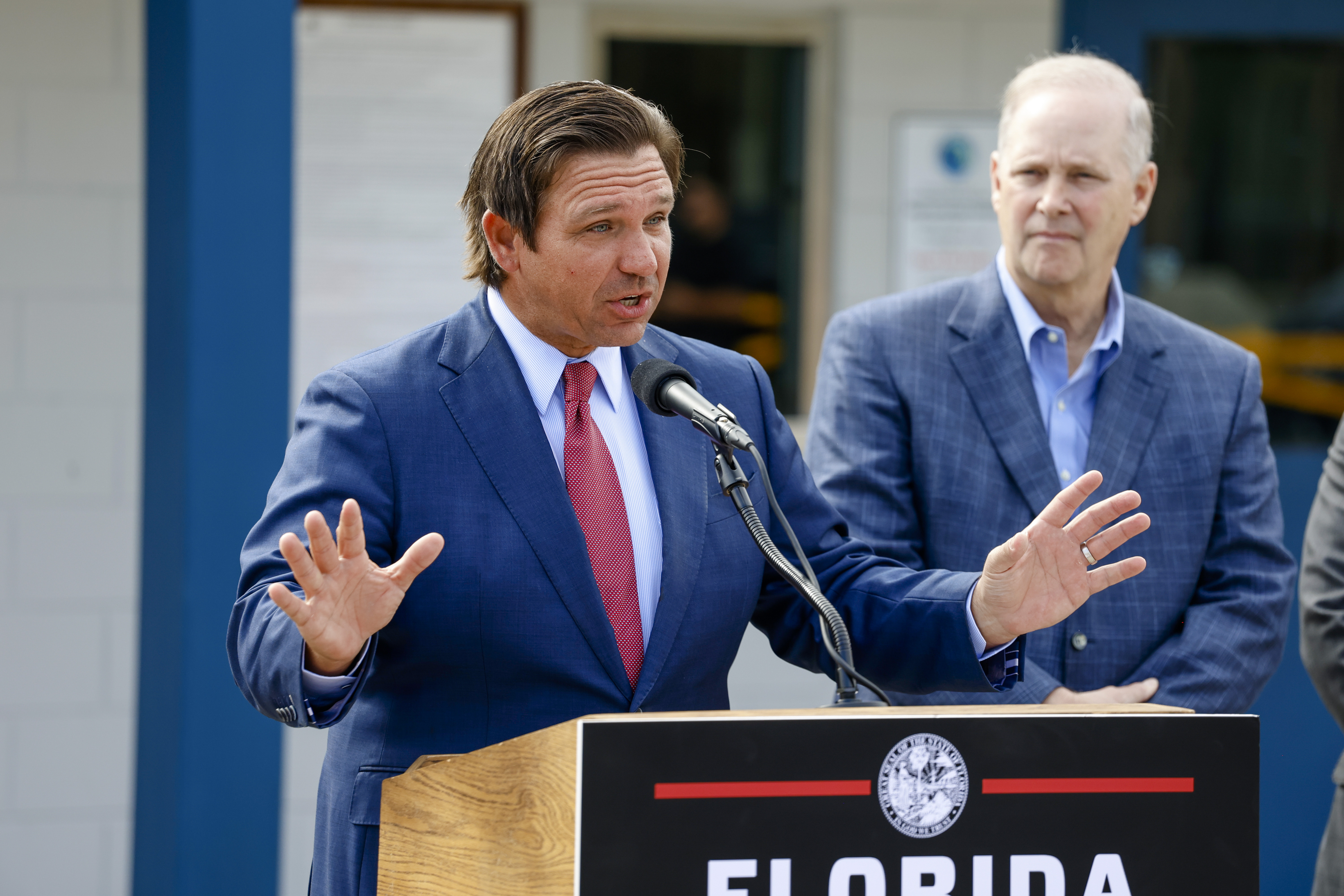
Nearly 20,000 immigration arrests were made in Florida in 2025, Gov. Ron DeSantis announced during a Jan. 5 press conference highlighting his state’s immigration enforcement standards.
Of that total number, 10,000 arrests were made as part of the Department of Homeland Security’s Operation Tidal Wave, and 7,674 were taken into custody by Florida’s highway patrol officers.
Those arrested included more than 6,300 people with criminal records, including violent and sexual offenses, as well as several hundred of the total 1,200 child predators arrested in the state that year.
It did not include any arrests made by federal agents or self-deportations, which authorities said reached about 1,000 people going through the state’s program alone.
DeSantis held the press conference at Deportation Depot outside Jacksonville, from which authorities said 93 deportation flights carried away 2,926 people in the few months the site was in operation last year.
Deportation Depot followed the establishment of the Alligator Alcatraz detention and deportation center deep in the Everglades.
DeSantis said that both facilities now had a federal immigration judge on site to expedite the deportation process.
He also announced that his administration was awaiting DHS approval to open a third detention and deportation center in North Florida that would be called the “Panhandle Pokey.”
The governor also suggested that a fourth site could open this year in South Florida, but he did not go into details.
DeSantis emphasized that the creation of every facility was meant as a temporary solution to support federal agents who have run out of space to keep illegal immigrants off the streets.
Although it is not clear how temporary they are, DeSantis expressed his hope that the federal government could expand its bed space and eliminate the need for any state intervention.
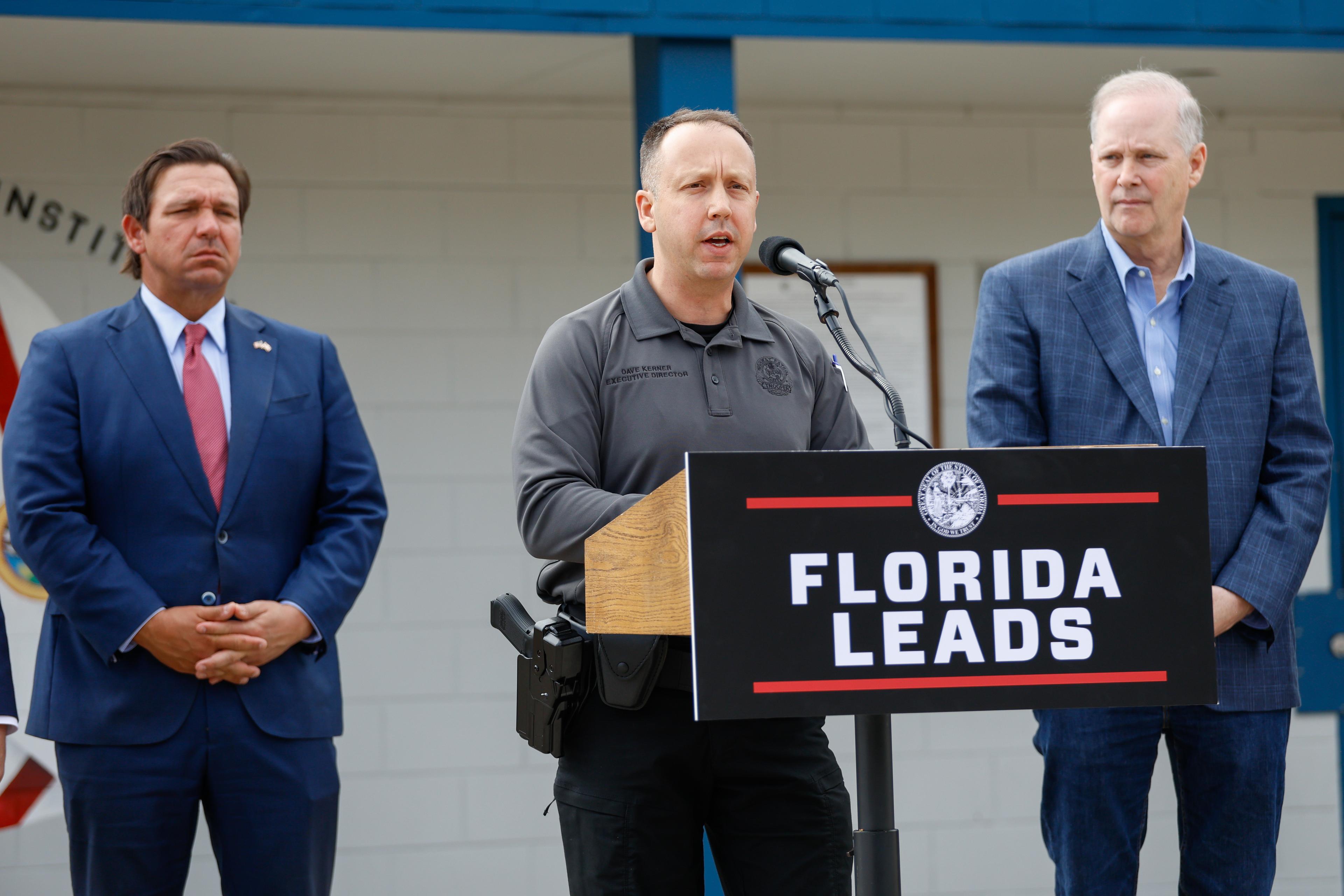
Dave Kerner (C), executive director of the Florida Department of Highway Safety and Motor Vehicles, describes the state's collaborative efforts with the federal government in immigration enforcement while speaking at a press conference at Deportation Depot in Sanderson, Fla., on Jan. 5, 2026. (Natasha Holt for The Epoch Times)
Florida Department of Law Enforcement Commissioner Mark Glass said his department and its partners in the Florida Department of Children and Families were continuing to work with the Trump administration to find the estimated hundreds of thousands of children who were brought into the country unaccompanied.
Florida Department of Agriculture and Consumer Services Commissioner Wilton Simpson announced the Department of Transportation was going to build another major highway checkpoint and close up what he called “a major hole” along the state’s northern border.
“We’re breaking up the fuel thefts,” he said. “We’re breaking up the stolen vehicles, the human trafficking, the illegals that we are catching, not only illegals, but the just bad folks ... making a big difference.”
Authorities pointed to Florida’s immigration legislation signed in February 2025, which required all state, county, and local agencies inside and outside of law enforcement to enter into 287(g) agreements and support the Department of Homeland Security’s nationwide crackdown on illegal immigration.
“Every state agency in Florida has made a 287 (g) Task Force arrest,” said Anthony Coker, State Board of Immigration Enforcement executive director.
“I think that it’s unprecedented, number one, but it also speaks to the leadership of our Cabinet and our governor really leading the way on immigration, and the state directors that are buying into it [have] been amazing.”
Coker said that state agency directors and county sheriffs have worked to build personal relationships with federal partners, and they continue to act on their own through self-initiated operations.
“The Florida blueprint of immigration enforcement has been widely recognized as being the gold standard of state-level immigration enforcement,” Coker said. “As we begin 2026, we’re excited for the opportunity to partner with other states and have them see as much success as we have.”
Many of these arrests came from engagements such as traffic stops by the Florida Highway Patrol.
“Is it easy? No,” said Dave Kerner, executive director of the Department of Highway Safety and Motor Vehicles.
“It’s not easy. Is it combative? It’s very combative. I can count at least 10 troopers who have been injured as a result of immigration enforcement operations, and seriously injured.
“But the point is, it can be done.”
The governor said that the enthusiasm for working with the federal government is not felt everywhere across the state, and he said that he is prepared to take action against anyone found “breaching duties.”