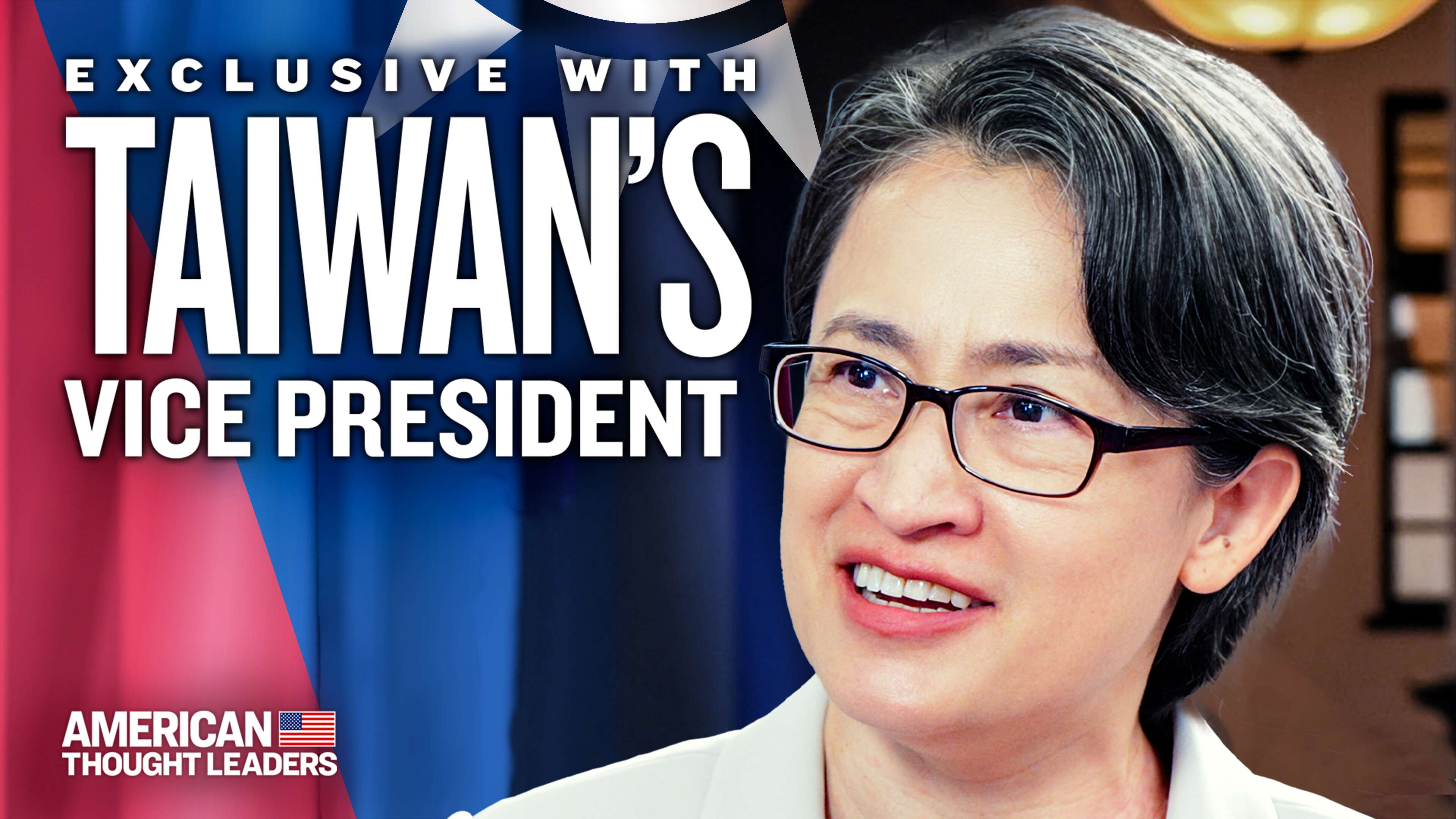

[RUSH TRANSCRIPT BELOW] “We will not let Communist Party of China define who we are,” said Taiwan’s Vice President Hsiao Bi-khim, who has been sanctioned by Beijing and labeled a “separatist.”
Despite Beijing’s ever-growing hostility toward Taiwan, she is not deterred.
In recent years, the Chinese Communist Party has escalated its “gray zone” operations, naval aggression, large-scale encirclement drills and missile tests, and aircraft incursions into Taiwan’s Air Defense Identification Zone. Chinese leader Xi Jinping has promised to seize Taiwan—including by force if necessary.
Beijing has also aggressively sought to isolate Taiwan internationally and peel away its allies. Only 11 countries and the Holy See still maintain official diplomatic relations with Taiwan as of 2026.
“China’s cognitive warfare, psychological warfare, political warfare, legal warfare, and very aggressive interventions in our domestic society and politics [have] become an increasingly serious problem,” Hsiao said.
Born to a Taiwanese father and an American mother, Hsiao previously served in Taiwan’s legislature and as the island’s top representative in Washington, where she became known for her “cat warrior diplomacy.”
Although Taiwan is only about the size of Maryland, it plays a pivotal role in the global economy, producing more than 90 percent of the world’s most advanced semiconductors—the chips that power artificial intelligence, smartphones, cars, and much of tomorrow’s technology.
It is also America’s fourth-largest trading partner, and nearly half of all global container ships—dwarfing even shipping traffic through the Strait of Hormuz—sail through the narrow Taiwan Strait, carrying trillions in trade.
“Everything we’re doing today in strengthening Taiwan is to prevent an invasion, to prevent that scenario from happening,” Hsiao said.
Recently, Taiwan’s National Security Bureau established a secure information-reporting channel for Chinese nationals to submit intelligence tips—a unprecedented move for Taiwan.
In this episode, I sat down with Hsiao in the presidential office of Taiwan to understand what’s really at stake here and how Taiwan is working to strengthen its whole-of-society resilience and deter a greater conflict.
Views expressed in this video are opinions of the host and the guest, and do not necessarily reflect the views of The Epoch Times.
RUSH TRANSCRIPT
Jan Jekielek:
Vice President Hsiao Bi-Khim, such a pleasure to have you on American Thought Leaders.
Vice President Hsiao Bi-Khim:
Welcome to Taiwan, and it’s a pleasure to talk with you.
Mr. Jekielek:
And it’s appropriate too, because your mother is American.
Vice President Hsiao:
Yes. My mother is a native of North Carolina, and growing up as both Taiwanese and with some American heritage, I always saw it as a lifetime duty or a mission to be bridging Taiwan and America. And I did not expect it, but I ended up as a diplomat, working also in this particular role in international relations. And so that’s been a very meaningful part of my journey.
Mr. Jekielek:
Absolutely. Well, as I was preparing to come here, something, to me at least, pretty astonishing happened. That was when your National Security Bureau published a website and a video encouraging Chinese whistleblowers to basically provide intelligence from China to Taiwan. This video really showcases, at least to me as I watched it, what can happen to anybody in China at any time, whatever their background. It’s just a stark reality. I thought, wow, this is fascinating. Of course, there are other intelligence agencies around the world that have been looking to try to gather intelligence in maybe slightly similar ways, but this strikes me as pretty unique. I just wanted to understand the thinking behind it.
Vice President Hsiao:
I generally don’t talk about our intel operations, but I think the broader context of that is that we’ve noticed some disappearances in China, including Taiwanese business people and also some of our religious leaders who have been practicing in China. And so these disappearances, these suppressions, and the deprivation of basic rights has become increasingly an issue not only for Chinese citizens, but for other travelers visiting China. So I think this is a broader context that reminds us how important the rule of law and how important the due process of law and the basic rights that sustain our society’s functioning are so important to us.
Mr. Jekielek:
The Chinese Communist Party [CCP] has been, I'd say, very effective at using these unrestricted warfare doctrines, especially this kind of cognitive warfare. And I’m looking at this short video that you published, I thought, could Taiwan be really stepping up its cognitive warfare capabilities?
Vice President Hsiao:
We’ve been mostly in a defensive position as China’s cognitive warfare, psychological warfare, political warfare, legal warfare, and very aggressive interventions in our domestic society and politics has become an increasingly serious problem for us. And we know that other democracies around the world are also facing similar challenges. And so, you know, building our defenses, especially in the age of AI [artificial intelligence], where very much of the cognitive warfare or the disinformation is amplified. And so finding the right tools and technologies to protect and defend ourselves is critically important.
But at the same time, what’s important for Taiwan is who we are, our values. And so, asserting those values—the rule of law, basic rights, our belief in freedom, our democratic institutions—all of those are important. And while we are defending ourselves, I think we also seek to make Taiwan an attraction for all of those who share our values in this region.
Mr. Jekielek:
Are you working with any other intelligence agencies on this project? Have you gotten any information yet?
Vice President Hsiao:
Again, we don’t comment on the intel operations of our country or working with others. But on the public side, many countries are facing political interference from authoritarian regimes and state-sponsored political operations. And so there are many opportunities among civil society, civic organizations, NGOs, as well as governments to interact and learn about the challenges that we share, as well as how to respond.
Mr. Jekielek:
You’ve actually been branded by the Chinese Communist Party as a separatist. I’m wondering about your own sense of personal risk. I’m here for the first time, and I sense how close I am to Beijing right now in comparison to almost anywhere else. What are your thoughts?
Vice President Hsiao:
Yes, they’ve called me a separatist, but they’ve also sanctioned me because they’ve accused me of cooperating with the Americans. And that’s another source of their anger tantrum. But I think, you know, first of all, we will not let the Communist Party of China define who we are. And secondly, I think these are tactics to intimidate, to threaten, and to prevent us from doing the work that we’re trying to do. But from my perspective, first of all, like many others who have been sanctioned, too, we take it in stride.
Secondly, it will not stop us from doing what we need to do to protect our country, to defend Taiwan, to defend our values, but also to really work with other partners internationally to assert the shared interests—the shared interest in preserving the peace and stability of this region, the shared interest in working together to support prosperity. And again, many others, and the list is growing, but I don’t have any personal business in China. So again, many of us also take this in stride.
Mr. Jekielek:
On this point of defense, there’s been a lot of discussion in the U.S. The thing that often is discussed in the U.S. around the Taiwan relationship is the arms sales and the funding of those arms sales. There’s this push from the current administration to get various countries to take on more of that aspect. And frankly, from the Legislative Yuan, the funding package for defense seemed to be underwhelming. How do you read that? How are Americans or even other nations supposed to read that?
Vice President Hsiao:
I think it’s reasonable to expect countries to invest in their own defenses, to shoulder those responsibilities. While the United States, as a global superpower, has carried that burden for decades, it’s about defending ourselves. And so ultimately, we are committed to also investing in defending ourselves. And that’s why President Lai has announced not only in our regular budget—and we’ve seen incremental increases over the years—but also we’ve presented a special budget or a supplementary budget that aims at reaching 5 percent of our GDP [gross domestic product] in defense spending by 2030.
Of course, increases in the defense budget require our legislative support. And we are a country with transparency and accountability. And within this process, we have managed to pass part of that defense budget, and that’s important. And we will continue to communicate with the different parties in Taiwan, especially the opposition parties, as well as our society on the importance of continuing to put our money where our mouth is, and that is in defending our country’s security, in defending what’s so cherished by our country’s people.
Mr. Jekielek:
And number five in economic freedom, looking at the Heritage Foundation rankings, that’s pretty significant, I would say.
Vice President Hsiao:
Yes. We appreciate that the Heritage Foundation, as well as others, have consistently seen Taiwan as a bastion of economic freedom. And that freedom has also enabled the people of Taiwan, through their hard work, diligence, and innovation, to build a very robust economy, one that has over the last year grown by over 8 percent and the first quarter of this year over 14 percent. Of course, this growth is in part spurred by or supported by the growing demand for AI and other key technologies around the world. But I think the people of Taiwan feel strongly that we have to continue to invest in our economic growth, but at the same time, the rule of law and the economic freedom that’s been so critical to a sustainable and long-term economy where all of the people here are stakeholders has also been part of that process.
Mr. Jekielek:
Taiwan is the hub for the vast, vast, vast majority of the highest-tech chip manufacturing. Actually, there are two plants that you’re building in Arizona. I remember I passed them not too long ago driving by. They’re being spun up over there. So you are branching out with that. What happens in the case of a China invasion? Because this is another thing that we hear a lot about outside, that the Chinese Communist Party has this interest. Of course, it’s in the rhetoric of the People’s Liberation Army [PLA]. It’s something that’s expected to happen from their perspective. What would happen to all of that manufacturing and that prowess? How do you keep that intellectual property from being lost?
Vice President Hsiao:
First of all, everything we’re doing today in strengthening Taiwan is to prevent an invasion, to prevent that scenario from happening. So building our strength—and we also share the belief that peace has to be sustained through strength—and that’s from the painful lessons of history. And so, by preventing any kinetic scenario from happening, the peace of Taiwan and the security and stability of this region can be maintained, as well as the global prosperity that is ignited by the critical role that Taiwan plays in global technology supply chains.
Essentially, Taiwan is embedded in every layer of the AI and technology supply chain, not only in the United States but around the world. And one reality is that there is an overwhelming global demand for more. And so Taiwanese companies like TSMC [Taiwan Semiconductor Manufacturing Company], our chip companies, are expanding their global presence to meet that global demand. They have considered the United States, and specifically Arizona, as a destination for rapid expansion.
That has worked in the form of the largest-ever foreign greenfield investments in the United States. So we are not only partnering with the United States in technology and advancing AI and technology, but we are also building in America, and that’s an important effort, and I think that will further deepen our partnership in so many ways.
Mr. Jekielek:
So speaking about America, I think I met you first briefly when you were the de facto ambassador to America, and I didn’t know at that time that you would become the vice president.
Vice President Hsiao:
I didn’t know either.
Mr. Jekielek:
So you’ve been described as this cat warrior. I think it’s even on the official site: cat warrior diplomacy. What is it that other countries can learn from cat warrior diplomacy when it comes to doing diplomatic relations with the United States? There’s a lot of interest in this.
Vice President Hsiao:
The concept of cat warrior was an idea I assigned to myself in response to dealing with the wolf warriors of the PRC [People’s Republic of China]. But essentially, I think it embodies the spirit of Taiwanese people. That is the agility that we are small, but we need to be mighty, and we need to be strong. And cats have incredible agility. Cats also have the ability to balance in very difficult circumstances, walking on tightropes. And they’ve got nine lives, but I think also a very important characteristic is that cats cannot be coerced. They have a mind of their own. And Taiwan can be soft and warm and cuddly if you’re kind, if people are friendly to us.
But at the same time, it’s important to keep our claws sharp in order to defend ourselves. And cats, they’re small, but they can jump ten times their height or more. And I think all of these characteristics; the agility, the spirit of having a mind of our own, are part of the Taiwanese characteristic.
Now, when that’s applied to diplomacy, it involves a lot of balancing. And we have to leverage Taiwan’s strengths in the context of finding common interests and especially shared goals and aspirations. And in the context of Taiwan and the United States, it was also about forging consensus in Congress, especially because Congress has such an important historical role in Taiwan-U.S. relations and the Taiwan Relations Act. We were pleased to see that across the board, across the political spectrum, there was tremendous agreement in the need to partner with Taiwan to deepen that relationship and to support Taiwan.
Again, the spirit of the need to balance across partisan lines, the need to balance, to find that commonality of interests, the need to leverage our strengths, to be force multipliers to each other in diplomacy. I think that’s where the attraction is, and that’s where Taiwan and the U.S. are so much stronger together.
Mr. Jekielek:
Talking about congressional support, you’ve become the fourth largest trading partner, which again, I think for a country of 23 million people, that’s pretty impressive. How would you describe this? What is it that Taiwan ultimately would like to see from America, and what doesn’t it need to see from America?
Vice President Hsiao:
Our partnership with the United States is one of the most consequential partnerships in the world. It is unique; although we do not have formal diplomatic relations, it is a uniquely strong partnership that, again, is supported in a bipartisan way by Congress. And it has survived generations, but also successive administrations. It’s not only survived, but it’s strengthened year by year. I'd like to highlight two areas of this partnership: one is on security, and the other is on economic relations.
On the security front, this partnership has enabled peace and stability in the Taiwan Strait despite changing geopolitical circumstances and a much more aggressive China. It is a partnership that has enabled the world to prosper. And as many countries, including the United States, as well as others around the world, have highlighted, the peace and stability of the Taiwan Strait is an indispensable component of global prosperity. And so this security partnership has enabled us all to maintain the status quo. Ultimately, the status quo is the largest common denominator among all the stakeholders in this region. I can’t say it’s the ideal satisfactory scenario.
As for China, obviously they’ve been threatening, and they have not been secret about stating their ambitions to annex and control Taiwan. For us, the status quo is a very harsh reality of very difficult international engagements. But again, it’s a geopolitical status quo supported by the United States and others in this region that has enabled the Indo-Pacific region to grow and prosper for decades. It also supported peace and stability in this region.
Now, the second point is on the economic partnership. And this has increasingly become more important as the United States in the early years, decades ago, was a key partner to Taiwan as we started to industrialize and grow our economy. And now Taiwanese businesses are investing in the United States. And many of us see Taiwan and Silicon Valley, or the United States tech community, as one single big ecosystem. That is, we thrive by working with each other.
The biggest American tech companies all have partnerships with Taiwan. Taiwan does a lot of the hard physical work of manufacturing and building American companies enjoy the larger margin of the profits made by the technology. And we’ve grown together. And now, of course, Taiwanese companies are taking that building spirit and also rooting that in the United States. Again, I think we are force multipliers on the economic side.
But as you asked about expectations in terms of what we would like to see from the United States, I think additional policy tools that would further make it easier for these business and commercial partnerships, such as legislation supporting avoidance of double taxation, as the United States has treaties with all of your other major investment and trading partners. The fact that Taiwan and the United States lack this, and it’s something that is good for businesses for both countries, will support growth.
Also, we appreciate that there’s been a framework that we call economic prosperity partnership dialogue that started in the first Trump administration and has carried on to today, a continuing strategic economic discussion. Within that framework, the supply chain security, energy security, and other areas that would foster economic resilience for both of us. I think that’s an important conversation to have.
We are also thankful to our very diligent negotiators on both sides in dealing with the tariff issues. And ultimately, we’ve arrived at some agreements and certainly hope that we will further consolidate those achievements that both sides have made in contribution to continuing growth in our economies for both our peoples.
Mr. Jekielek:
You know, it certainly makes sense that you would have a diplomat as the vice president or a seasoned diplomat as the vice president. There are very few countries that have official diplomatic relations that recognize Taiwan. One of them is Paraguay. We actually interviewed President Pena some time ago, not too long ago. But you actually were recently in Palau, which is another such country in the Second Island Chain. What is the significance of these countries that maintain the official recognition of Taiwan?
Vice President Hsiao:
I’m glad you got to sit down with President Pena of Paraguay. I have tremendous admiration for him. He’s a very diligent reformer, very much economic growth oriented, and his leadership is very valuable to Taiwan as we seek opportunities to further deepen the relationship, but also to work together for the benefit of both our peoples.
But we also have a number of other diplomatic partners, including in Central America and the Caribbean and the Pacific. I just visited Palau, the geographically closest diplomatic ally of Taiwan that formally recognizes us. These countries are important for Taiwan, and they have continued to lend a voice to Taiwan where Taiwan is underrepresented or not represented.
For example, in international organizations like the WHO [World Health Organization], Taiwan’s outstanding public health record, which is ranked globally as one of the best in the world, means that we continue to be unreasonably and unjustly excluded from the international community. But we appreciate these friends of Taiwan who continue to advocate for Taiwan’s inclusion. They also provide opportunities for Taiwan to make meaningful contributions.
Most Taiwanese people, while we strive to make our own country prosperous, are also very generous and kind and just good people. We want to be a force for good in the world, and we need to find these opportunities for Taiwan to demonstrate that. We will continue to work with them to ensure that our shared interests and our shared vision of how the world should be can continue to grow and prosper.
Mr. Jekielek:
A number of countries function, I guess, not officially, but in this sort of realm of strategic ambiguity. That’s the term you often hear in the United States, I suppose. Well, actually, I should ask as well, I mean, I’m Canadian, and we have a disproportionately large number of Canadian viewers. What about the relationship with Canada?
Vice President Hsiao:
I think Canada is certainly a partner country, a like-minded partner that seeks to find opportunities in building a more diverse set of relations. And of course, the United States remains our primary security partner. But with Canada, the economic relationship has grown, as have educational partnerships and also collaboration in some areas of hardcore shared interests, such as freedom of navigation, maritime security, and cybersecurity, among many other areas. Generally, I think Taiwan is open to partnering with all like-minded countries around the world in these areas of interest, and we will continue to work in a very pragmatic way.
We do occasionally find constraints and restrictions imposed by Chinese coercion when we try to build these partnerships. But we also appreciate, and we don’t take for granted, countries that are able to resist that coercion, to resist the pressures by the PRC to isolate and subjugate Taiwan. And we will continue to be open again to building new relationships and new partnerships around the world, including with Canada.
Mr. Jekielek:
There was just, with Canada, there’s just notably, a lot of criticism of Canada and kind of building, you know, this strategy recently, sort of going against previous policy, kind of a strategic partnership, if you will, I think it’s the official terminology with the Chinese Communist Party. So it’s just sort of a surprise probably to everybody.
Vice President Hsiao:
Yes, most countries in the world have some degree of economic entanglement or engagement with the PRC. And since the end of the Cold War, many countries had a hope and expectation that by engaging with the PRC, it would also prompt not only economic liberalization but perhaps political liberalization. We’ve seen tremendous economic growth, but we have not seen the kind of political openness or progress that many had expected, and instead, we’ve seen in some areas the reverse. So I think that’s a reality that most of us have to take into consideration as we find the most appropriate ways of dealing with the PRC.
Mr. Jekielek:
You know, one data point which I think is really kind of undertalked about is that you have three times greater GDP per capita here in Taiwan than China. That’s pretty significant given how China is sold as this incredible success story, I think. You know, what are your thoughts about that?
Vice President Hsiao:
China has certainly grown significantly since their reform and opening process on the economic side in the 1990s. But at the same time, we have a strong belief that democracy delivers. It’s not just an ideal, but we’re talking about a rules-based order, a rule of law, basic rights, and the freedom to innovate, the freedom to be creative, and that’s what really fosters economic growth. The Heritage Foundation’s ranking on Taiwan’s economic freedom, I think that’s very important.
So we want to continue to ensure that our political system delivers. And it has been an area of competition, of course. The PRC continues to champion their form of socialism and communism, while in Taiwan, we stand with our belief that economic freedom, market economics, in addition to the political freedoms that are so important to our society, are really what delivers to the needs of the people.
Mr. Jekielek:
And as you’re saying this, I’m thinking of this term, you know, whole of society resilience. This is something that I associate with Taiwan. Can you just expand on that a little more, what that means?
Vice President Hsiao:
Yes. This is an important initiative of President Lai in his administration or in our administration. Essentially, it’s a belief that Taiwan’s defense and resilience depends on not only military security. While we are investing heavily in bolstering Taiwan’s defense on the military side, at the same time, we see security as a whole of society effort. And that involves, for example, cybersecurity, the protection of our critical infrastructure. And many around the world have also experienced, for example, compromises or disruptions in undersea cables or in energy supplies, cyber attacks in critical infrastructure and financial institutions.
We also believe resilience is in a society able to recover quickly after all kinds of shocks and disruptions to our daily lives. We have a lot of experience in dealing with earthquakes and typhoons that have a very serious impact on our society.But I think by building resilience, we can quickly recover and ensure that the cohesion of society is sustainable over the long run.
So this kind of whole-of-society resilience concept, which, in addition to cyber critical infrastructure and all those areas, also involves, for example, telecommunications resilience, stockpiling, and critical supply chain protection. Everything that our society, from the private sector, can also contribute to helping each other through hard times. I think this has been demonstrated in Taiwan. We are increasingly a stronger and more resilient society as a result.
Mr. Jekielek:
Probably a lot to be learned from that for not just Taiwan, but many countries, is what I’m thinking. Let’s look ahead towards 2030. So what kind of Taiwan do you envision? Where do your dreams lie here?
Vice President Hsiao:
Yes, 2030 is not really far off. I think what everyone’s trying to achieve here in Taiwan is a Taiwan that is peaceful, that is stable, that is democratic and strong, and where the people have greater confidence in our own country and in the role that Taiwan could play in the world. We certainly strive to ensure that Taiwan is more connected globally and that that would bring about greater prosperity for our people, but also enable Taiwan to contribute more in a global context and perspective.
We might be a small country, but the people of Taiwan strive to be a great country when it comes to contributing to technological progress, when it comes to contributing to humanity, when it comes to contributing to a more peaceful and stable region. Essentially, we are stabilizers. We are peace builders. We are freedom-loving people, just like many of your viewers and audience around the world. And we want to be well-connected with the international community.
Mr. Jekielek:
Let’s expand the time window. Let’s go to 2040. I don’t want to say 2050 because that has its own significance. Let’s say 2040. There’s one thing that you would like to see shift or change or that would work for the benefit of Taiwan or perhaps the relationship with the U.S. and other free nations. What would that be?
Vice President Hsiao:
As I said earlier in this interview, we see the geopolitical status quo as the largest common denominator among all of the stakeholders in this region. And defending that and ensuring that stability, peace, and prosperity prevail in this region, I think, is foundational to the pursuit of our ideas in the future. And again, I see in Taiwan and in our people increasing confidence in the role that we can play in the world in contributing not only on the ideological good side in all of the international contributions in public health and In development and in resilience, but also with the United States.
I know re-industrialization and AI leadership is a priority. And this is an area where Taiwan, as a partner, can play a very meaningful role. And we seek to continue to deepen the foundations of the partnership so that these ideals can be achieved. And so that, again, Taiwan, the people of Taiwan, like many people around the world, can live in an environment where diligence and hard work pay off in the form of more prosperity and in the form of greater partnerships around the world.
Mr. Jekielek:
Well, Vice President Hsiao Bi-Khim, it’s such a pleasure to have had you on.
Vice President Hsiao:
Thank you for this opportunity.
This interview has been partially edited for clarity and brevity.