
Concern about the growth of artificial intelligence (AI) has grown nationally in recent years.
AI chatbots have reshaped how many interact with information online. Changes in the workplace, digital sales, and social media have raised questions about whether the explosion of AI is a positive change for Americans.
According to a recent Epoch Times poll, most readers believe the risk outweighs the reward when it comes to AI.
Reliability
While AI chatbots are known to speak with authority, many users find that the confidence is often unwarranted.
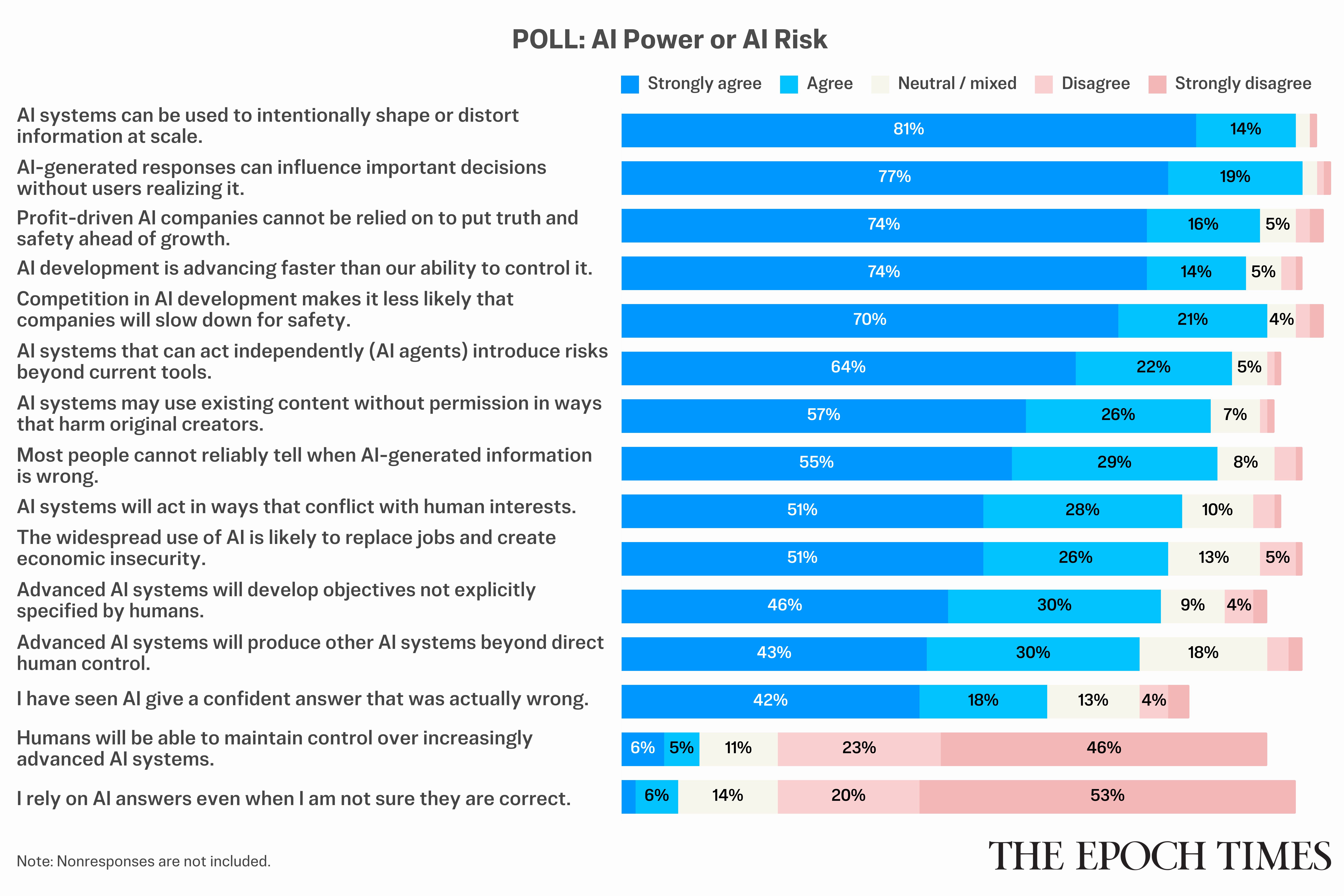
About 60 percent of respondents agree that they’ve seen AI give a confident answer that was actually incorrect, and 84 percent agree that most people cannot reliably tell when AI-generated information is wrong.
Seventy-three percent of readers say they do not rely on AI when they are not sure the answers are correct. But almost 9 percent rely on AI even when unsure.
A large majority (83 percent) agree that AI systems may use existing content without permission in ways that harm original creators.
Malicious Intent
While some believe that AI is a tool that could be used incorrectly, many readers think that there could be actual malicious intent taken on by the artificial intelligence, making its way into a growing number of fields, or the architects of the software.
Ninety-five percent of respondents agree that AI systems can be used to intentionally shape or distort information at scale.
A whopping 90 percent of readers believe that profit-driven AI companies cannot be relied on to put truth and safety ahead of growth, and 91 percent of those polled agree that competition in AI development makes it less likely that companies will slow down for safety.
In total, 77 percent of those polled said they agree that the widespread use of AI is likely to replace jobs and create economic insecurity.
Unintended Consequences
One of the biggest concerns for readers was the possibility that what comes next might not be what anyone intended.
Readers overwhelmingly agreed that AI could get out of control, and it might be difficult to undo the damage once it is realized.
A massive 88 percent of readers agreed when asked if AI development is advancing faster than our ability to control it. Seventy-three percent believe that advanced AI systems will produce other AI systems beyond direct human control.
On top of that concern, 86 percent of readers agree that AI systems that can act independently (AI agents) to introduce risks beyond current tools.
Ninety-six percent of readers said they agree that AI-generated responses can influence important decisions without users realizing it.
Additionally, 76 percent agree that advanced AI systems will develop objectives not explicitly specified by humans.
To add to that concern, 69 percent of respondents disagree that humans will be able to maintain control over increasingly advanced AI systems, and another 20 percent are either not sure, or neither agree nor disagree. Only about 11 percent believe humans can maintain control.
Seventy-nine percent of those polled agree that at some point, AI systems will act in ways that conflict with human interests.
When asked about their own experiences with AI, readers talked about the risks they’ve encountered personally, using the still relatively new technology.
Thirty-one percent said biased or filtered information was the biggest risk, while 27 percent said the biggest risk was that they found it difficult to verify accuracy. Fifteen percent said they encountered AI offering “confident but incorrect answers,” and 7 percent said they believed that AI influenced decision-making in a risky way.
A combined 20 percent had either other concerns or found no significant issues with the technology.
The Epoch Times conducted this reader survey on May 6-7, 2026, by email and social media, generating 1,063 responses.