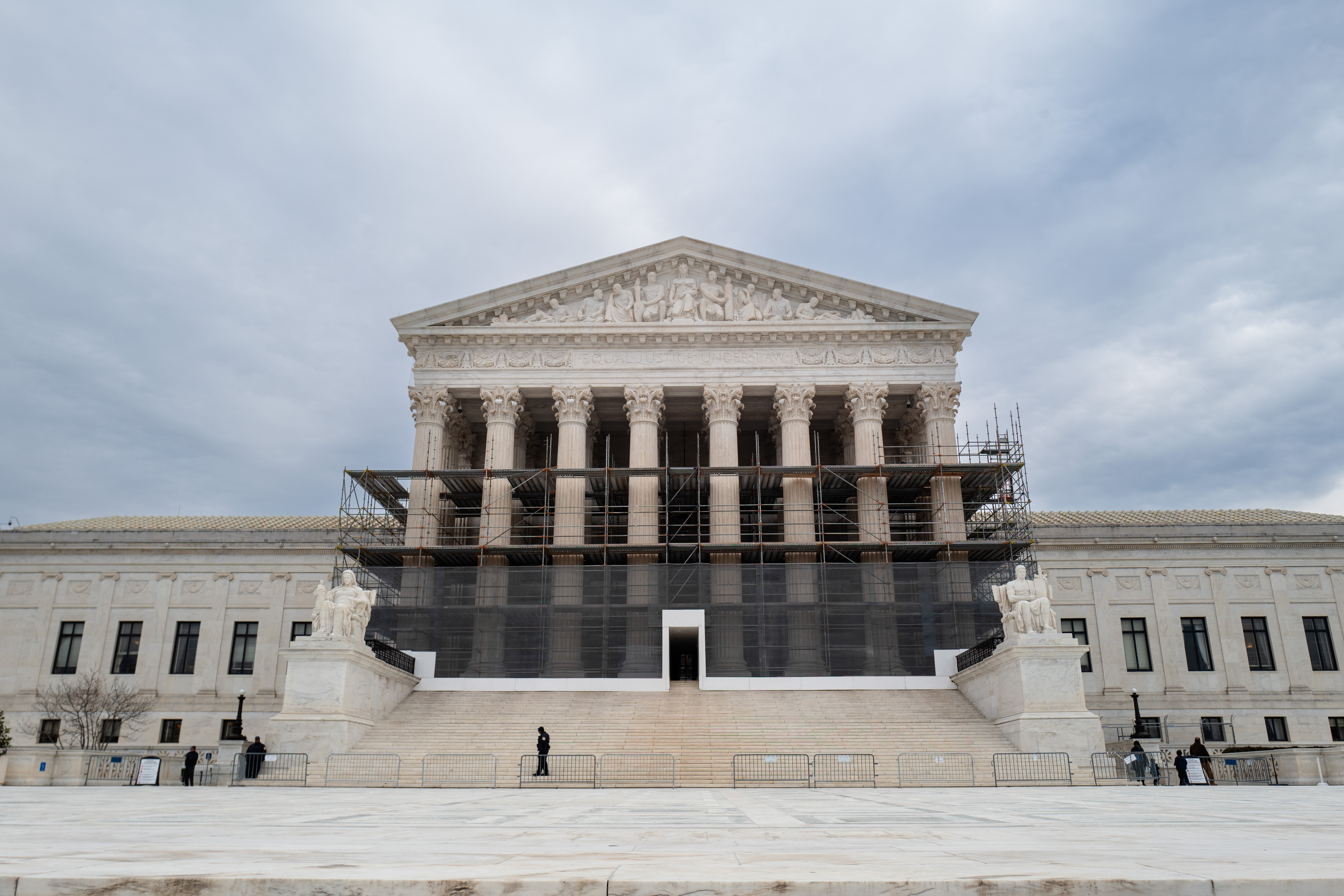

The U.S. Supreme Court on Jan. 12 grappled with energy companies’ bid to move into federal court several lawsuits filed by local Louisiana governments accusing the corporations of harming the state’s coastal wetlands.
In the case, Chevron USA Inc. v. Plaquemines Parish, Louisiana localities allege that the state’s environment was damaged, dating back to when oil production activities were carried out to honor federal refinery contracts during World War II.
Starting in 2013, six parishes along the Gulf of America coast in Louisiana initiated 42 lawsuits accusing oil and gas companies of violating a state permitting law, the State and Local Coastal Resources Management Act of 1978.
The first case went to trial, and in April 2025, a jury ordered Chevron to pay $744.6 million to Plaquemines Parish.
The oral argument on Jan. 12 did not center on the merits of the localities’ lawsuits, but instead focused on whether procedural rules governing jurisdiction—or authority to hear a case—were followed by lower courts.
Some companies prefer to litigate in federal court, which they consider more amenable to companies than state courts.
When a case is transferred from a state court to a federal court, lawyers describe the process as “removal” to federal court.
The multiple lawsuits that the local governments filed in state court against the petitioners—several energy companies, including Chevron and Exxon Mobil Corp.—concern exploration and production work carried out in Louisiana’s coastal areas.
The companies argued that the 42 lawsuits should be removed to federal court because federal officials had a connection to the refining contracts.
Specifically, they argued that the cases should be transferred because a 2011 federal officer removal statute gives federal courts jurisdiction over civil lawsuits filed against “any person acting under [an] officer” of the United States “for or relating to any act under color of such office,” the companies’ petition filed last year said.
The cases were removed to the federal district courts. The localities then challenged the removals, and federal district courts sent the cases back to state court, the petition said.
The corporations appealed, and in May 2024, a panel of the U.S. Court of Appeals for the Fifth Circuit ruled against the companies and ordered that the lawsuits should remain in state court, concluding that the cases should not have been removed to federal court.
The panel’s majority determined that the companies satisfied the “acting under” requirement of the federal statute but did not meet the “relating to” requirement.
The “exploration and production activities” were not related to the refining activities performed under the federal contracts, the panel found.
During the oral argument, Paul Clement, the attorney for the energy corporations, said that because the companies’ activities were related to the production of aviation fuel for the war effort, that should be a good enough reason to bring the dispute into federal court.
The phrase “relating to,” which was included in the removal statute, is “a broad, capacious term,” said U.S. Department of Justice attorney Aaron Roper.
In five opinions, the Supreme Court has held the removal provision was “a broad statute that was to be liberally construed,” Roper said, adding that the Fifth Circuit’s ruling in the case was “really novel.”
Chief Justice John Roberts questioned whether the dispute belongs in federal court.
Roberts told Roper that the term “‘relating to’ is very broad, but it’s hard to see where you stop.”
“I mean, is it a butterfly effect? You know, the butterfly flaps its wings, and it has the end result halfway around the world?” the chief justice said.
The butterfly effect is a scientific theory that posits that small changes in a complex system can lead to significant, unpredictable consequences later on.
Justice Neil Gorsuch picked up on what Roberts was saying, telling Roper: “The big bang is ‘related to’ you being here today, counsel, right?” The Big Bang theory holds that the universe was created in a huge explosion billions of years ago.
Justice Clarence Thomas asked Louisiana Solicitor General Benjamin Aguinaga, “What difference does it make to be in state court as opposed to federal court?”
Aguinaga said state courts are better at interpreting state law.
“We have the same reasons for wanting to be in state court that anybody who sues under state law wants to be in state court,” the state official said.
“We want the actual experts interpreting state law, especially when we get to the Louisiana Supreme Court on an important statute like this, and especially with respect to a problem that is so sweeping in scope.”
The Supreme Court is expected to rule on the case by the end of June.