
The U.S. Chamber of Commerce asked the Supreme Court on Nov. 14 to block two California laws that compel companies to make information about their emissions and climate risks public.
The Chamber and other industry groups filed an emergency application against Lauren Sanchez, head of the California Air Resources Board, and two other state officials, to block California Senate Bills 261 and 253 from taking effect. The application was directed to Justice Elena Kagan, who oversees urgent appeals from California.
The application said business groups oppose the two state laws, which they say involve companies in the public debate on climate issues and “pressure them to alter their behavior.” The laws force businesses to speak about climate change “even if they have said nothing about climate, emissions, or sustainability in the past.”
SB 261, which will take effect Jan. 1, 2026, will force businesses to publish on their websites “extensive” reports on a variety of climate-related risks such as rising sea levels, cyclones, and droughts. The reports must “assess the steps governments might take in response to those risks and analyze how those hypothetical governmental responses—and customers’ reactions—could affect the company decades into the future,” according to the application.
SB 253, which takes effect in mid-2026, will compel businesses to report “emissions generated by their own operations and by the energy they purchase—and eventually the emissions of everyone in their value chain, from suppliers to employees and customers,” the application said.
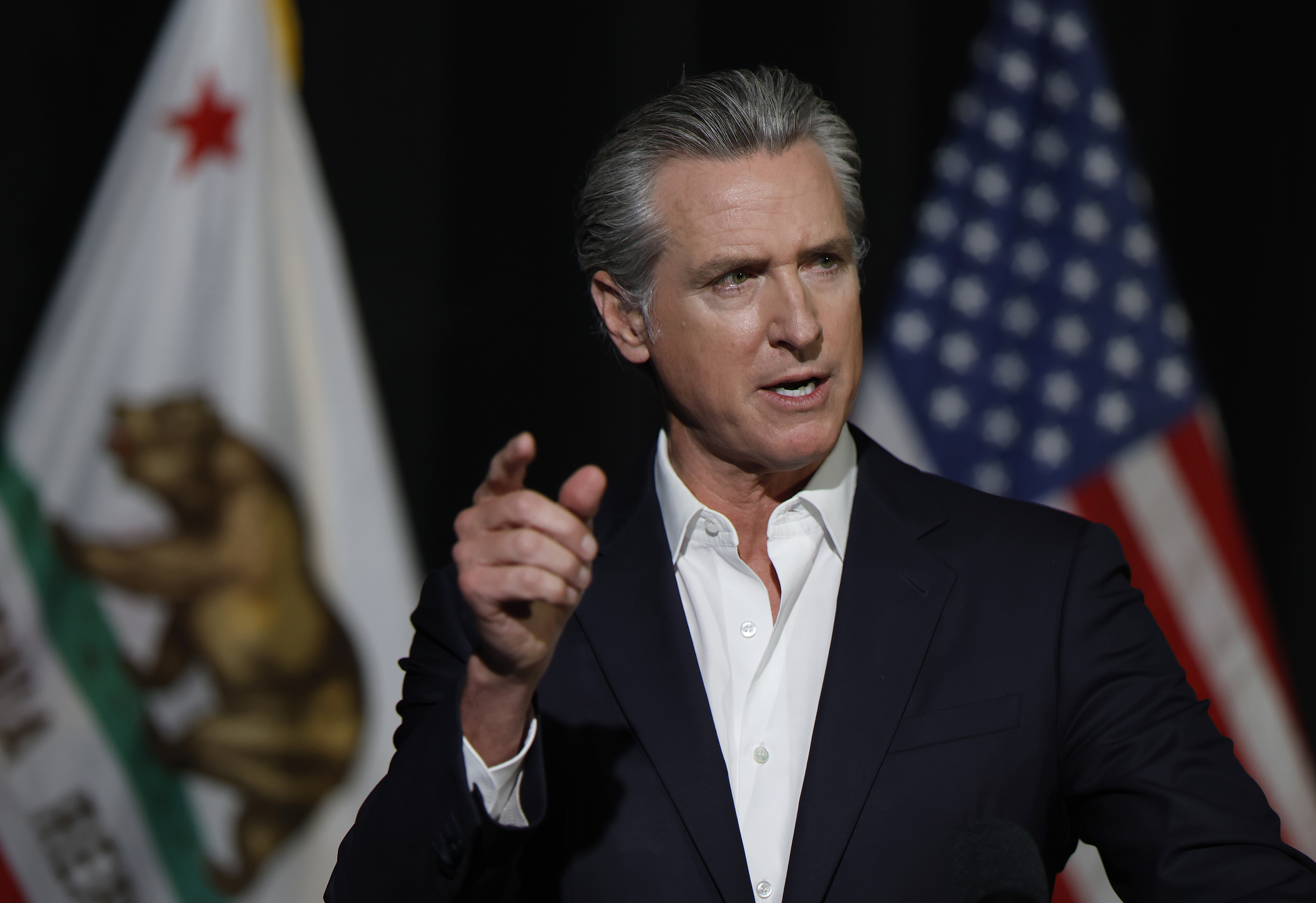
When signing the bills in October 2023, California Gov. Gavin Newsom (D) said SB 261 “will illustrate the real risks of climate change for businesses operating in California and will encourage them to adopt practices that seek to minimize and avoid these risks.”
Newsom said SB 253 “demonstrates California’s continued leadership with bold responses to the climate crisis, turning information transparency into climate action.”
The application said state laws presumptively violate the First Amendment to the U.S. Constitution when they compel speech, “especially where, as here, they dictate a value-laden script on a ‘controversial subject such as climate change,’” citing the Supreme Court’s 2018 ruling in Janus v. AFSCME. The government “may not compel a person to speak its own preferred messages,” as the Supreme Court ruled in 2023 in 303 Creative LLC v. Elenis, the application added.
The business groups sued in federal district court in January 2024 to challenge the state laws under the First Amendment. In August 2025, that court declined to issue a preliminary injunction blocking the laws, finding they would likely survive constitutional scrutiny.
The business groups moved for an injunction pending appeal, which the district court denied on Sept. 11. The groups then sought the same relief from the U.S. Court of Appeals for the Ninth Circuit. A Ninth Circuit panel is scheduled to hear the case on Jan. 9, 2026, after Senate Bill 261 is set to take effect.
The Supreme Court should block the laws and “step in to preserve the status quo until [the groups’] entitlement to a preliminary injunction is decided by the Ninth Circuit,” the application said.
Although the Supreme Court rarely intervenes in cases before lower courts hand down final rulings, the business groups argue in the application that the justices should act because the two state laws “will cause irreversible injury” if allowed to take effect.
“Unlike restrictions on speech, which may be lifted to allow future expression, compelled speech causes permanent injury: Once a company is forced to speak, the message is out. It cannot be unsaid,” the application stated.
Requiring companies to disclose the information that the bills encompass is a goal of the environmental, social, and governance (ESG) agenda promoted by activists. ESG is a set of standards that is used to measure an organization’s societal and environmental impact.
The ESG movement began two decades ago with a U.N. initiative, outlined in a 2004 position paper called “Who Cares Wins,” aimed at getting private companies in line with the U.N.’s sustainable development goals.
Those goals included climate action and gender and racial equity, and they aligned with corporate trends such as “conscious capitalism” and “stakeholder capitalism,” which redirected companies from merely serving their owners to serving employees, the community, and the environment.
Some states have pushed back against ESG objectives. In 2023, Florida Gov. Ron DeSantis signed into law a bill preventing state officials from investing public money to promote ESG goals.
Asked to comment on the pending application, California Air Resources Board spokesman Dave Clegern said the board “doesn’t comment on pending litigation or court action.”
It is unclear when the Supreme Court will act on the application.
Reuters and Kevin Stocklin contributed to this report.