The V-2 rocket could have changed World War II. It traveled faster than sound, too fast to be tracked or shot down by antiaircraft artillery of the day. It arrived unannounced, before the sound of its approach gave warning. Once launched, it couldn’t be lured off course by radio spoofing because it was internally guided. It couldn’t be stopped.
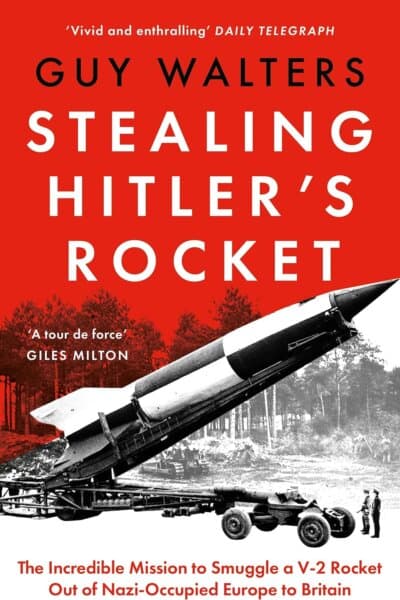
Author Guy Walters recounts an incredible tale of the rocket’s ultimate fate in “Stealing Hitler’s Rocket: The Incredible Mission to Smuggle a V-2 Rocket out of Nazi-Occupied Europe to Britain.”
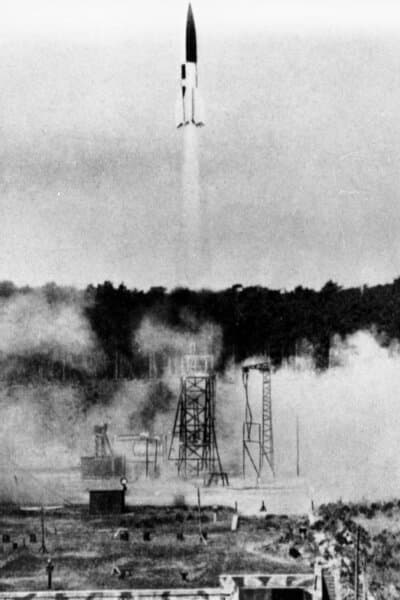
A V-2 launched from Test Stand VII in summer 1943. (Bundesarchiv, Bild 141-1880/<a class="mw-mmv-license" href="https://creativecommons.org/licenses/by-sa/3.0/de/deed.en" target="_blank" rel="noopener">CC BY-SA 3.0 de</a>)
If it'd been available three months before the Normandy landings in France, it could have prevented them. A rain of V-2s landing in the assembly areas could have disrupted the carefully coordinated invasion plans to the point where the landings would have been unsuccessful.
The British received advanced warning of the V-2 (and the V-1 “buzz bomb”) from an unlikely source: the Polish Home Army. The warning allowed the British to take steps slowing production by six critical months. Later, the Home Army smuggled a V-2 out of Poland to send to Britain for analysis.
Vengeance Weapons
Walters begins by introducing readers to the Nazi Vergeltsungswaffe (vengeance weapons) programs. These included a low-tech V-1 pulse-jet bomb and the leading-edge technology V-2 ballistic missile.
He describes the role the army intended for the V-2 as very long-range artillery. It was a way to evade restrictions imposed under the Versailles Treaty, which ended World War I.
He describes the cutthroat rivalry between the organizations designing them: the Luftwaffe for the V-1 and the Wehrmacht for the V-2. The Schutzstaffel (SS), a paramilitary group under the Nazi Party, wanted control of the programs.
Infighting slowed early development of these weapons. Development lagged until German battlefield reverses led to an increased desire for superweapons.
Walters introduced the Polish Home Army (Armia Krajowa), Poland’s underground army developed after Germany conquered Poland. The Home Army included the Polish military who escaped capture and tens of thousands of patriotic Poles who were determined to resist Nazi Germany. The Home Army built a shadow military within Poland, conducting sabotage and gathering intelligence.
The task seemed impossible, but the Polish Home Army did it.
Polish Intelligence
Its intelligence service collected information about V-1 and V-2 development at Peenemünde, a German research facility on the Baltic coast. Peenemünde employed Polish slave laborers, who smuggled word of the work there to Poland. Home Army analysts soon sent detailed descriptions of the project to Britain.
The information was convincing. It broke a deadlock between the British scientists who believed that Germany was developing a ballistic missile and those who thought it was impossible.
Once Britain took the threat seriously, the military took steps to stop development, launching a massive night bombing raid against Peenemünde. It destroyed the facility, killing many of the workers.
It didn’t kill the program. Germany dispersed the program, delaying it for many months. Test launches and development facilities were moved to Poland, out of the reach of the Royal Air Force (RAF).
The program, however, was within range of the Home Army, which turned its attention to uncovering the secrets of the V-2. Observers kept secret watch over the development and launch sites. Others collected bits of the rocket from impact sites. All of the intelligence collected was sent to Warsaw for analysis, then to Britain.
The picture emerging from the clues gathered frightened British intelligence experts. They sent a request back to Poland: Can you send us a V-2?
To satisfy the request, the Home Army had to obtain a 14-meter tall, 4500-kg V-2 and then spirit it out of Poland. It sounded impossible.
Smuggling a Missile
The book describes how the Home Army managed that feat. A malfunctioning V-2 landed relatively intact in mud flats near the Bug River. Walters describes how local Poles camouflaged the wreck, convincing the Germans it had landed in the Bug and was unrecoverable.
They took it apart locally, smuggling it to Warsaw. There, it was packaged up and shipped to a makeshift airfield in southwest Poland. From there, it was flown to Italy aboard an RAF Dakota. All this was done without the Germans realizing what had happened.
“Stealing Hitler’s Rocket” sounds like the plot of an improbable spy thriller novel, yet it really happened. The plot had to be kept secret during World War II.
During the Soviet occupation of Poland from 1945 through 1990, revealing the plot was inconvenient to the Soviets. It showed Poles acting independently of the Soviets to achieve an incredible result. By then, many of the participants were dead, and their accomplishments had been forgotten.
Guy Walters unpacks all of this in a fast-paced history. His account brings a story of an extraordinary achievement back to the prominence which it richly deserves. It’s a delightful and informative book.
’Stealing Hitler’s Rocket: The Incredible Mission to Smuggle a V-2 Rocket out of Nazi-Occupied Europe to Britain’
By Guy Walters
Apollo: Sept. 15, 2026
Hardcover, 304 pages
What arts and culture topics would you like us to cover? Please email ideas or feedback to features@epochtimes.nyc