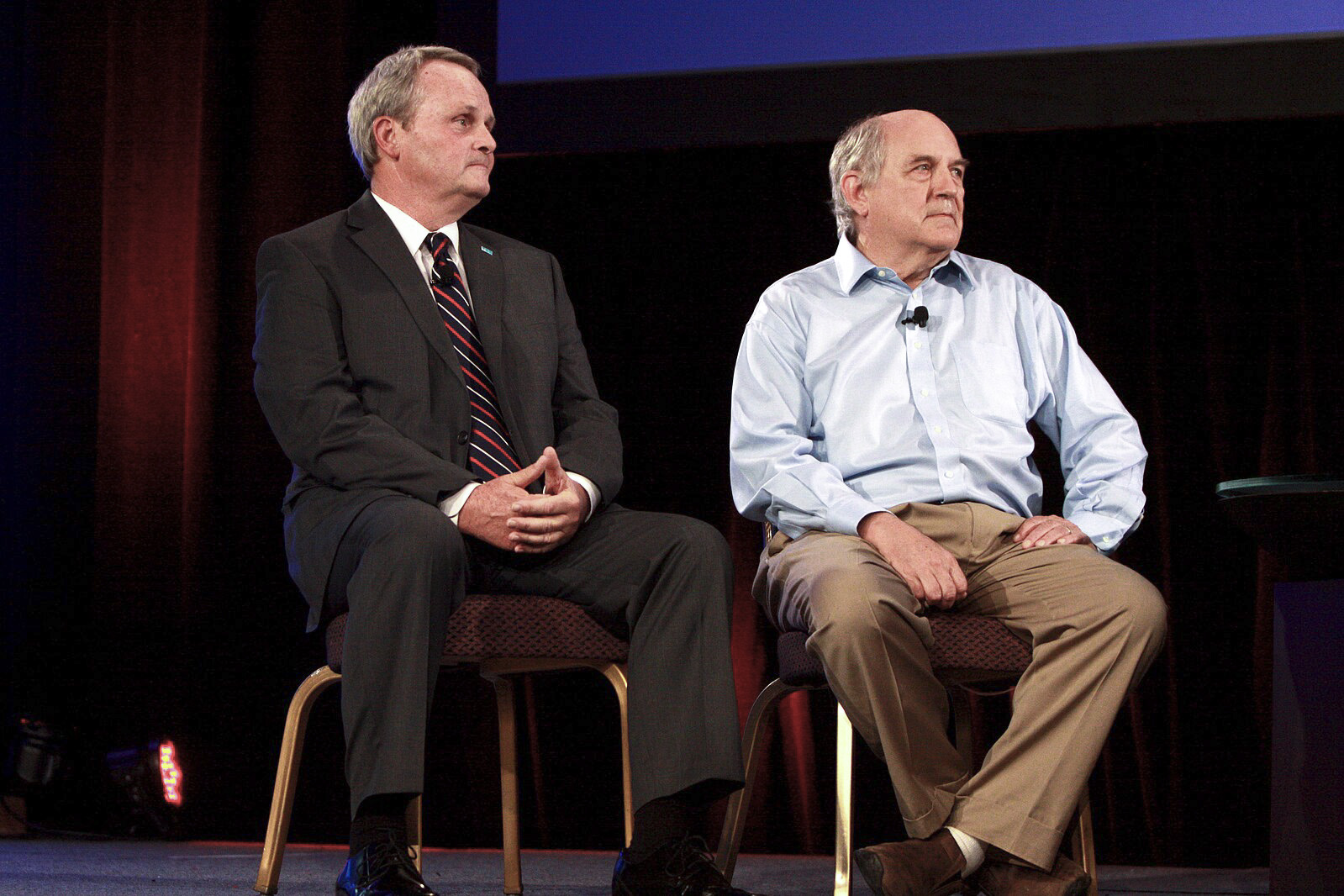

Charles Murray accepted Christ reluctantly after a 20-year journey. In an interview with The Epoch Times, he admitted that he is still not where he thinks he should be as he struggles with belief, but feels he had no other choice. Murray’s autobiographical account, “Taking Religion Seriously,” describes his continuing journey.
Murray is one of America’s most prominent public intellectuals, a political scientist with ties to Harvard and the Massachusetts Institute of Technology. Intellectuals believe themselves rational people and are not into discussions about spirituality. As Murray put it, “Intellectuals today and for a long time went to college as young people and have learned that smart people don’t believe that stuff anymore.”
Murray’s journey was an intellectual one. It started with his wife, Catherine, a woman for whom his deep love gleams when he speaks of her. He initially resisted the idea that religion was important and was worth taken seriously.
In college, he was an agnostic. “I bought into that [smart people do not believe in religion] without being really conscious I was buying into it. If that is the way you have grown up, it is harder to say I may have been wrong about that in a basic way.”
Murray added, “In the case of spirituality, I don’t have the usual cop-out. The usual cop-out for agnostics is to believe people who hold deep faith are kidding themselves. Maybe they are not that smart, maybe they are deluding themselves, but they are making it up. I have a wife of whom I cannot say that. She is a brilliant woman intellectually, and she’s perfectly in control of her self-awareness. She can absorb things spiritually I cannot.”
Murray felt he had a problem. “[What] I’ve got a spiritual perceptiveness and, if measured the way we measure IQ, would be about 75. In other words, I’m probably retarded. I believe spiritual perceptiveness is a trait in the same sense that the ability to appreciate great music is a trait. It is not particularly related to IQ. Is there any way I could get the experience in music that a friend of mine who is a professional violist could? No. It’s not in the cards, and it’s not my fault, but it’s a limit.”
With regards to spirituality, Murray explained his strategy: “I wanted to follow ... the progress [Catherine] was making. The only route open to me was to look at the thing in the same way I look at my professional work, which is evidence of various kinds.”
It was a step-by-step process, involving investigation of a great many different things: paranormal and psi phenomena, near-death experiences, the Big Bang theory and the odds against a randomly created inhabitable universe. Murray concluded, “I cannot believe I am thinking this but the only possible explanation for the physics of the Big Bang is that the universe has some sort of intention behind it.”
Then, he discovered C.S. Lewis and the book “Mere Christianity.” He said, “The fundamental reaction I had when I was reading the book [“Mere Christianity”] at the outset was to say to myself in effect, ‘Here is a really smart person who really does believe in this stuff.’ I could not read C.S. Lewis without being entranced by him as an intellect. His arguments are just pretty doggone persuasive.”
Further investigation into Christianity concluded with Murray believing Christ claimed to be the Son of God and his disciples believed those claims.
He stated, “I accept that they believed those claims. I am absolutely sure that something so profound happened on Easter, so powerful, that it had a miraculous effect on the apostles. That, in itself, is a major reason for me to believe those claims.”
Murray is the author of “The Bell Curve” and “Coming Apart,” two of the most controversial books of the last 30 years. “Taking Religion Seriously” is no less controversial. He got pushback.
Said Murray of one critic, “I thought he would be more open to saying things such as, ‘Well, I have got to admit the evidence you present poses problems to me but I still sort of accept it.’ That would have been fine. To be dismissive and even snarky about it? Not because the evidence does not deserve to be taken seriously, but because he absolutely hates the direction in which it points. That disappoints me.”
Murray identified scientism as the real villain. He says, “The interaction between rational intelligence and religion is inherently filled with tension in modern men and women. The reason is the enlightenment and the way it changed the socialization of people who are really smart. The enlightenment enthrones logic and empiricism as the way in which human beings can access the realities of the universe. It drove them to the assent there is not much room for any other kinds of profound insights.
“Scientism being the deification of the scientific method. The problem of scientism is real. I was already disappointed before I wrote the book in the position intellectuals take with regard to the blinders they have on.“
Murray added, “There is a famous line that science progresses one funeral at a time. Consider the reaction to the theory of relativity and, later, the evolution of ideas about the Big Bang. You had scientists, who resisted the evidence on those things to their deaths. The great thing about the scientific method is the method itself, not the people who practice it. The people who practice the scientific method are constrained by the method and thereby diminish the very human characteristic that leads to the bitter, bitter wars of academia.”
Does Murray still harbor doubts about God and Jesus?
“You might ask, ‘Why are you still such a wishy-washy believer?’ Part of the answer is, ‘Look. I am an applied statistician.’ I think in terms of probability distributions. It is simply out of character for me to take the totality of that experience (so far, it is impossible for me) and have the kind of full-hearted faith it would take.”
But he is working on it.
What arts and culture topics would you like us to cover? Please email ideas or feedback to features@epochtimes.nyc