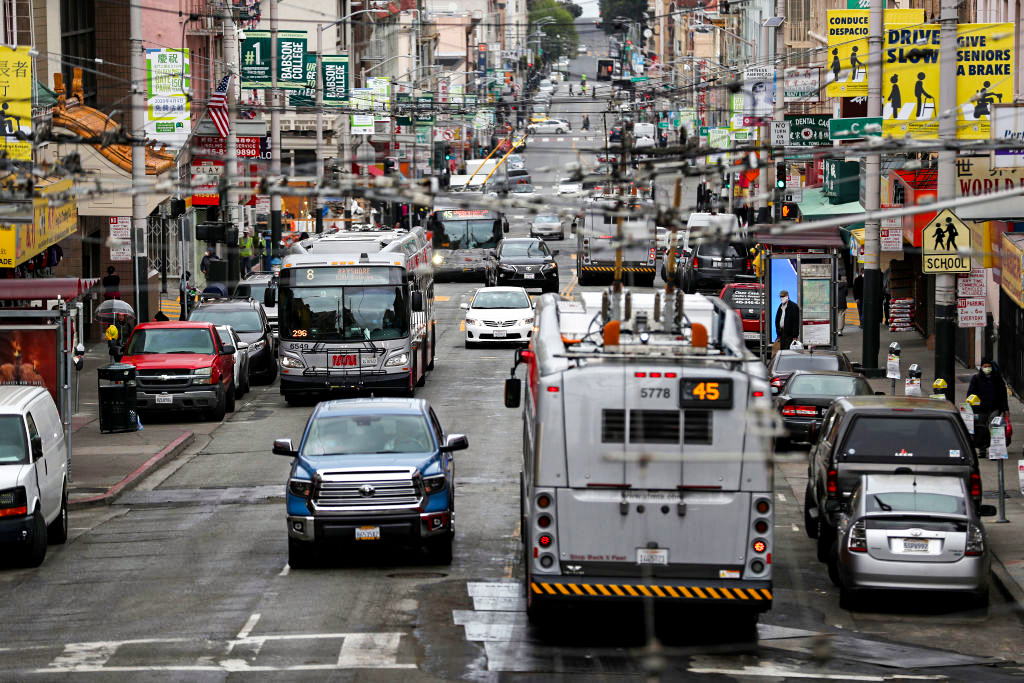

Collapsed fare revenues and expanded employee numbers are listed as areas that may have contributed to an operating deficit at the San Francisco Municipal Railway (also known as Muni), according to a new report from an urban think tank released on March 26.
The San Francisco Municipal Transportation Agency (SFMTA), the agency that runs Muni, reported to the Federal Transit Administration a fare revenue of $94 million in 2024, a 66 percent drop compared with the one of more than $283 million in 2015 adjusted for inflation.
“This drop in fare revenues is substantial and significantly exceeds Muni’s 27 percent drop in ridership during the same period,” said the report by the San Francisco Bay Area Planning and Urban Research Association (SPUR).
That means Muni experienced a 53 percent drop in per-passenger fares between 2015 and 2024, “resulting in a significant loss of revenue for the system,” the report said.
The San Francisco Municipal Transportation Agency faces an annual operating deficit of $307 million beginning in July 2026, when state and federal pandemic relief funding runs out, according to SFMTA’s budget overview presentation on Feb. 3, 2026.
The deficit could increase to $434 million by 2030.
“We appreciate how this deep analysis shows that Muni service performance compares favorably with our peers,” a SFMTA spokesperson said in an email statement to The Epoch Times, “but we also know there is more work to do.”
“Operating Muni as efficiently as possible is essential as we face unprecedented budget challenges,” the spokesperson added.
The SFMTA’s budget plan relies on the passage of two ballot measures: a regional ballot measure that will authorize a 1 percent sales tax increase in San Francisco to fund Muni for about $155 million per year, and a parcel tax local measure that will raise $150 million annually if passed.
SPUR’s findings were reported in its 33-page analysis comparing SFMTA to 14 of its national peers.
“Understanding the dynamics of Muni’s declining fare revenues is complex,” the report said, “and much of the drop may result from deliberate choices made by policymakers.”
SFMTA offers free rides to youth of 18 years and under, low to moderate income seniors and people with disabilities, and homeless people, according to the San Francisco government website.
The “Free Muni for Youth” pilot program was launched in 2013, initially for low and moderate-income youth aged 5–17 years old. The program was made permanent in January 2015.
The program was expanded to all 18 years or under and students enrolled in Special Education or English Learner programs through age 22.
There were more than 39,000 active users of the program in 2021, according to a SFMTA blog celebrating a one-year expansion during the COVID-19 pandemic.
Roughly 14,000 students take Muni to and from school.
SFMTA estimated in late 2024 that nearly 20 percent of riders do not pay a fare, compared to about 12 percent in 2019.
The agency increased fare inspection, and the revenue per rider increased by 6 percent from February 2024 to February 2025.
Other factors that affect fare revenue include the SFMTA Board deciding to cease fare increases during the COVID-19 pandemic and fewer riders purchasing monthly passes, according to the SFMTA document.
Full-time employees serving Muni expanded 22 percent from 2015 to 2024, a significant increase, the SPUR report said.
SFMTA had almost 5,400 employees in December 2014, and the number increased to 6,798 in fiscal year 2024–2025, according to SFMTA’s consolidated budget.
About 72 percent of Muni' $1.473 billion operating expenditure went to labor in 2024, including $935 million for employees’ salaries and $110 million for services of other departments, according to SFMTA’s fiscal year 2025–2026 budget.
SPUR’s report said the increased staffing helped Muni to improve its services in recent years.
SFMTA hired 1,050 employees in 2022, according to its fiscal year 2022–2023 annual report.
In its Feb. 3, 2026, budget plan, SFMTA planned to lay off 700–900 positions if one of the cost-saving measures is not approved by voters in the upcoming election, and 1,500–2,100 positions will be cut if both measures fail.
In the worst-case scenario, 20 Muni routes will be cut, and the rest of its services will be cut by half, according to the plan.