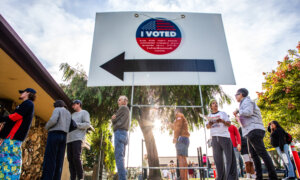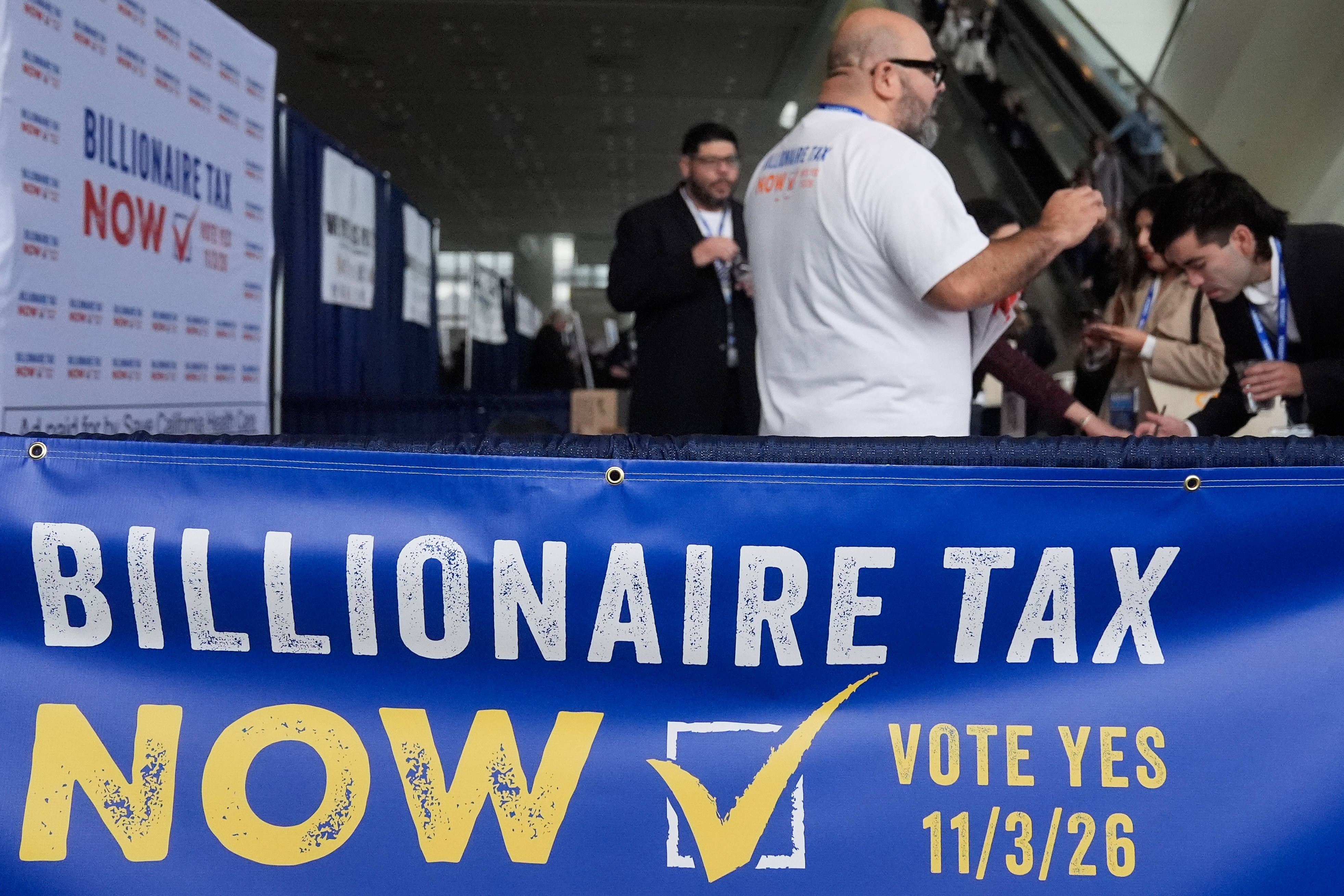

Organizers of California’s billionaire tax proposal say they turned in more than 1.5 million signatures to state election officials on April 27, which could be enough to qualify the initiative for the November ballot.
Backers of the act, including Service Employees International Union-United Healthcare Workers West, needed 875,000 signatures to qualify before the June 24 deadline.
If passed, California residents who live in the state as of Jan. 1, 2026, with a net worth of more than $1 billion would pay a one-time tax of 5 percent on their net worth, a plan that proponents hope will raise $100 billion to fund local hospitals and emergency rooms, food aid, and public education.
“When funding is cut, it brings a world of pain,” said Mayra Castañeda, an ultrasound technologist and member of the union, in a statement. “It’s clear that most Californians and most billionaires recognize how reasonable and necessary this proposal is—both to keep emergency rooms open and to save California businesses from closing.”
Sen. Bernie Sanders (I-Vt.), a strong supporter of the measure, applauded the signature collection numbers.
“Congratulations to the California unions who have gotten over 1.5 million people to sign a petition to put a Billionaire Wealth Tax on the ballot,” Sanders posted on social media. “At a time of massive income and wealth inequality, the richest people in our country must start paying their fair share of taxes.”
Gov. Gavin Newsom has publicly voiced his opposition since the beginning of the year over fears the move would drive high-income earners out of the state.
Newsom pledged to fight the proposal in interviews in January, telling Politico that news of several billionaires preparing to flee the state was proof that he was right.
“This is my fear,” he said. “It’s just what I warned against. It’s happening.”
Newsom told Bloomberg Businessweek that a wealth tax would eventually lead to a decline in the state’s tax base, which would reduce revenue meant for social services and education, and reduce investments in firefighting and police. He had met with several billionaires who were concerned about the initiative, he said.
“I’ve been very mindful, as a guy who budgets for this state, that we rely on a very small number of people that allows us to do historic things,” Newsom said.
Nearly 30 percent of the Billionaire Tax Act’s tax base has already left the state, the Hoover Institution found in a March 2026 report.
Since news of a possible billionaire tax began to surface, Google cofounders Larry Page and Sergey Brin, Meta CEO Mark Zuckerberg, PayPal’s Peter Thiel, Uber CEO Travis Kalanick, car loan magnate Don Hankey, and director Steven Spielberg have all left the state, along with more than 45 California limited liability companies.
As billionaires flee, the expected tax revenue has also dropped, according to a report by the Hoover Institution. It found that the tax collected would likely be $40 billion over five years—instead of $100 billion.
“More importantly, the permanent loss of income taxes from the departing residents indicates high likelihood that net effect of the Billionaire Tax Act will be negative,” senior fellow Joshua Rauh and research fellow Ben Jaros of the public policy think tank said in the report.
The act would also amend the state constitution to lift California’s cap on taxes on intangible personal property with no end date, giving state lawmakers the power to easily impose regular or future wealth taxes, according to the Hoover Institution.
California has faced deep budget deficits in the past few years caused in some part by an ever-increasing budget for Medi-Cal, which now funds illegal immigrants. The program’s budget issues also stem from the Trump administration’s further restrictions on federal funding.
Newsom’s political team did not respond to a request for comment about the governor’s current position on the measure. He has spent the past few months focused on a national and international tour ahead of a possible presidential run in 2028.
Graham Stephan, a real estate investor from Las Vegas, said the tax could discourage future residents from California.
“Roughly 220 billionaires reside in California,“ Stephan posted on X. ”They employ roughly 10 million people. If a wealth tax passes, everyone with a billion-dollar idea will think twice about whether they want to build that business in California. But that isn’t even the most dangerous part.
“When this turns out to raise less money than expected, the bar will be lowered to $100 million. Then $50 million. Then $10 million. Then $1 million. ... Then it becomes a downward spiral where they have to tax everyone else to stay afloat.”
The California Secretary of State’s Office told The Epoch Times that county elections officials had not yet reported signature counts to the state for the measure.
Correction: An earlier version of this article misspelled the name of Mayra Castañeda. The Epoch Times regrets the error.