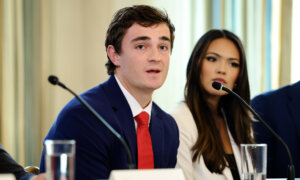

Health Secretary Robert F. Kennedy Jr. on April 22 said he supported the U.S. military’s ending its mandate for influenza vaccination.
War Secretary Pete Hegseth announced the end of the decades-long mandate on Tuesday.
“Secretary Hegseth was just recognizing that these soldiers are being sent over to fight for our freedoms and that they should have some freedoms, too,” Kennedy told a Senate committee in Washington.
He also said that the flu shot “is often ineffective,” with 20 percent effectiveness, and that there are studies showing that people who receive a shot are more prone to non-influenza infections.
The Centers for Disease Control and Prevention estimates that the vaccine was 36 percent effective in late 2025 and early 2026. The effectiveness has ranged from 19 percent to 60 percent since 2009, according to the agency, which is part of the Department of Health and Human Services (HHS).
Flu vaccines are updated each year to target circulating flu strains, which often change.
Military researchers have said in the past that the mismatch between the formulation of the annual shot and the circulating strains means that “vaccine-derived immunity is non-efficacious in many cases.”
Sen. Patty Murray (D-Wash) had asked whether HHS was prepared to detect flu outbreaks that happened “as a result of this new, what I think is a backwards policy.”
Kennedy said that officials monitor flu outbreaks.
Murray expressed concern about the ramifications of the mandate being rescinded.
“If you have a submarine full of people who we are counting on and a virus goes flying through it, we don’t have a ready military,” she said.
Some health professionals also said they opposed the move. Jennifer Nuzzo, an epidemiologist and director of the Pandemic Center at Brown University School of Public Health, said that fewer personnel receiving the vaccine would likely mean more troops getting sick and an increase in health care costs, according to the center.
Sen. Roger Marshall (R-Kan.), a doctor, said in a separate hearing with Kennedy on Wednesday that “the biggest challenge with flu vaccines is it’s not very efficacious.” Kennedy told Marshall his department is trying to develop a universal flu vaccine that will provide better protection.
Hegseth said that he reviewed the flu vaccine policy and decided to remove it.
“The notion that a flu vaccine must be mandatory for every service member, everywhere, in every circumstance, at all times, is just overly broad and not rational,” he said, adding that members are still free to take the shot if they choose.
The Pentagon had previously, in 2025, ended mandated flu vaccination for most reservists.
The military first implemented a flu vaccine mandate in the 1940s. It withdrew the mandate after the effectiveness of the first vaccine faded, but reinstated it in the 1950s after changes to the vaccine were made.