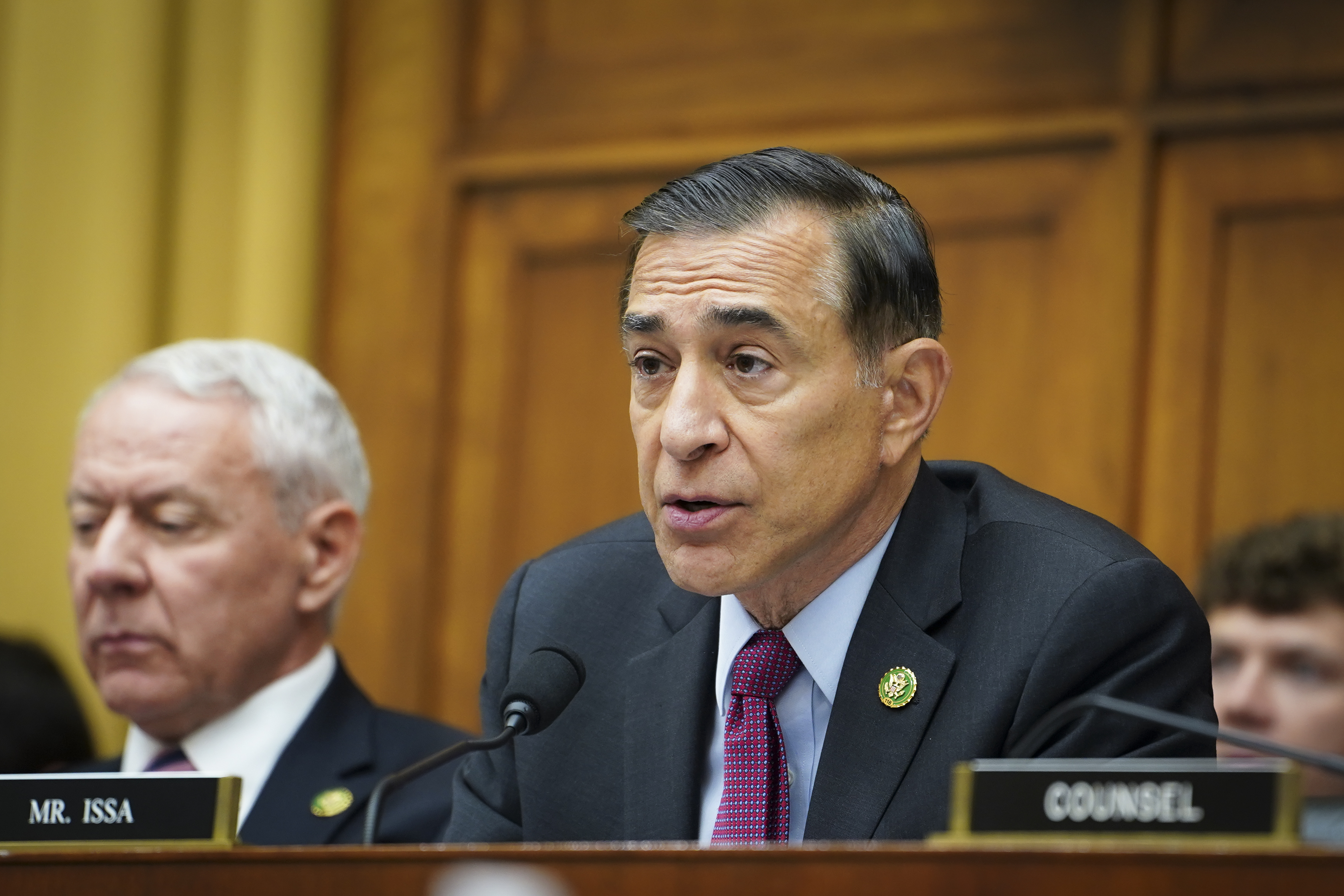

Rep. Darrell Issa (R-Calif.) has said he will not seek reelection in his southern California district, which was redrawn to favor Democrats in last year’s redistricting.
On March 6, the longtime congressman announced, shortly after the candidate filing deadline passed, that he would retire at the end of his term.
“This decision has been on my mind for a while, and I didn’t make it lightly,” Issa said in a statement announcing the end of his reelection bid.
Issa said he had built a strong campaign operation, enjoyed broad support, and believed that polling showed that he could win.
“First, we built the right campaign infrastructure, support has been overwhelming—including from President [Donald] Trump—and our polling was unmistakable: We would win this race,“ he said. ”But after a quarter-century in Congress—and before that, a quarter-century in business—it’s the right time for a new chapter and new challenges.”
Issa endorsed member of the San Diego County Board of Supervisors Jim Desmond, a fellow Republican, to succeed him. Desmond filed paperwork on the morning of March 6 amid uncertainty over whether Issa might be dropping out of the race.
“He understands this community, was born and raised here, and will make a terrific Congressman,” Issa said of Desmond in his statement.
A former Army officer and tech entrepreneur, Issa was first elected to a San Diego-area House seat in 2000. He chaired the House Oversight and Government Reform Committee from 2011 to 2014, overseeing high-profile investigations during the Obama administration. These included probes into the 2012 attack on the U.S. Consulate in Benghazi, Libya, and Operation Fast and Furious, in which agents from the Bureau of Alcohol, Tobacco, Firearms, and Explosives allowed illegal gun purchases in an effort to map Mexican cartel networks but lost track of many of the weapons.
Issa left Congress in 2018 after President Donald Trump, then in his first term, nominated him to head the Trade and Development Agency. Although his nomination never advanced in the Senate, he mounted a successful comeback in 2020, winning a seat that had remained safely Republican until the latest remapping shifted the partisan balance of his 48th Congressional District.
After the lines shifted, Issa briefly floated the idea of running in Texas, but later said he would stay, declaring that he “wasn’t quitting on California.”
Several Democrats are already in the race for the now-bluer 48th District, including San Diego City Council member Marni von Wilpert and Navy veteran Ammar Campa-Najjar, and Democrats have quickly framed Issa’s decision as a sign the seat is ripe for a flip.
“Issa abandoning his voters now is the clearest sign yet that Republicans know he can’t win,” Anna Elsasser, spokesperson for the Democratic Congressional Campaign Committee, said in a statement. “Any Republican who tries to parachute into this race with the same extreme agenda will face the same fate.”
Republicans, meanwhile, praised Issa’s tenure and said they expect to remain competitive in the district even as the party defends a narrow House majority. Republicans currently hold a 218–214 edge in the chamber, with vacancies.
“We are grateful for Congressman Darrell Issa’s decades of dedicated service to the people of California and our nation,” a spokesperson for the National Republican Congressional Committee said in a statement to The Epoch Times. “We are optimistic that this district will continue to be represented by a Republican.”
Issa’s announcement capped a day of California election shake-up. Rep. Kevin Kiley (R-Calif.), a two-term congressman, on March 6 filed to run in the Sixth Congressional District with “no party preference,” citing frustration with congressional “hyper-partisanship” and gerrymandering.
“It is no secret I’ve been frustrated, at times disgusted, by the hyper-partisanship in Congress,” he said in a statement.
“In the last year, it’s led to the longest government shutdown in U.S. history, a massive increase in healthcare costs, and, of course, a pointless redistricting war. The epidemic of gerrymandering has spread from Texas to California to states all across the country. Both parties are complicit.”