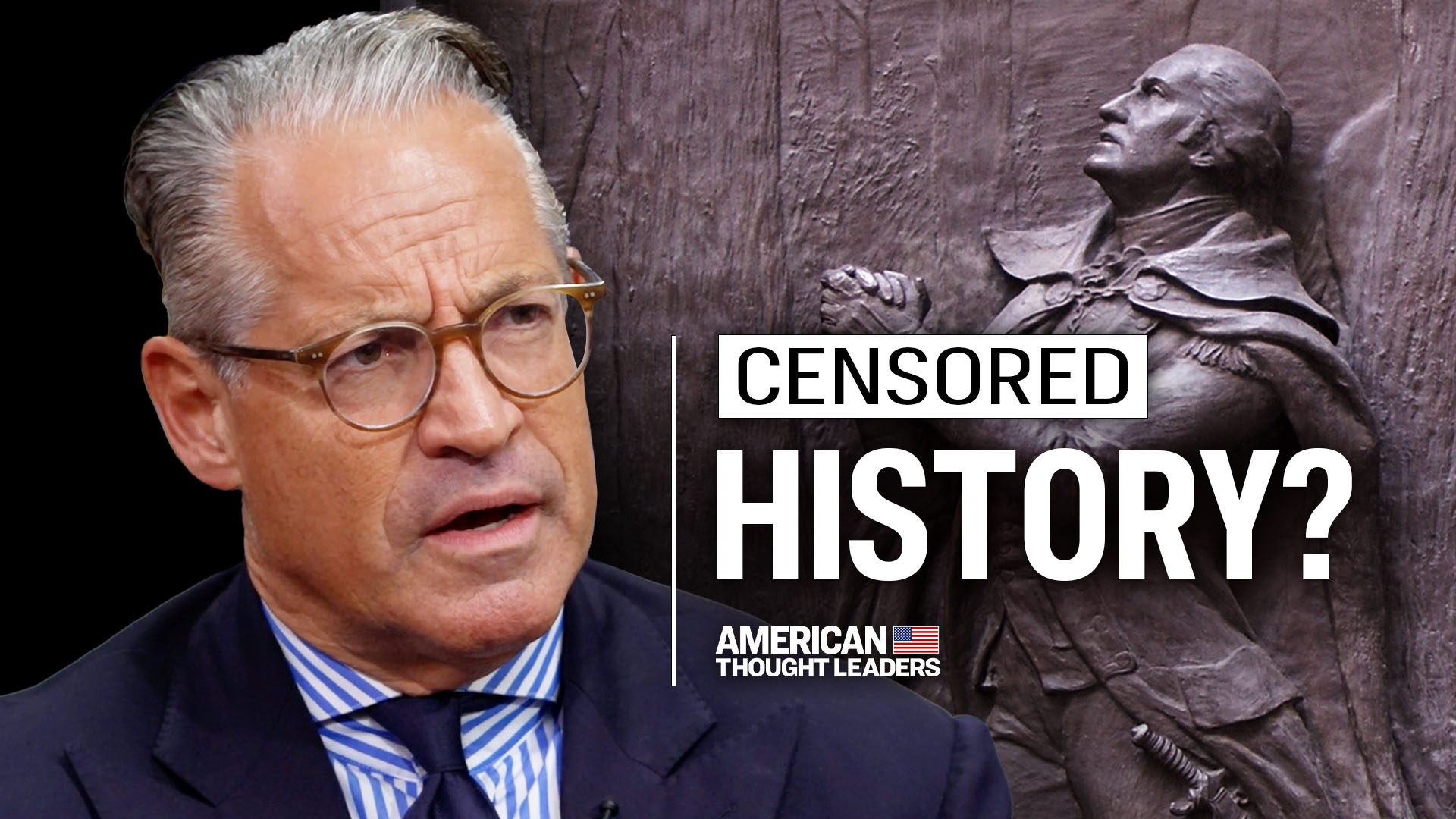

[RUSH TRANSCRIPT BELOW] Ahead of the 250th anniversary of America’s founding, New York Times bestselling author and talk show host Eric Metaxas is publishing his latest book, a 600-page volume titled “Revolution: The Birth of the Greatest Nation in the History of the World.”
In the book, he argues that the American Revolution is the “only genuine revolution in the history of so-called revolutions.”
So what separated the American Revolution from other revolutions? What made it succeed? And what critical aspects of the American Revolution are no longer being taught in schools today?
Metaxas argues that America is currently facing its third existential crisis, after the American Revolution and the Civil War, and understanding the core principles behind America’s founding story is critical to preserving the liberties of this nation.
In the interview, we confront some key questions: How is the erosion of spiritual faith transforming American society? How does self-government work without the “moral and religious people” that John Adams described as a prerequisite for self-government? What is the proper role of a good citizen?
Views expressed in this video are opinions of the host and the guest, and do not necessarily reflect the views of The Epoch Times.
RUSH TRANSCRIPT
Jan Jekielek:
Eric Metaxas, such a pleasure to have you on American Thought Leaders.
Eric Metaxas:
My pleasure. Thank you.
Mr. Jekielek:
Congratulations on your book Revolution. Well, tell me, what would you say is the most controversial thing that finds itself in this book on the American Revolution?
Mr. Metaxas:
It depends on how you want to phrase it. I would say that this may be controversial, but it’s absolutely unavoidable and inarguable ultimately, not debatable, is that all of the founders, most people don’t seem to know this because there’s been a real kind of secularist push in our lifetimes, but all of the men of the revolution understood that this sacred cause, as they called it, was inextricably intertwined with the God of the Bible. That’s something that I didn’t really learn in school. You really hardly ever hear it in our culture now, but when I did the research and I did a lot of research, I read a lot of books, it is absolutely undebatable that that’s how they saw it.
So even if we don’t see it that way or somebody doesn’t see it that way, you have to acknowledge that they saw it that way, and you have to understand why that would be. And I think I’ve come to see it that way myself, but we’ve really been living in a time where people act as though you can get the liberties that we have had in America for 250 years without reference to God. It’s some kind of enlightenment, French enlightenment project. That’s simply not true. And once I did the research, I thought I never dreamt it would be so crystal clear, but it’s just a fact. And I think we have a kind of an obligation to know that and to know that history and to know how the men who gave us this revolution saw it. But I think that it becomes unavoidable.
Mr. Jekielek:
Well, there’s that famous line, is it John Adams, about it can only work for moral people? Maybe you know the exact citation.
Mr. Metaxas:
Yes, it’s been quoted a million times, and there are many other similar quotes from other members of that generation. I mean, he says that our constitution only works for a moral and religious citizenry or something like that. And he basically is making clear that unless the people, we the people, actually govern ourselves because we’re moral, we’re people of virtue, it doesn’t work. The Constitution, he says something like, you know, that it simply doesn’t have the ability to force us. And that’s the conundrum or the paradox of freedom is that to be free, to govern ourselves, we have to govern ourselves. And so what does it mean? How do I govern myself?
Well, if I’m a person of virtue, if I have an opportunity to steal, I don’t steal because it’s wrong. I believe it’s wrong. And so the founders saw that if people believe in God or a higher power, they have the ability to do the right thing, and they don’t need the government to force them to do the right thing or to threaten them to do the right thing. This was at the heart of why the men of that generation believed it would be possible to have self-government because they saw a population that was very Christian, very religious, and therefore very virtuous.
They saw this because of the first great awakening. Really, Christian culture was everywhere, and they thought it’s possible to do this. And they knew, apart from that, how do you get people to govern themselves? How do you not have a big government forcing them to behave? That really was, it was everywhere. So that’s the famous quote from John Adams, but there are so many; they all really understood this.
Mr. Jekielek:
Something strikes me here. Okay. Something I think is pretty fascinating. Obviously, all of them were very serious about their faith. All the people that came to America did so because they basically stood for something. In fact, they were challenging the existing religious order back home. So that’s interesting, isn’t it, in itself?
Mr. Metaxas:
Yes, it is fascinating, because there were multiple different groups. So on the one hand, everybody had deep convictions. On the other hand, they had different deep convictions in many ways. Well, not that different. This is what’s interesting to me. Because of the Reformation, suddenly you have a host of people in Europe, you know, different communities that say, I want to worship God this way. Now, it was all Christian, okay? This is not anything beyond that, but it was different kinds of Christian, whether it’s Quakers or Anabaptists.
Mr. Jekielek:
But huge variation, yes, Anabaptists vs. Calvinists, for example. I mean, it’s quite different, right?
Mr. Metaxas:
The point is that it wasn’t, it didn’t go beyond Christian faith. But the point is that their understanding of Christian faith, suddenly, you know, let’s say you’re a Puritan, you’re living in England. And King James I says, you know, if you don’t toe the line with the Church of England, we will crush you. We‘ll persecute you. We’ll throw you in prison.
We’re going to make you suffer because we don’t believe in religious liberty. We believe that we’re the king, we have the power, and we will crush you. So if you’re a dissenter, you thought, this is bad. What do we do? So they suffered. And then eventually, some of them were able to escape to Holland, right?
So a number of the group that eventually comes across in the Mayflower, you know, they spent a few years in Holland, but there were a number of these groups that were being persecuted. And they said, we believe we have a duty to worship God in the way that we see, you know, from what the Bible says, and we’ve come to these convictions. And so all of these groups realize, there is a continent. We didn’t know it was there a hundred years ago, but now we know it’s there and we can get there. Let’s go there.
And so you have all these different groups coming over in the 17th century because they want to effectively be left alone to have a Christian community. The classic case is in Plymouth, Massachusetts. We call them the Pilgrims. Then ten years later, with John Winthrop on the Arbella, they came over and they found the Massachusetts Bay Colony, and they wanted to govern themselves.
Fast forward 100 years, all of the descendants of all these groups have effectively been governing themselves up and down the 13 colonies for like 100 years. They’ve been doing it. England has not bothered them very much. And then where the book starts is suddenly in, let’s say, 1763, the British win the French and Indian War. So they get big chunks of Canada, and their empire is much bigger, and it costs them a lot of money.
And they say, Now, we’ve got this big empire. We got to pay for it. Now it’s time to get serious. So we’re going to make the colonists pay their fair share because we’ve won all this territory and they need to, you know, we did it for them. Not true, but that was the theory.
So they decide to do what had never been done before and to say to all these colonists, you need to pay all these taxes. And the colonists really had principles and convictions about how we are supposed to govern ourselves and who has the right to tell me that I need to pay you money. Are you threatening me, or is this legitimate? And so they pushed back way harder than Parliament and the King thought that they would.
So suddenly, you have this conflict about who has the right to tell me to pay money or whatever. We govern ourselves. We tax ourselves. You know, if I want a road, and we get together and we pay, and we get a road, or we defend ourselves. But suddenly now, this foreign power effectively is saying, no, you’re under us.
And so it’s an amazing thing that because of this religious background, they had, number one, these convictions about to whom they answer. It’s not the state. It’s not the government. It’s to God and to each other in this covenant that they have with God and with each other. And they were not going to roll over just because, you know, the most powerful empire in the world had the power. They thought, no, we have God on our side.
So that was part of the DNA of most of these colonies, but it was also fanned into flames. In other words, it had been kind of, I would say to some extent, latent for a number of decades. But then you get the first great awakening, which really brings a lot of those in the colonies back to this kind of vibrant faith that their forefathers had a couple of centuries ago. So it really is kind of amazing to see how it comes together.
Mr. Jekielek:
And you describe this historic trial. It was in 1761. That’s what comes to my mind anyway, where, I mean, before the revolution, the principles are laid out.
Mr. Metaxas:
There are a number of moments. So it’s not like it happens all at once. But John Adams, and I start my book with this, John Adams years later says the opening scene of the revolution, I start in chapter one, for him happened in a Boston courtroom in 1761 where James Otis Jr., who’s an important figure in the beginning of the book, was arguing against what they call the Writs of Assistance.
This is where the king in England says that if we want to search your home, we can just write a writ of assistance and they can just go in. They don’t even have to tell you why they’re going into your home. They don’t have to tell you what they’re looking for. They just have the right. And people like James Otis Jr. said, no, you don’t. A man’s house is his castle. We have rights as British citizens. You can’t just come in.
James Otis Jr. arguing this against the Writs of Assistance in court in 1761, he said that was the moment that, in a sense, these ideas go head to head with England’s power. And so not a lot of people would point to that. But John Adams, who was in a position to know, he goes, that was the opening scene of the revolution. And he says, that day, the child of independence was born. So he really sees it as happening right at that moment.
And then of course, two years later, because of the victory of the French and Indian War, you know, Great Britain decides, okay, you know, we’re gonna lay some taxes on you and the sugar tax. and the stamp tax. And then it really, it really picks up. But for John Adams, it happened in that courtroom on that day. He was a 25-year-old single man watching this. And he just thought, I’m watching something that’s more than a simple court case.
Mr. Jekielek:
It’s incredible. You take us step by step through these opening salvos, if you will. But I actually find quite a few controversial things in your book. So one of them, and this is one of them, is that it’s the only revolution that ever worked. It’s the only real revolution. Actually, I think that’s what you say, right?
Mr. Metaxas:
Yes, that’s at least debatable. I say the reason the book is called Revolution and not the American Revolution is because there was never a revolution that can compare to it. I mean, when you look at the Bolshevik Revolution or the French Revolution, they’re miserable failures. Everything they promised, they did not deliver. So they’re political revolutions. You can call them political revolutions, but they don’t deliver. This is the only revolution that actually stunningly succeeds. And why is that? Because they very wisely understood that it’s not just about throwing off the chains of authoritarianism.
Once you do that, you then need to say, OK, so we’re not being governed by those people that we hate. How are we going to govern ourselves? The men of the American Revolution understood we can only govern ourselves if we bow to God’s authority. Samuel Adams on August 1st, 1776. So it’s the day before they all sign the official Declaration of Independence, gives a speech or sermon and he has the line, he says, we have this day restored the Sovereign, capital S.
In other words, like the Israelites in the wilderness, we are looking directly to God as our king. We’ve thrown off the fake king, the false king, the monarch, and we’re looking to the one true king. And so it’s really because of that that it worked. And then when you see in the French Revolution, they said, well, we don’t need a king. We don’t need God. We don’t need anything, and it turns into a horrifying bloodbath. That’s the basic idea of why I say this is the one revolution that changed everything and succeeded.
Mr. Jekielek:
Well, so another thing that you say, I think, that is also, I would say, very controversial to me, you say that we need to continue the revolution, have perpetual, almost like you’re saying perpetual revolution. And that reminds me of actually something that the Bolsheviks might say.
Mr. Metaxas:
When I say revolution, I don’t mean the war because we call the war the revolution. But John Adams says there’s a revolution before the revolution. And that is this revolution of ideas of how we think and so on and so forth. And then Benjamin Rush refers to the revolution after the revolution. In other words, if we don’t continue living out these ideals and take them seriously and attend to them, in a sense, it goes away. The natural course of things is for us to be governed by an authoritarian government or by authoritarian bureaucracy. So to continue the revolution doesn’t mean to continue the war, because by God’s grace, that ended in 1783. But Benjamin Rush and others said this is something that we have to understand. We have to keep it alive.
Nobody understood it better than Abraham Lincoln. He gives a speech; I don’t reference it in this book, but he gives a speech to the Young Men’s Lyceum in Springfield around 1838. He’s a very young man, 28-years-old. He talks about that in 1838, the men of the revolution are dying out, and we’re forgetting this. And he says that the silent artillery of time, just the passage of time, is going to drift away from this and lose this. And it is vital that we educate ourselves.
And so really what it boils down to is, and it’s why I wrote the book, we have to know our history. Lincoln says that, and many have said that. If you don’t know it, it just evaporates. You’ve got to continue, in a sense, the principles of the revolution. Lincoln is saying by being true to that revolution, we have to continue the revolution by abolishing slavery because that’s in the DNA of how we were conceived in liberty. And so now we have to take care of that. So we’ve got to do this next thing. And Dr. King, in giving his speech, talks about the founding documents being a promissory note. In other words, we have more to do.
So the question is, you know, how are we faithful to the revolution or what have we missed or what have we allowed to slide? And I guess I would say by allowing government to grow and become bloated and out of touch with we the people, that’s another way. You know, so it can mean many things. But it doesn’t. I didn’t mean war revolution. I mean revolution in a different sense.
Mr. Jekielek:
Did you by any chance catch any of Clarence Thomas’s commencement speech at the University of Texas, Austin?
Mr. Metaxas:
Just bits of it, but I know that he said similar things only because they’re true. It’s not like he thought of it or I thought of it or these things are just, they’re there, but much forgotten. One of the things he talks about is, you know, sort of the rise of progressivism in the early 1900s and how, and he says, in some ways, you could—he says that you have these two systems that are opposing now and that they can’t, and that it’s not possible for the two to coexist forever.
Mr. Jekielek:
What’s your view?
Mr. Metaxas:
That’s a fact. First of all, Lincoln is quoting Jesus when he says a house divided against itself cannot stand. What is a house divided against itself? In other words, if you have people not buying into these basic ideas, you can have a few people, but at some point, if most Americans don’t buy into these ideas, freedom goes away. The Marxist view of the world is dramatically opposed to the American view of the world.
Mr. Jekielek:
And you equate progressivism with Marxism?
Mr. Metaxas:
Ultimately, yes. In other words, when we say progressivism, you know, that can mean a lot of things. But I’m saying that we’ve watched it through the decades become cultural Marxism. When we talk about progressivism, maybe at another time, we can quibble, but it’s not yet rising to the level of an existential crisis. But when you have many Americans opposed to the ideas of our founding documents, you think, what’s going to hold us together? What’s going to keep us free?
There was once a consensus in America. I often joke around that the Democrats are no longer like Richard Gephardt, Dukakis, Gary Hart and Tip O‘Neill. We’re now dealing with proponents of socialism and Marxism. And that’s a whole— that’s another level. I mean, if we’re talking about Tip O’Neill’s idea of the Democratic Party or John F. Kennedy’s view of the Democratic Party, that’s radically different.
There was a great consensus in both parties. That, I think, has largely gone away. We’re dealing with something—now we’re seeing what I would say are the fruits of progressivism, and we’re kind of seeing it for what it is. And the Democratic Party in the day of John F. Kennedy or Truman really was not anywhere near that.
Mr. Jekielek:
I think, I mean, the idea was, right, perhaps back in the day, unless you have it, you view it differently, that, you know, it’s a complex society. We need these experts to basically be the intermediaries to understand the system and manage it.
Mr. Metaxas:
To me, that’s a slippery slope. Yes, obviously I don’t need to be, you know, a traffic engineer or know how to design an aircraft carrier or how to plan, you know, a multi-front war. We farm those things out, but at the end of the day, our government is supposed to be responsible and responsive to we the people and supposed to answer to we the people. I think that if you’re not careful—and I do think this has happened over time—you start acting like, well, they’re the government and they’re the professionals, and I’m just over here minding my own business. You think, no, that’s not the way it works.
If you want liberty, you are the government. We the people are the government, and we elect people. It takes a little work to know how things should work, whom I should elect, whom I should work against electing. That really matters, and if you don’t take a role in that, if enough Americans don’t take that seriously and take a role in that, then we are already being governed by others. That’s effectively been happening in this country, where the government’s so big and so out of touch, and it’s a bureaucratic class that is there no matter who is elected. That’s how I think we’ve gotten into the mess we’ve been in for the last number of decades.
Mr. Jekielek:
So, reading your book, I can’t help but notice—and I'll include myself in this—that a lot of these things that the founders understood, in some cases understood just as obvious, right? We don’t even know those things.
Mr. Metaxas:
Look, that’s kind of the point of my writing the book. I said, we need to know this. This is not optional. Like, every American needs, you know, this is on the test. This is not like it might be on the test. These are the basics. And we are going to be tested and tried as a people. We need to know what we believe. So not everybody needs to know every little thing, but to be an American citizen, we need to know the basics. And that’s why I felt this compulsion to write a one-volume story that kind of puts it all out there.
Because in my lifetime, I’ve seen this not be taught in schools. This was de rigueur in another generation. If you took a microphone around any main street in America in 1960 and asked, who are the Sons of Liberty? Who is Patrick Henry? Everyone knew this. Just like today everyone knows whatever nonsense we know from the world of entertainment, everybody. knows this or that. Everybody knew this. This was part of American culture, and we are not really able to be a free people unless we take that seriously. I do think we’ve kind of farmed it out.
With his classic line, William F. Buckley said that he would rather be governed by the first 300 names in the Boston phone book than by the faculty of Harvard College. In other words, the faculty of Harvard College are out-of-touch intellectuals. The first 300 people in the Boston phone book, these are people who have to pay the bills and run a business. They’re forced to know how the world works to some extent. We’ve allowed community organizers and intellectuals, in a sense, to more and more govern us, and they are out of touch. I mean, you see it far more dramatically in the EU [European Union], where there’s this kind of bureaucratic class that is out of touch with the concerns of the average citizen in Europe. And that is dangerous, I would say.
Mr. Jekielek:
Community organizers, though, isn’t this the amazing thing about America? It’s people getting together around shared ideas and figuring out how to solve the problem together, building institutions around solving those problems.
Mr. Metaxas:
Oh, absolutely.
Mr. Jekielek:
You say community organizer.
Mr. Metaxas:
I’m being sarcastic.
Mr. Jekielek:
You’re talking about something very specific.
Mr. Metaxas:
I’m only talking about a certain president. But what I mean is people who haven’t had regular jobs, who haven’t run businesses—kind of like more and more, we’ve seen those kinds of figures take power. And you realize that it doesn’t go as well and that the expert class, the so-called experts, won’t ultimately serve us well. They haven’t served us well. That’s why Buckley’s famous line means the so-called elites are out of touch.
But we’ve been sold this idea that they know better. You’re just a, you know, you’re just a shoemaker. You’re just a shopkeeper. What do you know? And self-government requires average people to be a part of the government. That’s the idea. We, the people, are the government. And the moment we lose touch with the government and think it’s them versus us, we are no longer the government. And then you’ve ceased to be self-governing, which is to say you’ve ceased to be free.
Mr. Jekielek:
So where do you stand when it comes to, well, let me ask the question differently. There are some people who would agree with many of the things you said. Well, you say, well, we’ve actually kind of crossed this Rubicon. People don’t actually know these things. They’re actually uninterested. They’re interested in the bright, shiny object, not in knowing what the founders’ insights were and so forth. And actually, so this is why America is inexorably in decline, and we need something else. And because we’re just totally out of touch with that, just as you say. How do you respond to those?
Mr. Metaxas:
There will always be people who don’t give a darn. They existed in the revolutionary generation. You know, they were Tories, or they were people who said, I just don’t want to even take sides. Just tell me who’s going to win, and I'll side with them. These are people with no principles.
I wrote about Dietrich Bonhoeffer. There were people like that in Germany. They said, who’s going to win? I don’t really care about, you know, whether the Jews are butchered in camps or whatever. I can’t be bothered. I just want to keep my job. There are always going to be people like that.
So the question is, are there enough people who actually believe in something to do something or not? And so I think we can always depress ourselves by focusing on the people who don’t care. They’re just concerned with the bright, shiny object or whatever it is, or how can I get what’s coming to me? Those people existed.
Here is what is fascinating. In the research of the book, I realized they were there in the revolution, but there were enough—just enough people who really did care, who were willing to fight for what they thought was right and true and just. And we call them heroes, right? But they just felt, we’re just doing our job. We have to do this because our children and our grandchildren are depending on us. This is not just, you know, some intellectual idea that if I want my children and grandchildren to be enslaved, then I'll do nothing. That really has always been the case.
Part of writing this book is to say, look at some of these wonderful people that risked everything because they knew this is right and true. And those who did nothing get the benefit of their fight and their suffering. And I think, you know, part of writing the book is to say to us today, don’t be part of that group that does nothing and that reaps the benefit. Understand that we have a duty to do something. We have a duty to try to be a part of, you know, the revolution after the revolution to say, I’m going to fight for what is right and true. I’m going to advocate. I’m going to do my best. I’m not going to just do nothing.
When you do that, you create a culture where people innately sense, yes, it is the right thing to do. I should be involved. I shouldn’t just be sitting back. But there were plenty of those sitting around during the revolutionary era, but thank goodness, not enough to cede everything over. to the authoritarian British. In the end, obviously, we know who won.
Mr. Jekielek:
Something that I’ve only recently fully become aware of through one of our actually major columnists, Jeffrey Tucker, who writes six times a week for us, astonishingly. But he’s deeply into these questions and has a new book actually out about, again, sort of, kind of the spirit of America, if you will. And so the Declaration of Independence, it wasn’t about how to do government. It was about the purpose of government, which is just, that’s fascinating, right? That was really drawing a line. I mean, again, it’s kind of obvious the moment that you say it, but how many of us knew that? I mean, I’m Canadian, so I guess I have an excuse.
Mr. Metaxas:
Yes. I think that nothing is more important than this idea of what is government? Why does government exist? Who is government? What is my role? This is basic stuff. Thomas Paine writes about it brilliantly, and I write a chapter on his brilliant, extraordinary pamphlet, Common Sense. I don’t think there was any writing ever more powerful in changing the world than that 47-page pamphlet. But he talks about what is the role of government. Now, others have spoken of it before him, but he puts it into common language that anybody can understand, and it’s not complicated.
We say it in the Declaration—our rights come from God. God created us equal in His image. And government exists to protect those rights because there are always going to be challenges. Somebody is going to say, I have more power than you do. I want what you have. I’m going to take it from you. Government exists to make it difficult for people to rob each other of their liberties or their property or that kind of thing.
But this is basic civics. Every single American should know this because we’re all participating in the system. If we don’t know it, we’re not going to elect people that understand this. There are many senators today who don’t have a clue about the most basic stuff. The other day I was almost laughing out loud.
I was interviewed by National Public Radio, and the young woman journalist asked, did you know Pete Hegseth, who’s speaking at this event you’re speaking at, believes that our rights come from God? She said it while sort of cringing. I thought to myself, I don’t think that idea is original to Pete Hegseth.
Mr. Jekielek:
You should have said, do you know who I am?
Mr. Metaxas:
It’s comical because you think everybody in America used to know that our rights come from God. That’s the whole basis of everything. And here you have a journalist who seems to think of this as some fringe idea. So you think, okay, if our rights don’t come from God, where do you think they come from? Does the government dole them out as favors? Then maybe you want to live in China or North Korea.
Mr. Jekielek:
That’s the old system, right?
Mr. Metaxas:
Right. That’s corrupt, and it’s wrong. And, you know, we fought a revolution. I should write a book about it. We fought a revolution because we said that’s wrong. And our rights really do come from God. But it is a dramatic idea in world history, which is one of the reasons I say that our revolution is such a big deal, because, you know, it took until 1776 for this nation to come into being. It’s not like it happened many times before. It didn’t.
Mr. Jekielek:
There are quite a number of religions now in America.
Mr. Metaxas:
Yes.
Mr. Jekielek:
And a lot of deeply convicted people in those faiths, and many who are not as well, of course.
Mr. Metaxas:
Yes, of course.
Mr. Jekielek:
And many who are agnostic or atheist. But so at the beginning of our conversation, you talked about how, I mean, of course they were Christian. To me, it’s kind of obvious, right? Because that’s why they came here, right, or at least in some cases their forbearers. But yes, how does that work for a more, let’s see, a more—I use this word in the very precise, exact meaning that it has—a more diverse society?
Mr. Metaxas:
The beauty of the American Revolution is that they were forced to think about this. We can kind of mock the diversity of our times and say, they were all Christians. Well, they didn’t see it that way. A Church of England Christian was dramatically different from a Quaker. They persecuted the Quakers and persecuted the Congregationalists, of whom Samuel Adams was one. It was bitter. They were forced, in part by the French Enlightenment, which was very secular, very anti-clerical, to think more deeply about, okay, what do we all really believe? What does the Bible really teach?
And what came out of that was they thought, well, the one thing that we all can agree on is this idea of religious liberty, that you cannot coerce faith. You cannot coerce religion. If you convert by the sword, you are doing something antithetical to the teachings of the Bible. Religion has to be free. Now, there are plenty of examples in the case of the Christian church where they didn’t yet get that. But by the 1770s, they got it. And that’s amazing to me.
And so they thought, we have this paradox because we believe that what the Bible says is true and that the God of the Bible gives us certain inalienable rights just by virtue of being born. But we also believe that if you don’t believe that, we won’t persecute you. You can be a good citizen if you don’t believe what I believe, and we will allow you that freedom. We have religious liberty, and we believe that religious liberty comes out of Christian faith. That’s, to me, an extraordinary paradox that they said faith has to be free.
And so if you want to be an agnostic or an atheist, as Thomas Paine becomes, or you’re Jewish or Muslim or whatever you are, it’s a free country and you can do that up to a point. Now, when I say up to a point, if somebody says my religion is killing people who disagree with me, well, we say, religious liberty doesn’t extend to killing people who disagree with you or, you know, there are limits. Every liberty is going to be limited.
We know that free speech, you know, the Supreme Court says, yes, you don’t have permission to scream fire in a crowded theater, you know, there are limits. But that’s, to me, the genius of the founders is that they were able to assert these ideas. And at the heart of these ideas is the notion that we can’t force people to believe these ideas. That’s really something that is beautiful and fragile.
And it’s one of the reasons I think that everybody needs to understand these things, because you can’t have a civil society unless everybody gets that idea. And I think mostly in America, we’ve gotten that idea until fairly recently. I think that these ideas are being pushed out. And I think it’s important that we reassert them and debate them and understand them, because you cannot have the free society that we’ve been privileged to have without most Americans understanding that.
Mr. Jekielek:
The right to conscience, the right to believe what you want to believe. Yeah. I think it’s our fundamental right. And I’ve believed this actually before I really understood as much as I do today about the founding, the Declaration of Independence, the Constitution, and the amendments. And so, you know, The Epoch Times, we were actually founded to challenge a really big narrative. That narrative was that China was liberalizing, right? And we knew it wasn’t, actually. It was very clear.
We knew it wasn’t, because what we call the First Amendment here, they were very specifically, they were literally killing people for exercising what we call the First Amendment here. So that can’t be. That’s kind of a deal breaker. You’re not liberalizing if people can’t assemble, speak, or believe what they want to believe. And I find it fascinating that this is, in a way, a difficult concept, or has become somehow a difficult concept.
Mr. Metaxas:
It can be depressing when you think about it because we’ve known this for centuries now, or we should have known this. The West has known this. I will say it again; it comes out of the Bible. You see it with Martin Luther. I mean, I wrote a biography of Martin Luther when he says, here I stand, I can do no other. He’s basically saying, I believe this. My conscience leads me to believe what I believe, and I have no choice. I can’t just back down because you’re bullying me. And so that idea, I would say, comes out of the Bible.
Now the thing is, even if you don’t know that it comes out of the Bible, it’s still true. In other words, you know, I could argue that, well, you know, the God of the Bible says that one plus one equals two, but you may have never heard of the God of the Bible, and you know that one plus one equals two. Truth is truth, and I would also argue that because we’re created by the God of the Bible in His image, everyone, whether they’re conscious of it or not, innately knows these things or that we have the ability innately to know these things. I mean, Socrates, who was certainly not a Christian, innately knew that there seems to be this thing called the truth. And if I pursue it, I think I can find it. And he spent his life doing that.
Mr. Jekielek:
So one way that’s, you know, that’s been described as natural law, for example, right?
Mr. Metaxas:
Yes.
Mr. Jekielek:
You think that’s findable?
Mr. Metaxas:
Yes. And I would argue that it’s God’s will that we look for it and that we care about it. There are some people that don’t. But I do think that, you know, truth is true for everybody. It’s not, you know, a parochial thing. And I would argue that anybody who’s interested in truth genuinely will find it, that it’s God’s will that we find truth, that we seek for truth.
But we have to do it with honest hearts because, you know, there are always going to be people that throw terms around like truth or just as, you know, China throws terms around like, you know, we’re opening things up, and they’re doing no such thing. They’re just giving the appearance of it to shut someone up. But in fact, they’re doing what they’re doing. But, you know, if our hearts, if we’re honestly looking for truth, I think that because of how God has made us, we will move in that direction.
Mr. Jekielek:
So you’ve called our current time period the third existential crisis facing the West. What were the first two? And what makes this moment, in your opinion, so uniquely dangerous?
Mr. Metaxas:
I don’t say facing the West; I say in American history the first existential crisis is the revolution, of course. The second is the Civil War. For the first time since the Civil War, we have, in the last few years, been facing the loss forever of liberty. If you go back to 1980, there’s always been contests of ideas and ideological conflicts, but it’s never been existential. It was existential in the revolution. If they don’t win, it’s over. They became enslaved by the British effectively, and they knew that in the Civil War, you know, if the Union doesn’t win, whatever we had won in the revolution effectively goes away.
I think because of the threat of globalism, Marxism, and now Islamofascism, if we’re not awake to these threats, and if we’re not awake to the answer, what I would see as the answer to these threats, we can lose everything. I mean, you know, it’s not—I didn’t think I'd ever live to see it. But in the last number of years under the Biden administration, I was staggered by the ignorance of many Americans to what our liberties are and how things work. They seemed all too willing to say, I will go along with it.
I’ve written about the Germans. Many Germans in Germany just said, oh, I’m just going to go along with it. I don’t want any trouble. I just want to be able to keep my job, and I don’t want to be demonized by anyone. So I’m just going to go along with it. In the case of Germany, we see where that led. We’re now in a season where, and I think we will prevail, but...
Mr. Jekielek:
But what is it that you think we need to reassert? Is it going back to the Declaration, the Constitution? What is it that needs to be reasserted?
Mr. Metaxas:
Yes, it’s all of that. In other words, I think that it’s understanding what is liberty? You know, even in determining, as you asked me the question, what’s the existential crisis? What is America, because we can always have America in name, right? You can turn it into North Korea and call it America.
What is America? What does it mean to be free and self-governing? What does it actually mean? We would say in part it means I believe in free speech and freedom of religion and freedom of conscience, and that even if you disagree with me, I have the right to say what I think. I have the right to question things. I have the right to question the election and to say what I think. I have the right to question things. I have the right to question the election and to say, is that fair?
I think it’s important that we have fair elections. Let’s open the books. Let’s look at this. I have questions about, you know, a vaccine or some kind of a mandate. I have questions. In America, we’ve had the freedom to question. This has been fundamental. But during the Biden administration, I was stunned to see the abrogation of those freedoms.
We’re seeing it in spades in Europe right now. It’s unbelievable that in England or in Germany, you could say the quote-unquote, wrong thing, and get in huge trouble. This is fundamental stuff. People have died so that we have freedom of religion, so that we have freedom of speech. This is as basic as it gets. And we are, you know, for the first time in this last, as I say, five or plus years, really seeing that there are people that don’t agree with that, and they would be all too willing to seize power and take it away.
And so if we the people don’t stand up and don’t educate ourselves about what it means to be free, what it means to be self-governing, we will lose it. So I’m actually very hopeful that a lot of people have woken up. A lot of people were pushed too far and said, wait a minute, I’ve got questions. A lot of people that we would think of as politically liberal have stood up as well. And so I think we’re in a healthy place right now.
Mr. Jekielek:
So as we finish up, what does that look like? What does your best-case scenario look like?
Mr. Metaxas:
Well, I think that we came into being as a free nation because there were a lot of people who freely chose to live out their Christian faith and understand that. So again, that cannot be coerced. But I think that that is a part of how we have liberty. And again, liberty for all, liberty for people who are not Christians. That’s the whole idea.
Mr. Jekielek:
Sounds like you’re saying for the people who are Christian, they should reassert their Christianity.
Mr. Metaxas:
I think they should know. Do they really believe this, or is this some kind of identity, some tribal identity? You know, I’m not Jewish, I’m not an atheist; I guess I’m a Christian. Well, not really. You really have to understand: do I really believe this? Is this really true? Would I die for this?
Because throughout history, people have died for their faith. Do you really believe? Is this actually true? I think what is sometimes called revival, that is what led in the 18th century, because of the preaching of George Whitefield and others, that’s what really led to the American Revolution. That’s what led to the birth of America. I don’t think that’s really deniable. But I think that what it leads to is liberty for all.
So again, there’s the conundrum or the paradox, I should say, that if Christians live out their faith, it’s better for non-Christians, it’s better for Jewish people, it’s better for anybody because we all have liberty and we all acknowledge that it is our right to believe what we like and so on and so forth. So that’s a big part of it. That’s not the only thing.
I think civics education is huge. It’s why I wrote the book, because I think that we’ve got to know our story. We’ve got to know our history. Otherwise, we’re just adrift, and people can tell us what they think is what and compel us to believe it because we’re not going to push back very hard. We really do need to understand these kinds of things. It would be my hope not just that Americans would get this, but that people in Europe would wake up. I think of the people in England right now. There are many people who are finally waking up, thinking, what has happened here? We’ve got to get serious about it.
Mr. Jekielek:
Well, Eric Metaxas, it’s such a pleasure to have had you on.
Mr. Metaxas:
My pleasure. Thank you so much.
This interview has been partially edited for clarity and brevity.