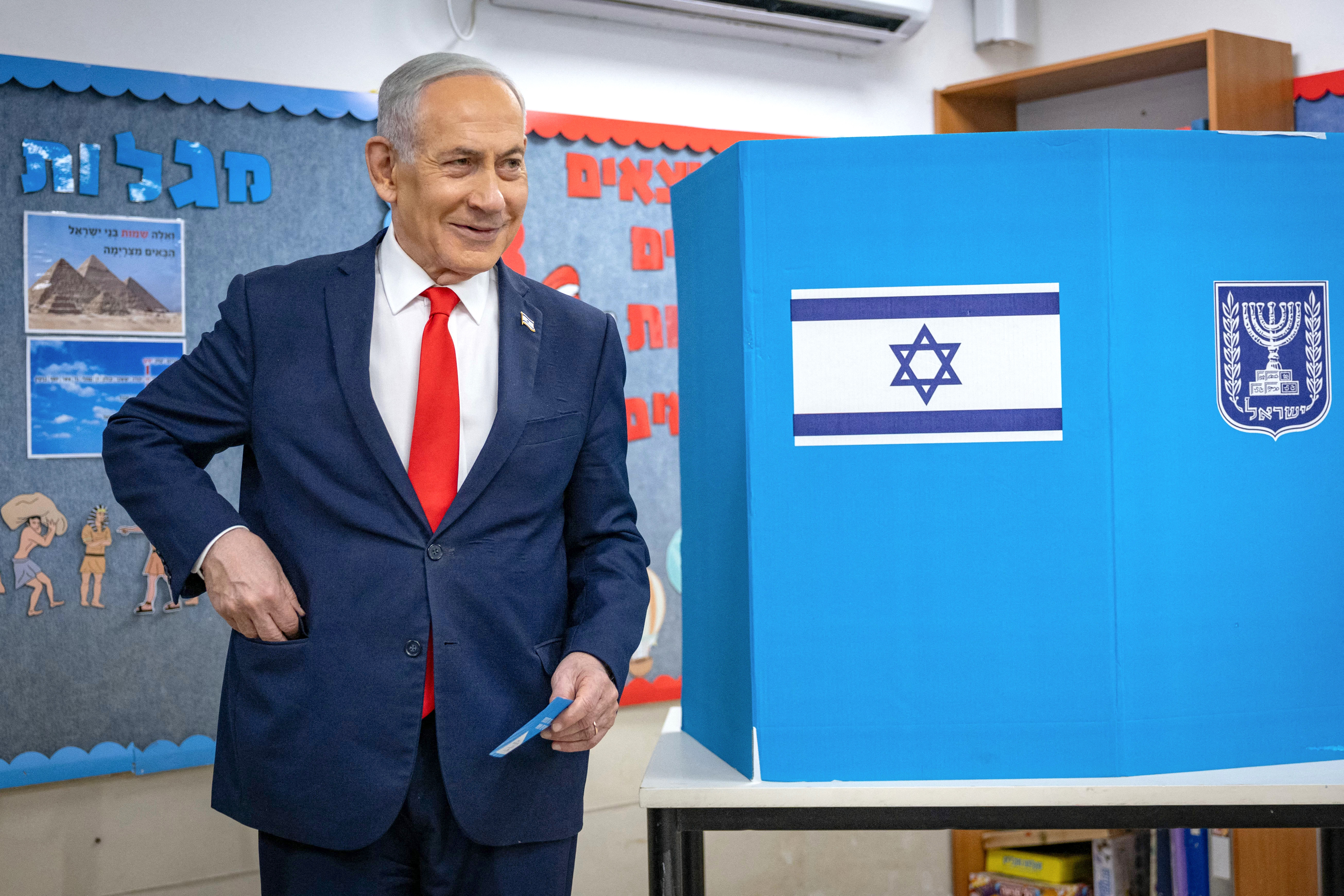

Vote tallying in Israel’s national election began on the evening of Oct. 27, and exit polls from Israeli media outlets showed no clear winner in a multi-party contest.
Early exit polling from Israel’s Channel 12 showed the Likud Party, led by Israeli Prime Minister Benjamin Netanyahu, projected to win 24 seats—the most of any single party. The same exit polling also showed that a bloc of opposition parties is together projected to win about 52 seats, positioning the opposition bloc ahead in the contest to achieve a governing majority of at least 61 seats in Israel’s 120-member Knesset.
The ballot count is not expected to be finalized until Oct. 30, after which it will be published on Nov. 4.
A party must win at least 3.25 percent of the vote tally to hold any seats in the Knesset.
In the likely event that no single party wins a 61-seat majority, Israeli President Isaac Herzog will choose the political party leader he believes is best positioned to form a governing coalition and give that party 42 days to form a multi-party government.
If no coalition is achieved after this first 42-day window, other party leaders may attempt to form a governing coalition before a new election may be called.
The 2026 Israeli election comes a little more than three years after the Oct. 7, 2023, Hamas attacks and ensuing war in the Gaza Strip and is seen as a referendum on Netanyahu and his Likud-led coalition government.
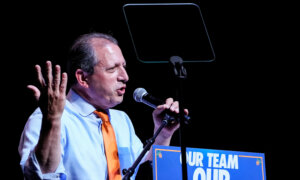
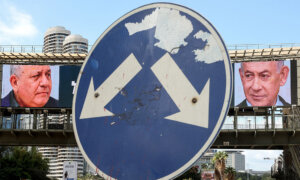
The Yashar Party, led by former Israel Defense Forces chief of general staff Gadi Eisenkot, is the leading opposition party projected to win 22 seats. He and his party have called for the formation of a new government commission to review the Israeli response to the Oct. 7 attacks.
Eisenkot has all but ruled out forming a government with Israel’s Arab parties, complicating his path to power. A Channel 12 exit poll showed a projected Likud-led coalition with a narrow 52–49 edge over the Yashar-led coalition, leaving neither party with the numbers needed to form a majority government.
The Arab Joint List and Ra’am parties were projected to win 18 seats.
With nearly 42 percent of the ballots counted, the Likud-led bloc was still short of a 61-seat majority, with a projected 57 seats to the Yashar-led bloc’s 47, according to local media reports. The Arab parties sat on 16 seats according to the partial count, compared with 17–19 in exit polls.
The deadlock could work in Netanyahu’s favor, leaving him in office as a caretaker prime minister during what are likely to be prolonged coalition negotiations or even until another election can be held.
The Oct. 27 election also comes about eight months into an armed standoff between Israel and Iran.
U.S. President Donald Trump, who ordered U.S. forces to join their Israeli counterparts in bombing Iran on Feb. 28, recently endorsed Netanyahu’s reelection bid.
Ahead of election day, Netanyahu raised warnings that Iran may attempt to disrupt voting. In response, Iranian Foreign Ministry spokesman Esmail Baghaei said the outcome of the Israeli election “makes no difference” to Tehran.
Partway through election day, the Likud Party filed a petition to extend voting hours past 10 p.m. local time, when polls were originally set to close. Eisenkot challenged the petition, saying there had been no exceptional event to justify such an extension of hours.
Israel’s Central Elections Commission declined the Likud petition but has said voters in line before 10 p.m. would still have their ballots counted.
The commission reported voter turnout of 77.7 percent—the highest in more than two decades and around 7 percentage points higher than in 2022.
Throughout election day, Netanyahu and members of his current governing coalition also raised the alarm about high voter turnout in left-leaning communities and among Arab Israelis.
“My brothers and sisters, right-wing voters, if we don’t go out to vote, we'll get a government of the Muslim Brotherhood,” Netanyahu said in one election day post on X. “The turnout in the strongholds of the left and the Arab sector is breaking records.”
High voter turnout could make it harder for smaller parties to clear the threshold needed to win Knesset seats.
Israeli Finance Minister Bezalel Smotrich, who is a leader in the Likud-aligned Religious Zionist Party, called for right-wing voters to avoid casting ballots for smaller right-wing parties and instead choose the larger ones within Netanyahu’s coalition.
“The chance of the small right-wing parties passing the electoral threshold is zero!” Smotrich wrote. “The right’s victory depends on voting for parties that are certain to pass the electoral threshold.”
Eisenkot also issued last-minute appeals for voters to make Yashar the top party in the ballot tally, in hopes of persuading Herzog to grant him the first opportunity to form a governing coalition.
Reuters contributed to this report.