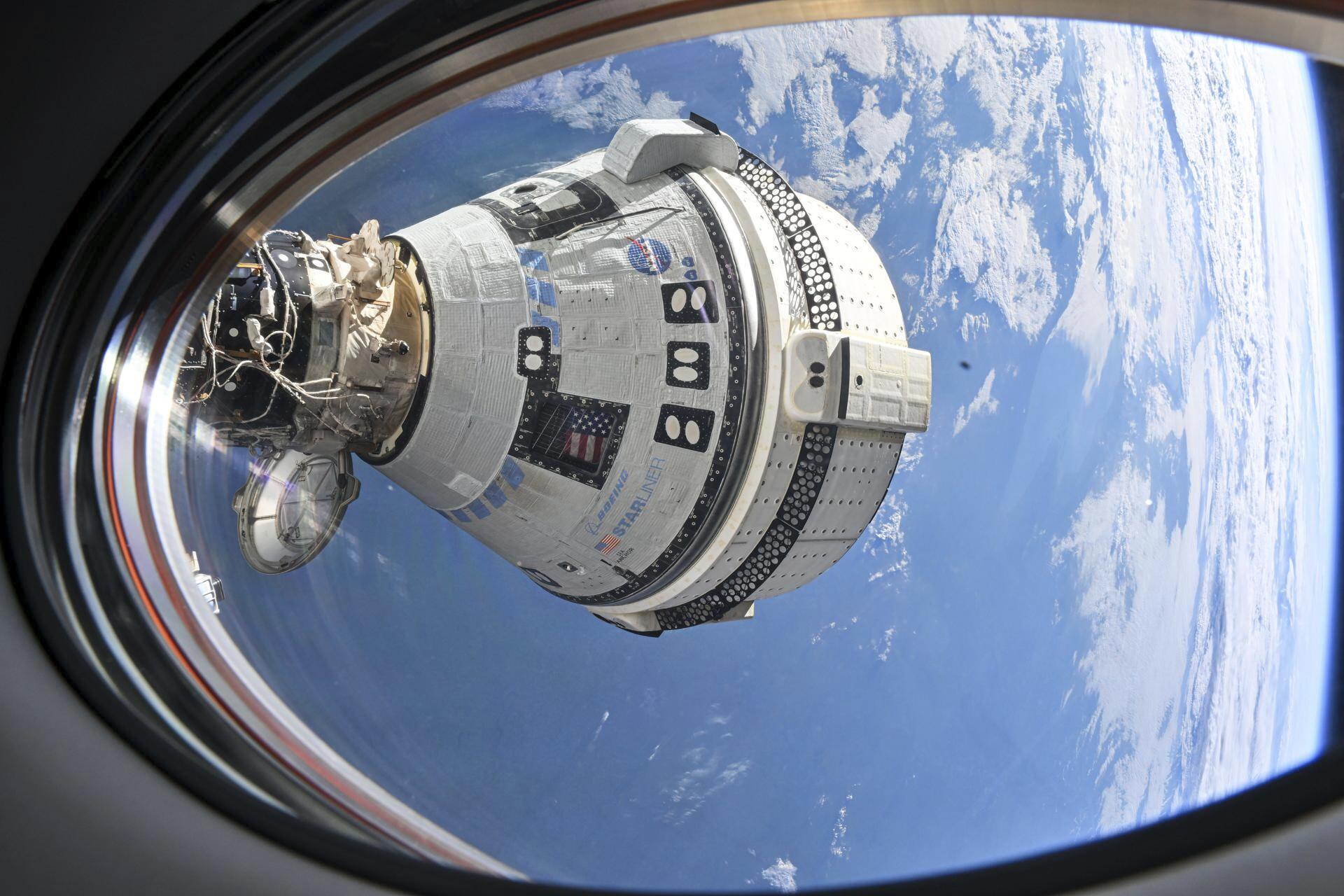

NASA and Boeing leaders announced that the Starliner spacecraft built to carry astronauts to and from the International Space Station could fly by the end of the year.
Persistent technical mid-flight failures, particularly with its thrusters, climaxed in 2024, when two astronauts lost significant control of the spacecraft on their way to the International Space Station, and as a result, they stayed aboard the orbital outpost for nearly 10 months.
But after two years of internal and third-party investigations, leaders of both teams told reporters on Sept. 28 that they were confident that all technical and cultural problems with the Starliner program had been identified and that they were far enough along in resolving them to announce two upcoming flights.
The first flight, Starliner-1, will be an uncrewed mission to the space station that is expected to launch as early as December 2026.
The second flight, Starliner-2, will be the first crewed mission. It will be commanded by NASA astronaut Woody Hoburg, and Boeing and NASA hope to launch the mission by mid-2028.
Hoburg was introduced at the press conference and began his opening remarks by thanking astronauts Butch Wilmore and Suni Williams, who flew the ill-fated crewed flight test (CFT) that extended their two-week mission for several months as they waited for a SpaceX Crew Dragon to bring them home.
“CFT, as you know, was a remarkably challenging mission, and Butch and Suni conducted themselves with the utmost professionalism, competence, and humility throughout the mission,” Hoburg said. “They are American heroes, and I am deeply humbled to follow in their footsteps.”
Structurally, the Boeing Starliner needed redesigned thrusters on both the crew module and service module to ensure better corrosion control and thermal control. It also needed new hydrogen seals, new batteries, improved parachutes, and a higher-frequency data collector.
These new systems will be tested to a great extent during the uncrewed Starliner-1 mission as further advancements are implemented on the crew-capable spacecraft for Starliner-2.
However, NASA’s investigation also found significant cultural problems that needed to be resolved. Hoburg noted that a major problem was a failure in systems integration that left gaps in hardware qualification. The helium leaks and thruster failures were due to failures on the ground, not in space.
“We now know that the hardware damage occurred before liftoff,” he said. “It is, I believe, critical that we deeply understand not just the hardware issues themselves, but the conditions that allowed major quality gaps in critical systems to go unnoticed, so that they cannot surprise us again.
“We must provide evidence to demonstrate that all Starliner subsystems have been reevaluated for qualification due to the misses in operational environments. That work is underway today.”
That said, Hoburg still had a lot of praise for the Starliner, calling it a “pilot’s spacecraft.”
He said that “off-nominal events,” moments when something goes wrong during a mission, have been a focus.
“These were exercised during CFT, and along with our expert flight control team, the manual control capabilities on Starliner were critical to achieving a safe docking despite numerous thruster failures,” Hoburg said.
Dana Weigel, manager of NASA’s Low Earth Orbit Program, said that once the Starliner returns to flight operations, she hopes to use it for as many missions as the SpaceX Crew Dragon and utilize it for other future destinations in low Earth orbit besides the International Space Station.
NASA Administrator Jared Isaacman said he expects to have five Starliner missions planned, utilizing the soon-to-be retired Atlas V rocket from United Launch Alliance (ULA). The space agency has an option to pick up a fifth and sixth mission, and Boeing is looking into using the ULA’s Vulcan Centaur rocket to carry the capsule. To make that happen, testing needs to be done on both vehicles and follow NASA standards to ensure Vulcan is certified to carry astronauts.
Isaacman also said he expected SpaceX to eventually phase out the Falcon 9 and Crew Dragon crew transportation system, and he considered Starliner’s return to flight operations as “the fastest path to preserving reliable crewed access to low Earth orbit.”
The International Space Station is set to be retired in 2030, and Weigel told reporters that crewed missions currently go up to Crew-17. The Crew-13 mission is set to launch Oct. 1, and Crew-14 astronauts were only recently announced. After that, it is unclear which astronauts will be selected for those later crews. Even Hoburg has yet to be given a crewmate.
Isaacman said he hopes to maintain the baseline demand of at least two astronauts going to space every six months for commercial crew providers such as Boeing and SpaceX.