
HOUSTON—The first astronauts to fly around the moon in more than 50 years are finally back where they started.
NASA’s Reid Wiseman, Victor Glover, and Christina Koch, as well as Jeremy Hansen of the Canadian Space Agency, returned to Houston at about 3 p.m. CT on April 11, less than 24 hours after they splashed down in the Pacific Ocean inside their Orion crew capsule, Integrity.
Launching from Florida’s Kennedy Space Center on April 1, those four pioneers took Integrity on a 10-day test flight that covered more than 700,000 miles at speeds nearing 25,000 miles per hour. They went farther from Earth than any other humans in history, and saw things humans have never seen with their own eyes.
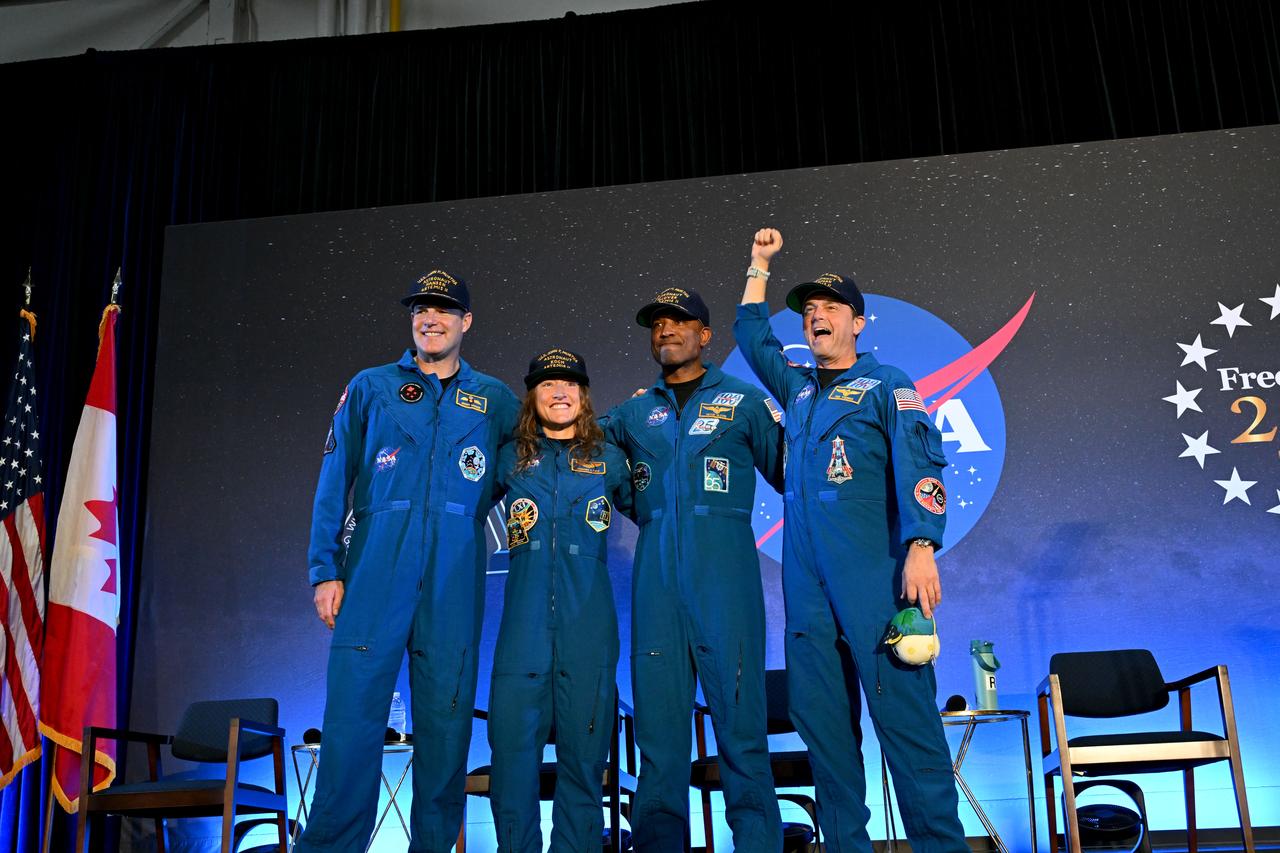
Dressed in their blue flight suits and wearing hats bearing the name of their U.S. Navy recovery ship—just as the Apollo astronauts did on their return—the crew members of Artemis II reunited with their families and made their first post-mission public appearance in front of their fellow astronauts, politicians, and members of the NASA workforce that made their mission possible.
“I have not processed what we just did, and I’m afraid to start even trying,” Glover said. ”When this started ... I wanted to thank God in public. And I want to thank God again, because even bigger than my challenge trying to describe what we went through is the gratitude of seeing what we saw, doing what we did, and being with who I was with. It’s too big to just be in one body, and I wanted to thank our families for everything.”
Each statement was bookended by rounds of applause, hugs, and emotion. Each astronaut, in his or her own words, affirmed that the crew members will forever be bound together by their shared adventure, by their love for their families, and by the fact that there is really no place like home.
“Man, this was not easy, being 200,000-plus miles away from home,” Wiseman said. ”Before you launch, it feels like it’s the greatest dream on Earth. And when you’re out there, you just want to get back to your families and your friends.
“It’s a special thing to be a human, and it’s a special thing to be on planet Earth.”
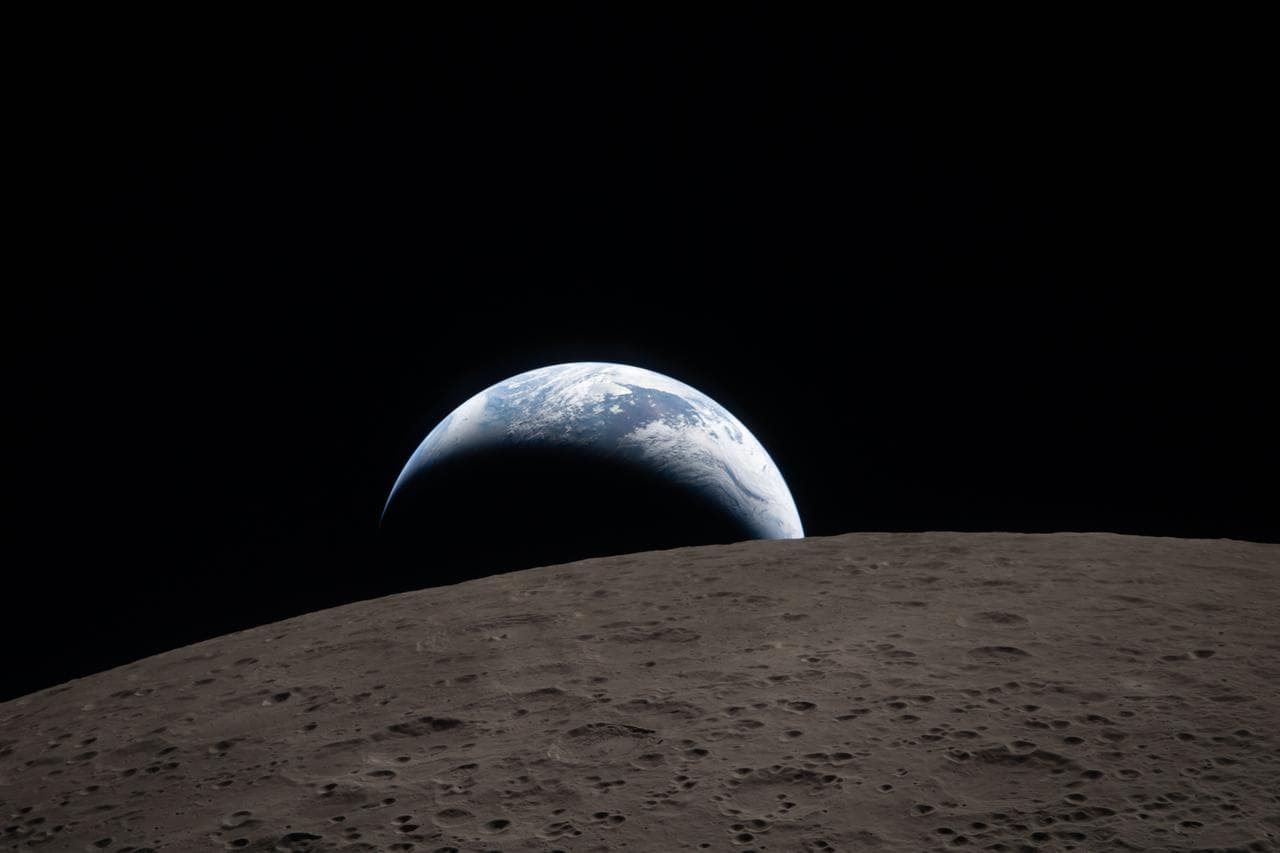
Earthset captured through the Orion spacecraft window at 6:41 p.m. ET on April 6, 2026, during the Artemis II crew’s flyby of the moon. (Courtesy of NASA)
An Unforgettable Moonshot
The astronauts were introduced by NASA Administrator Jared Isaacman, who told Wiseman that his hopes of Artemis II’s mission being forgotten and overshadowed by the extraordinary missions to come will never happen.
“Artemis II will always be remembered,” Isaacman said. ”It was the moment we all saw the moon again, where childhood dreams became missions. You helped the world start believing again, and this is something no one’s ever going to forget.”
“On behalf of NASA and the space-loving community from around the world, thank you for showing us your courage, your professionalism, your unity, and your humanity,” he said. “Thank you for showing us the moon again. Thank you for showing us planet Earth again, and thank you for contributing to the greatest adventure in human history.”
An outline of that contribution was touted by Artemis II mission leaders throughout the mission, closing with a final post-splashdown news conference on April 10.
Wiseman, Glover, Koch, and Hansen flew a total of 700,237 miles, including a record 252,756 miles from the surface of the Earth. Integrity’s crew capsule and European service module performed exceptionally well. Its translunar injection burn was so accurate that multiple scheduled course correction maneuvers were canceled. It demonstrated precise and responsive manual flight capabilities, reaching a peak velocity of 24,664 miles per hour and splashing down within a mile of its target.
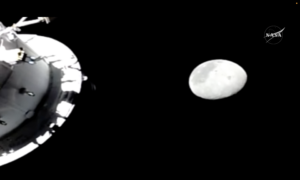
The spacecraft’s windows and camera-mounted solar array wings unveiled areas of the lunar far side that were never seen by Apollo astronauts and gave the world a front-row seat to new views of the moon, the Earth, and a solar eclipse. It hosted the first ship-to-ship communication from astronauts in deep space with astronauts on the International Space Station, and it carried and collected treasure troves of lunar science and human science data.
And importantly, it brought the crew home safe and sound, blazing the trail for a lunar landing in 2028 and all the ambitions beyond it.
“We sent four amazing people to the moon and safely returned them to Earth for the first time in more than 50 years,” said Lori Glaze, acting associate administrator for NASA’s Exploration Systems Development Mission Directorate. “[To] the generation that now knows what we’re capable of, welcome to our moonshot.”
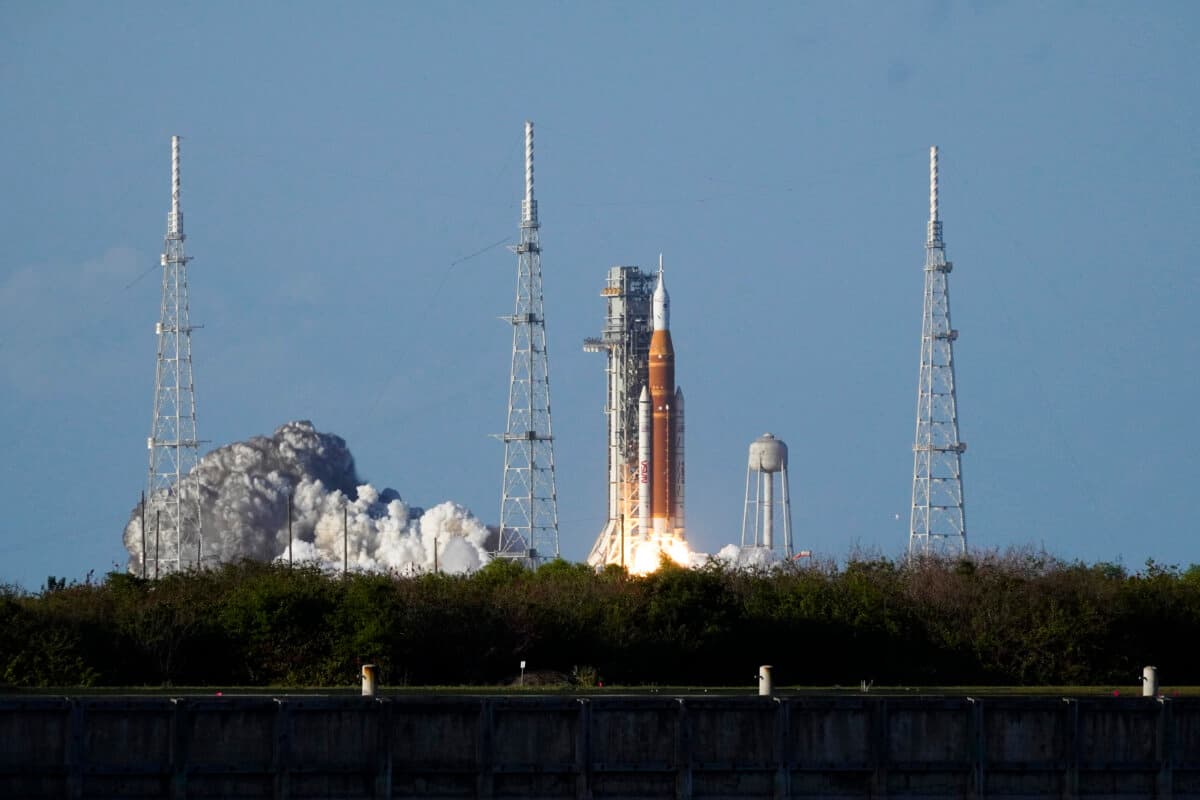
The NASA Artemis II Space Launch System rocket and Orion spacecraft blasts off at the Kennedy Space Center in Cape Canaveral, Fla., on April 1, 2026. (T.J. Muscaro/The Epoch Times)
Up Next: Artemis III
As the crew members prepared to make the final leg of their journey back to Houston from splashdown near San Diego on April 10, NASA Associate Administrator Amit Kshatriya said splashdown day belonged to the engineers and thousands of people who built the spacecraft in which the astronauts flew their mission.
Artemis II’s launch was the manifestation of projects 15 years in the making. The Space Launch System moon rocket was approved by the federal government in 2011. Now, it opens the door for NASA to fulfill manned lunar ambitions left untouched since 1972.
“This program faced every obstacle an institution could face,” Kshatriya said. “The team faced each one with work, and tonight is the proof. But that work needs to continue.”
Up next is Artemis III. Set to launch in mid-2027, that mission will launch a crew into Earth orbit inside an Orion spacecraft with upgraded software and hardware from Artemis II and a fully tested manual flight control system. Its job will be to demonstrate rendezvous and docking capabilities with one or two of the lunar landing spacecraft currently being developed by SpaceX and Blue Origin.
Mission leaders said progress toward that mission is already underway. For example, elements of the solid rocket boosters are already being delivered from the testing and manufacturing facilities in Utah to Kennedy Space Center, and the moon rocket’s core stage was scheduled to be delivered on April 20.
An unmanned Mark 1 version of Blue Origin’s Blue Moon lunar lander completed its gauntlet of tests at the Johnson Space Center this week. In a matter of months, it will launch on an unmanned test flight targeting the Shackleton Crater near the lunar south pole, a crucial prerequisite before NASA approves the vehicle for human transport. SpaceX was also closing in on the first launch of its latest version of Starliner, a predestined workhorse for NASA’s lunar base development.
“The path to the lunar surface is open, but the work ahead is greater than the work behind us,” Kshatriya said. “It always will be. Fifty-three years ago, humanity left the moon. This time, we return to stay. Let us finish what they started. Let us focus on what was left undone.”
As for who will be part of the next crew, mission leaders declined on April 10 to give any details, including whether or not Artemis II backup crew members—NASA’s Andre Douglas and Jenni Gibbons of the Canadian Space Agency—will be assigned to a future mission.