
Turns out your memory might not be waiting until retirement to start slipping.
A brain-imaging study published in July in the journal Cerebral Cortex found that people aged 50 to 60 were only about two-thirds as accurate as people in their 20s at remembering not just what they saw, but what it went with.
“This is one of a growing list of studies highlighting that the period of middle age is really important for memory functioning and shouldn’t be ignored,” study co-author Ian McDonough, an associate professor of psychology at Binghamton University, said in a statement. “For a long time, most studies have been focused on young adults versus older adults.”
Memory Changes by Midlife?
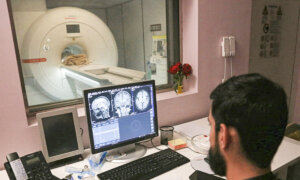
Imagine lying in an MRI scanner as you are shown a series of faces, each paired with an image of an everyday object or scene. After a five-minute period of rest, you see the faces again, this time with four possible images next to each one. Your job is to choose the one that was originally paired with it.
This isn’t a simple memory test. Researchers call this associative memory, or the ability to remember which details belong together. You might remember seeing a particular landscape or lamp, for example, but still be unable to remember which face went with it.
In the study, 61 healthy adults completed the task: 17 people aged 18 to 30, 21 people aged 50 to 60, and 23 people aged 61 to 74. Younger adults got the pairing right about 36 percent of the time, on average, compared with about 24 percent among participants in their 50s and 20 percent among those in their 60s and early 70s. The difference between the middle-aged and older groups was not statistically significant, meaning that, statistically, the 50-somethings’ performance looked more like the oldest group’s than like their own recent past.
What Was Happening in the Brain
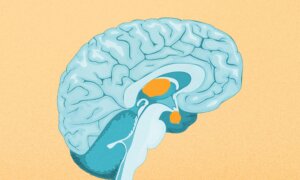
Researchers also scanned each participant’s hippocampus—a small, seahorse-shaped brain region that helps people form and retrieve memories of events—at three points: while participants learned the face-image pairs, while they rested afterward, and while they tried to remember them later.
The idea is that during rest, the hippocampus may reactivate aspects of a new memory, a process scientists think can help lock it in.
In younger adults, the more similar someone’s hippocampal activity was while learning to his hippocampal activity later while recalling, the better he tended to do on the test. That connection weakened in the 50s group and disappeared almost entirely in the oldest group.
Among the older groups, another, more counterintuitive pattern emerged. The more similar someone’s brain activity was across learning, rest, and recall, the more likely he was to make a specific kind of mistake: choosing an image from the wrong category—for instance, selecting a scene when the correct match was an object.
The researchers call this “misbinding”—essentially, the brain mixing up which details go together. Their interpretation: A brain pattern that sharpens memory in younger adults may become less precise with age, making it more likely to blur details together rather than keep them straight.
McDonough stated that reactivating the hippocampus in a way that normally supports learning was, in this case, “associated with those errors” rather than better memory performance.
So, Is 50 a Turning Point?
Not necessarily.
The study does not show that everyone’s memory starts declining at 50, or that forgetting something in midlife signals a problem. The researchers tested one specific kind of memory in a laboratory—not the everyday skills that help us remember an appointment, follow a conversation, or learn a new skill.
And the study cannot tell us exactly when these changes begin. The study included no participants in their 30s or 40s, and the researchers compared different age groups at one point in time rather than following the same people for decades. Individual performance also overlapped substantially across age groups.
As McDonough put it: “We really don’t have a good scientific understanding of what is happening in middle age, because the brain isn’t declining uniformly across this time, with some regions declining faster than others.”
There’s another wrinkle worth keeping in mind: Not every memory lapse means that the brain is losing its ability to remember. Sometimes the problem starts earlier—when a memory forms.
Memory formation depends in part on attention. When attention is split—by a phone alert, a second conversation, or simply a mind elsewhere—we may not take in an experience well enough to form a memory we can easily recall later. It can feel like forgetting, even though the information may not have been strongly encoded in the first place.
That is not just common sense. A 2021 study found that divided attention during learning impaired not only memory for individual details, but also the ability to link related details together—the same kind of memory the July study looked at.
Larger, long-term studies that follow the same people over decades, rather than comparing different age groups at a single point in time, could help pin down exactly when the decline starts, and how much it varies from person to person.
Still, the findings point to something researchers have often overlooked: Middle age may be an important period for understanding how memory changes.
“Finding when those tipping points are is going to be important,” McDonough said.