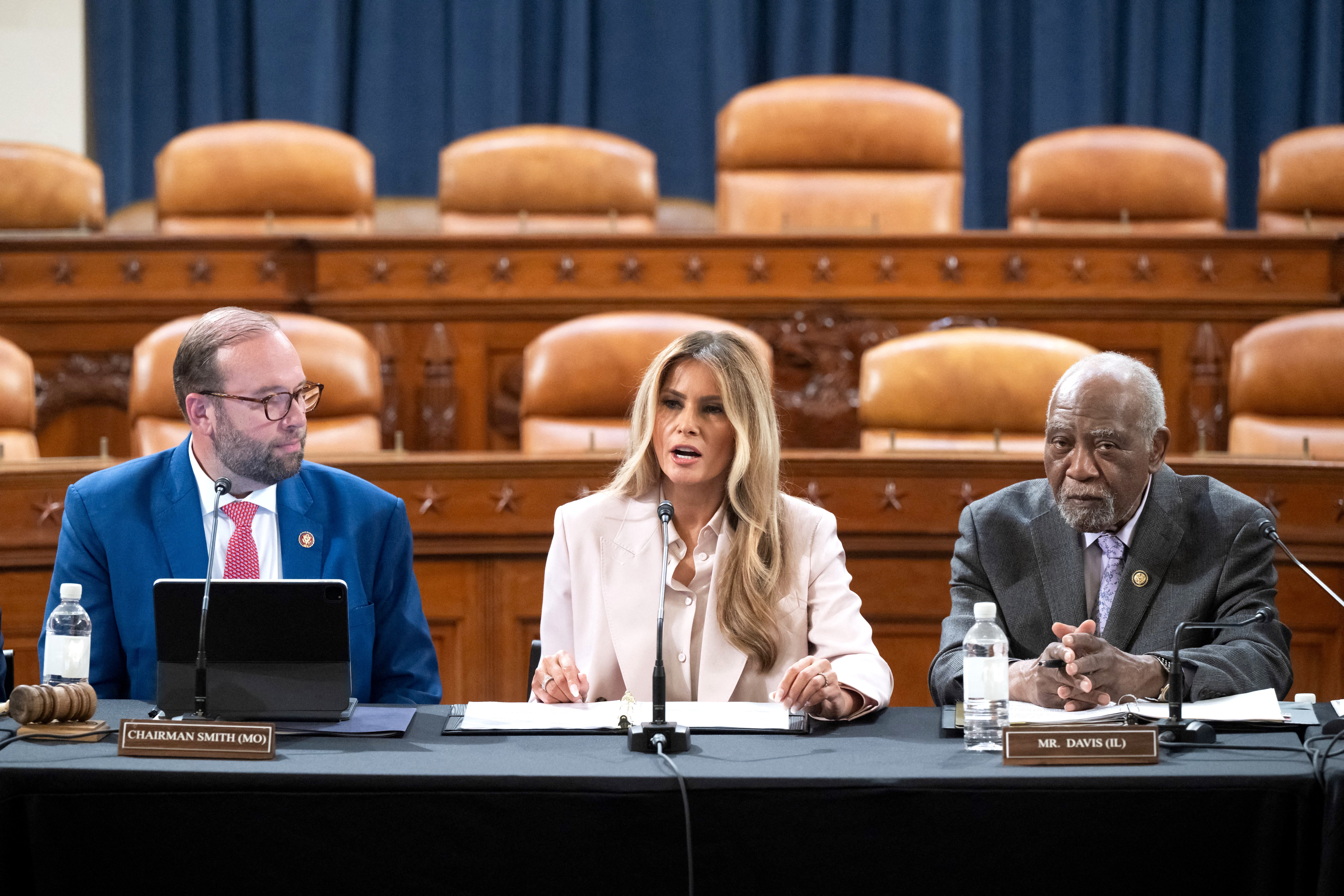

First Lady Melania Trump appeared on Capitol Hill on April 15 to promote a slate of bills that would change the assistance offered to children aging out of the foster care system.
Trump spoke to the House Ways and Means Committee in support of the legislation and to urge for reform, which she called a “moral imperative.”
“As parents and leaders, it is our ethical obligation to ensure American children develop emotionally and physically within a safe environment,” Trump said to the full committee.
The hearing was part of Trump’s Fostering the Future initiative, which aims to provide those in the foster care community access to higher education and add more overall support for vulnerable children.
Trump said that while reports vary, it’s estimated that around 3 percent of those in the foster care community earned a college degree in 2025.
“We can close this gap, but still, foster youth face a special set of challenges outside the classroom that have a serious impact on their academic performance,” Trump said. “These issues include housing, disability, educational efficacy, financial barriers, transportation continuity, access to technology, and other related issues.”
The legislation in question includes six bills to improve the John H. Chafee Foster Care Program for Successful Transition to Adulthood program.
The reforms include modernization of the program rules to reflect the current economic challenges foster kids experience when exiting the system.
They would strengthen accountability and tracking to ensure that housing, employment, and education opportunities are available to youths in need.
The legislation would also improve access to job training and financial literacy, as well as expand flexibility for how states can use the funds available to support foster youths transitioning to adulthood.
The roundtable discussion included testimony from two individuals formerly in the foster system who recounted challenges they faced entering and graduating from higher education institutions.
Aside from changes made during the COVID-19 pandemic, the Ways and Means Committee has only increased funding for the Chafee program by $3 million in the last 27 years, according to Congress.
Rep. Darin LaHood (R-Ill.), who serves as the chairman of the Work and Welfare Subcommittee, underscored the need for additional support. He noted a study that found that around one-third of foster youth experience homelessness by the age of 21.
Trump went on to say, “My goal is to prepare these individuals to secure entry-level jobs, become financially independent, and eventually, innovate, create new businesses, and generate employment opportunities.”
Trump announced that more than 20 universities, including Vanderbilt University, University of Miami, University of Texas, Ohio State University, and Louisiana State University, now educate students who have been involved in the Fostering The Future program.
Those schools, and others, have added tuition assistance and other resources to assist former foster kids in pursuing higher education.
“Beginning here in this room, we can once again change people’s lives,” Trump said. “With new legislation, we can ensure that opportunity is more than hopeful for individuals in the foster care community—it can be their birthright.”