
In 2020, more than half of Californians voted in favor of Proposition 19, a revenue-generating ballot initiative to tighten rules on inherited properties.
Prop. 19—named The Home Protection for Seniors, Severely Disabled, Families, and Victims of Wildfire or Natural Disasters Act—reshaped how property can be passed down in California, making it far harder for parents to transfer real estate to their children without triggering substantial increases in property taxes.
“I called it the wolf in sheep’s clothing,” Lalit Kundani, partner at Bridge Law LLP, said in a recent interview with Siyamak Khorrami, host of EpochTV’s “California Insider.”
The outcome essentially altered key components of 1978’s Proposition 13, particularly regarding inheritance rules and senior tax-based transfers.
Under Prop. 19, children who inherit a home can keep part of their parents’ low property tax assessment only if they move in and use it as their primary residence. If the home’s market value exceeds the allowed $1,044,586 threshold, the excess is reassessed and taxed at 1 percent.
Removing a parent from a deed, transferring property to a child, or inheriting a home—even in cases involving co-ownership or special-needs heirs—now triggers a reassessment to full market value. For many families, this would likely lead to a dramatic property tax increase the moment that ownership changed, contributing to financial strain for residents across the state, according to estate planning attorney James Burns.
“The first thing I’m seeing is a lot of people are unaware of it; they come in to my office thinking that they’re going to just take over mom and dad’s house and they’re going to do what they want with it,” Burns said on “California Insider.”
“We have to rain on the parade and tell them, ‘Well, back in around February 2021, when this law came into effect, it limited your ability to enjoy that property directly from your parents and receive a step up in basis in the property tax.’
“[That means] having a complete reassessment at today’s fair market value, which for most families, will force them to have to sell, and they have to do that within a year.”
To win voter support, Kundani said, the Prop. 19 campaign emphasized the initiative’s property tax portability relief for older homeowners and disaster victims. The measure allows homeowners older than 55, those who are disabled, and wildfire victims to transfer the lower assessed property value and tax base of their home to a new property in the state.
California Professional Firefighters stated that Prop. 19 would lead to new revenue in the aftermath of wildfires.
“The wildfires California has experienced in the past few months make it abundantly clear that additional resources are needed,” Brian Rice, president of California Professional Firefighters, said in a statement. “The funds from Prop. 19 will make a difference in fire protection and emergency response to safeguard millions of California homes and lives.”
The real goal, Kundani said, was to bolster housing turnover.
“If more Californians were forced to sell their property, then [California and the National Associations of Realtors] was going to do its job,” he said.
“But of course, you can’t just come out and say that. Like many propositions, they had to find a sheep to dress up the wolf in. And the sheep was 55 and over, elderly wildfire victims, victims of natural disasters.”
The California Association of Realtors said it would cause a “housing economic recovery” in the state by opening up “thousands of housing opportunities,” effectively “making homes more readily available for first-time homeowners, families, and Californians throughout the state.”
Despite the framing, the measure barely passed in the Golden State.
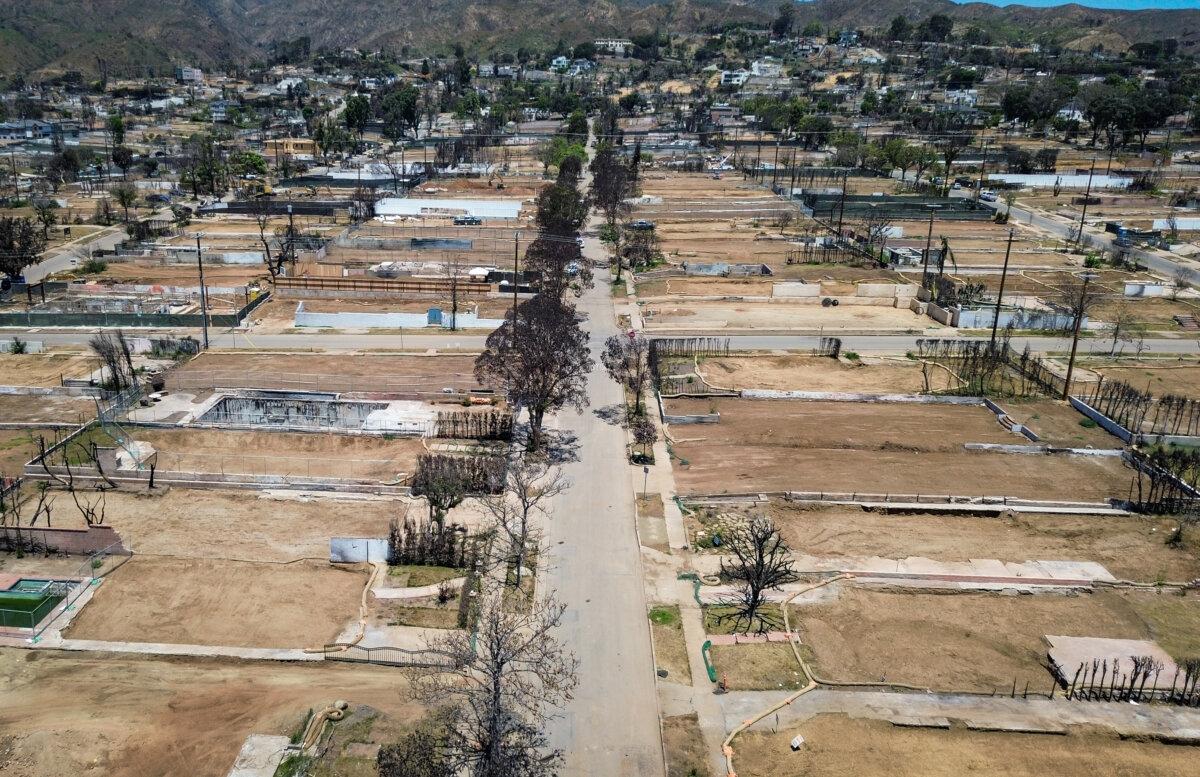
The property lines of homes burned during the Palisades Fire are visible in the Pacific Palisades neighborhood of Los Angeles, on June 9, 2025. (John Fredricks/The Epoch Times)
Of the approximately 15 million votes cast, Prop. 19 received 51 percent in support.
The razor-thin outcome has left opponents hoping to overturn the ballot measure.
Repeal Initiatives
Over the past few years, there have been multiple attempts to roll back some provisions or to repeal Prop. 19 altogether.
Many who support what is sometimes called the Repeal the Death Tax Initiative want to restore the parent–child and grandparent–grandchild exclusions and allow inherited homes and rental properties to retain their tax base.
The Howard Jarvis Taxpayers Association has introduced a new initiative called the Save Proposition 13 Act.
Prop. 13 capped property tax rates, limited how much assessed home values can increase, and required a two-thirds vote for new local taxes.
This measure, the group says, will close a loophole that “has allowed unconstitutional tax increases to take effect if they were proposed by a citizens’ initiative instead of by a city council or other government body.”
“The ‘Upland’ loophole has become a weapon of special interests to raise taxes,” the organization stated.
But although local support is growing, any repeal attempt may face an uphill battle because of projected property tax revenues.
Before the vote, the Legislative Analyst’s Office estimated that Prop. 19 would create a massive windfall for schools and local governments.
“Local governments could gain tens of millions of dollars of property tax revenue per year. These gains could grow over time to a few hundred million dollars per year,” the Legislative Analyst’s Office said in a report.
It said that schools could likewise experience such gains.
To date, it remains unclear how much total revenue Prop. 19 has generated for either schools or local governments.
But California Secretary of State Shirley N. Weber has said that overturning Prop. 19 would reduce revenue for local governments and schools “by around $1 billion per year in the first few years.”
“These losses would grow over time, reaching around $2 billion annually,” Weber said in a November 2025 statement.
Kundani said he is optimistic that Prop. 19 could be dismantled.
“The reality is, if we could get this back on the ballot, my prediction is most Californians overwhelmingly are going to try to repeal Prop. 19,” he said.