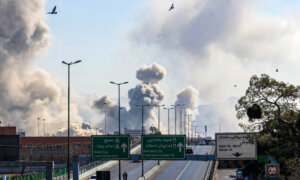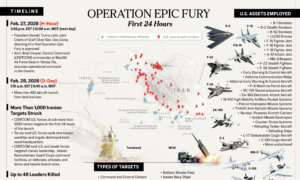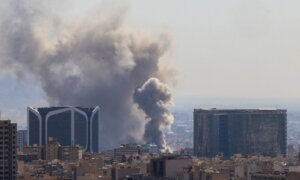

The latest U.S. strikes on Iran have put China’s oil supply chain to the test. As the world’s largest energy consumer and a net importer of crude, Beijing has long treated energy security as a core national priority.
Chinese leader Xi Jinping has repeatedly emphasized the need for self-reliance in energy supplies.
“The energy rice bowl must be held in our own hands,” Xi said in 2021, a phrase that has since become a slogan for his energy policies.
The latest conflict involving Iran has underscored the vulnerability of that “rice bowl.”
Tune in to China Watch, a podcast on Chinese politics, technology, and business.
According to energy consultancy Wood Mackenzie, the Iran War significantly affects the crude oil market, with 15 million barrels a day (mbd) under threat, five times the comparable impact of the Ukraine War.
In comparison, China’s total oil imports last year were 11.6 mbd, more than 70 percent of its total demand of 16 mbd. Beijing is expected to respond by adjusting its oil shipments and import sources, and by tapping into its crude stocks.
Two-thirds of China’s crude oil demand is acquired via the seaborne market and is potentially exposed to the supply disruptions in the Gulf region, Emma Li, analyst at oil analytics firm Vortexa, told The Epoch Times.
In the Middle East region specifically, Iran and the other Gulf states account for about half of China’s global oil imports.
With the Strait of Hormuz practically closed, most of the Middle East’s oil supply cannot reach the market, according to Wood Mackenzie.
Gulf states, including Saudi Arabia and Iraq, have suspended or reduced their oil production at various sites.
Diversion of China’s Oil Sources
China has already ramped up its oil imports from Russia during the first two months of this year, according to Vortexa.
The year-on-year increase in average seaborne inflows from Russia to China is nearly 50 percent, said Li.
The volume rose from an average of 1.2 mbd last year to this year’s 1.8 mbd.
Before the latest U.S. and Israeli military action, Iran significantly increased its oil exports.
Vortexa reported its exports above 2 million barrels a day, one of the highest levels in history.
Although China still imported most of the Iranian oil, it scaled down from last year’s 1.4 to 1.7 million barrels per day to this year’s 1.2 mbd, according to the oil-market intelligence firm.
China Likely Concealing Iran Imports
China stopped reporting its imports from Iran in 2022, according to data from Global Trade Tracker.
For comparison, in a January report, Columbia University’s Center on Global Energy Policy noted that China’s official oil import data from Malaysia far exceeded Malaysia’s production capacity, and that much of Iran’s and Venezuela’s oil was likely rebranded as Malaysian.
Analysts’ consensus is that the magnitude of the war’s impact on the global oil market depends on how long the Strait of Hormuz remains closed.
Vortexa estimates China’s total crude stocks at 1.3 billion barrels, about four months of seaborne imports at last year’s average rate.
In a client note on March 5, Vortexa described the de facto closure of the Strait of Hormuz as a “financial blockage just as effective as a naval one.”
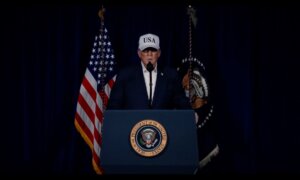
Two days prior, a day after Iranian state media reported that Iranian forces would enforce the strait closure, President Donald Trump signaled that he could use U.S. Navy escorts and government insurance issued by the U.S. International Development Finance Corporation to maintain the flow of energy.
The corporation announced on March 6 a plan to provide insurance companies with up to $20 billion in coverage for war-related losses in the Gulf region.
China’s Ministry of Foreign Affairs has urged an immediate stop to military operations.
During the annual assembly of China’s rubber-stamp legislature on March 5, China unveiled its economic growth target for 2026. This year, the goal is below the benchmark 5 percent rate, at 4.5 to 5 percent.