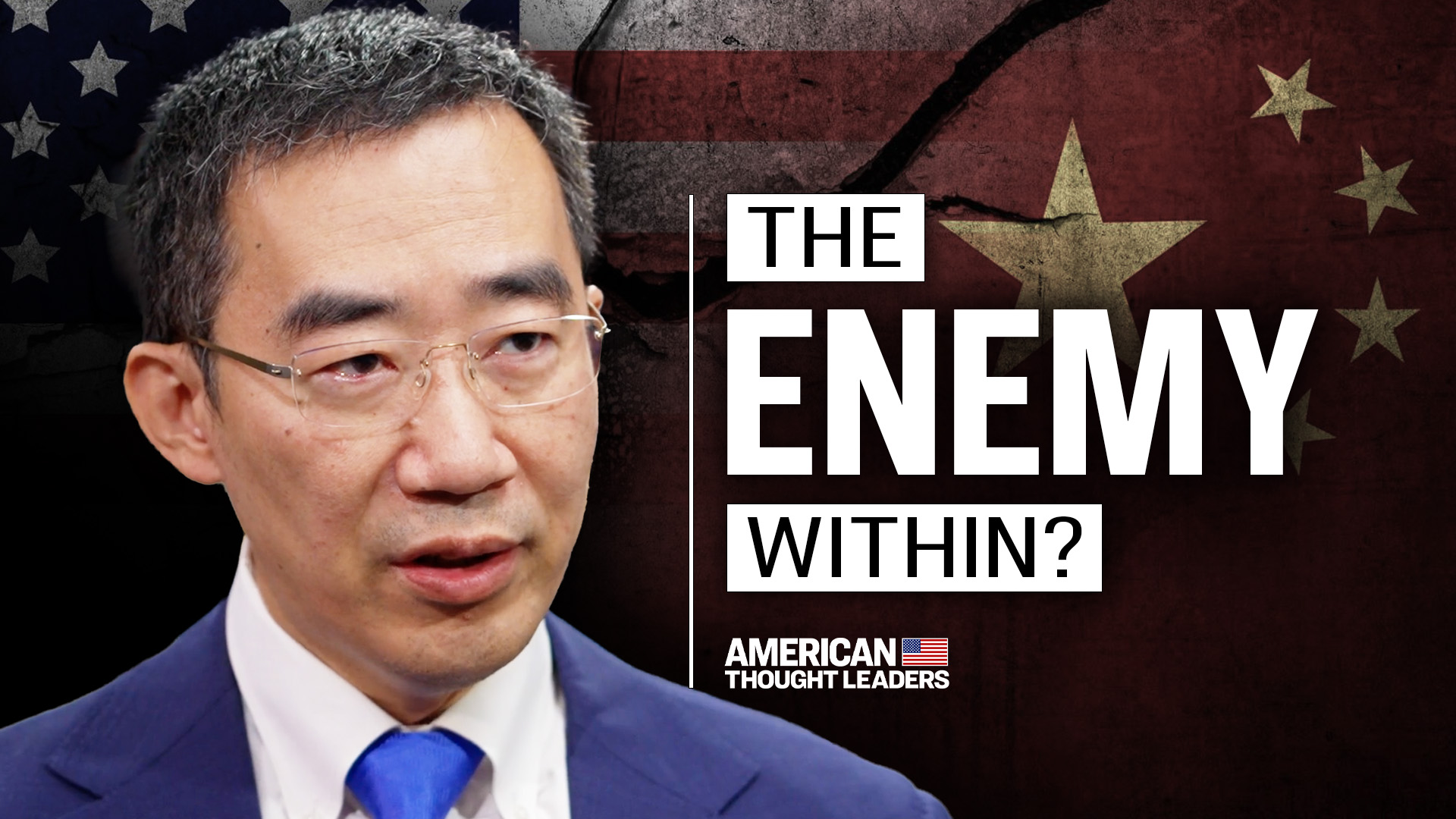

[RUSH TRANSCRIPT BELOW]The values Americans hold dear—such as freedom of speech, religious liberty, and democratic elections—are weaponized by the Chinese Communist Party (CCP), says Tianliang Zhang, an author, historian, and popular commentator on China affairs.
In this episode, he argues that the CCP devised a master plan called “America against America” to exploit those very freedoms and openness in order to undermine U.S. interests.
The concept was developed by Wang Huning in 1989, chairman of China’s top political advisory body, the Chinese People’s Political Consultative Conference (CPPCC).
“But how to implement that, that’s the unrestricted war,” Zhang says.
Unrestricted warfare is a CCP doctrine of leveraging everything as a tool of war, whether it be fentanyl, the media, or election integrity.
How is this war waged in practice? The transnational repression targeting Falun Gong practitioners is one such example.
The Falun Gong meditation practice was popular in China during the 1990s. An estimated 70 million to 100 million people took it up, crediting it for health benefits and mental well-being. In 1999, the CCP unleashed a nationwide persecution, subjecting the practitioners to various abuses, including slave labor and forced organ harvesting.
“CCP sees it as [the] number one threat in its history … so they use American media, they use the freedom of speech here, they use the justice system here to persecute Falun Gong [practitioners],” Zhang said.
The CCP’s goal, Zhang says, is to “eliminate all the independent thoughts” that do not conform to communist ideology.
Zhang is the executive producer of the new film, “China’s Stealth Invasion.”
Views expressed in this video are opinions of the host and the guest, and do not necessarily reflect the views of The Epoch Times.
RUSH TRANSCRIPT
Jan Jekielek:
Tianliang Zhang, such a pleasure to have you on American Thought Leaders.
Tianliang Zhang:
Thanks for having me.
Mr. Jekielek:
Recently, President Trump gave a speech about the 2020 election, about interference, and published a series of documents that have been declassified and others. One of those packages focuses specifically on the Chinese Communist Party’s efforts. What do we know about how the Chinese Communist Party [CCP] was involved in all this?
Mr. Zhang:
I think it’s not surprising at all. Going back to 1998, we have already known that the Chinese military was spending money to try to influence or support a specific candidate. And I guess that pattern just continued all the way up to now. The most surprising thing to me is that they have already stolen 220 million voters’ information from us. So I think this is a very, very serious national security issue.
I remember that the federal government wanted to collect all the voter information from different states, and they said we won’t give it to you because we don’t want it to be concentrated into one place, and then it will be breached, and somebody will steal that. But actually, it happened. Actually, China has already had that. And also, I read some news, probably unverified, that said that Chinese people have manufactured a lot of fake driver’s licenses and then shipped them to America and then registered them as voters. So I think this is very, very alarming.
Mr. Jekielek:
The bottom line, when you look through these documents around the Chinese Communist Party’s role, what facts come out? Because there’s a lot of discussion about this. It’s kind of a mess. Even around this issue of the 220 million voter records, you hear there’s some media that are saying, It’s just not a big deal. Those are available, right? So, what is it that these documents showed?
Mr. Zhang:
I think we can see a clear intention that the CCP wants to understand the voters, their partisan choice. And also, I think they are trying to look into their data and then see how they can manipulate their ideas. I think nowadays, with all this information on social media platforms, it’s very easy to target a specific person and tailor the information that he can see so that his opinion can be swayed. I think I have seen some kind of experiment.
They tried to manipulate voters’ opinions in the election in India. They did find it’s very, very effective. Then people were manipulated without knowing. I think with all the data and also with the platform the CCP controls, like TikTok, I believe they also heavily infiltrate into other social platforms like Facebook, Instagram, and they can change people’s minds to vote for the candidates that the CCP favors.
Mr. Jekielek:
One of the things that I did notice was that there were a number of documents saying that the Chinese Communist Party really didn’t want President Trump reelected.
Mr. Zhang:
The CCP believes that Biden is probably more easily manipulated and probably in their pocket. They know that President Trump is very, very tough on the CCP, especially since he started this tariff war or trade war with China. That never happened before the Trump era. So I think the CCP was kind of scared. And also, Secretary Pompeo was also very, very tough on the CCP. I guess the CCP was afraid that if Trump had a second term and with Secretary Pompeo, the CCP would be in a very, very hard position.
Mr. Jekielek:
Well, the new Secretary of State, Marco Rubio, is also actually sanctioned technically. This is actually, there’s kind of this interesting change in the language. Maybe you can remind us actually about the exact nature of this. But for Secretary Rubio to go to China, they actually altered the characters in his name. Can you explain that?
Mr. Zhang:
Interesting, because Marco Rubio, I guess the CCP never imagined that in the second term of the Trump administration, they would have an even tougher Secretary of State. Marco Rubio, actually, he was sanctioned twice. The first time was on the Hong Kong issue, and then the second time was on the Xinjiang issue. He was sanctioned twice, and he was not supposed to go to China, not allowed. And then because he is now the Secretary of State, and they have to allow him in, they changed his translation of his name. Same pronunciation, but a change of the Chinese character. This is a very subtle change. People really laugh about that.
Mr. Jekielek:
This is a bit into your expertise. They laugh about it, but it just seems like it’s not needed, right? They’re letting him in. Why would they do this? Explain to us the mentality here.
Mr. Zhang:
Just to save their face. They feel like they have to allow him in, but what will they do? Do you want to repeal the sanction, or do you want to maintain it there? Because if you repeal the sanction, it means you are surrendering. They don’t want to give people such an impression. They just change his name subtly.
Mr. Jekielek:
Basically, you’re saying it’s the most neutral way.
Mr. Zhang:
It’s the most face-saving thing they could do or something.And people can see that, but they still do that. Sometimes the CCP will do something that looks very, very stupid, but they do it nonetheless. So you can see Xi Jinping; a lot of people mocked him because his actual diploma is just a graduate from an elementary school. But meanwhile, he’s holding a PhD degree from Tsinghua University. In speeches, for many, many times, he read the Chinese characters with the wrong pronunciation. It seems like he was not very well educated.
On the other hand, you can see he published tens, maybe dozens of books of his thoughts. He can get his PhD when he is working in a very, very busy position, but he can still get his PhD. You can see that this is an obvious academic corruption, but he still does that. I remember that he went to Russia, he went to France, and some other countries, and he gave a speech by just reading a list of books he has ever read. It’s a long, long list, so people just mocked him.
Mr. Jekielek:
But he did it nonetheless.
Mr. Zhang:
Yes.
Mr. Jekielek:
And so, because why?
Mr. Zhang:
I think he did it just because his secretary gave the list, gave the speech to him. I don’t think he even read it before the speech. He just read it. So sometimes when you see his speech, and probably it’s also AI-made, but they just mark some difficult Chinese characters with a different Chinese character, but with the same pronunciation. And then when he reads it, they make sure that he doesn’t read it wrong.
Mr. Jekielek:
Fascinating. You introduced me to the book, America Against America. And of course, this is featured in your new film. But tell me, what is America Against America? What is it? When did it come out? And how does it relate to this election interference you’ve been discussing?
Mr. Zhang:
Okay, so this book was authored by Wang Huning, who is the mastermind behind the three generations of CCP leaders from Jiang Zemin to Hu Jintao to Wang Huning. He basically came up with a three-step strategy. The first step was during the Jiang Zemin era. At that time, it was right after all those Tiananmen massacres and also all those sanctions. So, the CCP was very weak and then had a very negative view all over the world. At that time, the basic idea is to hide your strength and buy your time.
Mr. Jekielek:
Right, Deng Xiaoping’s kind of maxim.
Mr. Zhang:
Right, yes. After the Tiananmen massacre, we see the Cold War finished. The Berlin Wall was torn down, and also the Soviet Union was dissolved. CCP’s idea because at that time they were both very weak militarily and economically, and they wanted to make friends. So when you see, like, whenever the CCP is very, very weak, they’re trying to make friends.
I remember in 1939, the CCP published a book called Introducing the Communist, by Mao Zedong. And Mao said, we had three magical weapons. The first one is the party building, so basically to build solidarity. And then the second one was armed struggle, meaning like we will never give up violence. And the third one is called the United Front Work.
So because the CCP was very weak at that time, and they always say like America is our best friend, and we admire what Americans have achieved. And we really like their system. We really like democracy. And they published a lot of articles at that time promoting democracy, praising America. So they did it for like 10 years, from 1939 to 1949, in their official, like the mouthpiece of the Chinese Communist Party.
And interestingly, in 1999, 50 years after the CCP became the ruling party of the country, people found, dug out, and republished all those articles. And they called it the pioneer voice or the pilot voice of history. So basically, they republished what the CCP published 50 years ago, but then that book was immediately banned. So from that story, you can tell that whatever the CCP said, it doesn’t count. So even though they signed the joint statement with the UK.
About Hong Kong’s status, they talked about one country, two systems. But in 2020, they passed the so-called national security law. And then they said, the statement we signed with the UK is now a document in history. So basically, it doesn’t count. So basically, when the CCP is very, very weak, they try to make themselves look good in other people’s eyes, and they try to make friends, and they try to capture some elites to support them.
So, this is called the United Front Work Department. And this is also exactly the strategy Wang Huning invented for Jiang Zemin. They call it the three represents. I don’t know whether you heard of that. It means you’re trying to make friends with everybody, like capitalists, with foreign governments. You try to make friends with everyone. And then when Hu Jintao became the leader of the CCP, that was in 2002.
A very, very important thing happened the year before. That was 2001, and China joined the WTO [World Trade Organization]. And suddenly, all the tariff barriers were removed, and then the CCP became the powerhouse of manufacturers. So basically, they can produce all those very cheap stuff and then flood into other countries, and then basically destroy other countries’ factories and also jobs. So this is the second phase: scientific development. It means we are developing our country in a scientific way.
Then, after 10 years, it came to 2012, and then Xi Jinping became the leader of the CCP. At that time, Xi Jinping felt like we are strong enough, so we don’t need to hide our strength. Now, we can openly tell the world that we will be the dominant force of the world. Basically, he talked about the shared future of humanity. So he means we need to change the international or the world order, which was established by the United States after World War II. And now, since we want to be at least a peer force, like a peer power of America.
By achieving this, you can see Wang Huning has been using the idea of America against America; using the so-called free market, and we use diplomacy to buy time. But basically, when you talk about the free market, it seems like nobody here will be against that, right? But then they are actually not a free market because the CCP was stealing intellectual properties, and the CCP was polluting the environment.
So they used kind of the national allowance to give it to all those factories, all those research centers to develop their own product and then dump it into other countries. When you look at a very specific example, it’s like Huawei. Huawei used to be very, very weak. But then we say, oh, we have such a large country, we have such a large population. So, Nortel, if you want to enter China, then you have to give us your technology.
Mr. Jekielek:
A company famously that died.
Mr. Zhang:
It’s like AT&T. Then they enter China and Huawei reverse-engineered their technology and then they start to build their routers and switches with the allowance from the government, and then they can sell it very, very cheap.
Mr. Jekielek:
Subsidy, like by allowance, you mean subsidy from the government, right?
Mr. Zhang:
Yes, a kind of subsidy. It’s the subsidy of the government and then they can sell it at a very, very cheap price. Nobody can compete with them. It’s half price, it’s a third price. And they can even give it to you for free for a few years and then you can pay me back later. So basically, they finance the product for you. And then nobody can compete. And then Nortel just died, it disappeared. I guess this is just an example.
So this pattern is repeated all over the place. So by doing this, when you talk superficially, it looks like a free market, but actually, it’s not. But they talk about the free market because that’s the value you treasure. That’s the value you feel like is not disputable. And you have to follow the rule. But actually, they are not following the rules. So that’s the problem. So they are using your rules to take advantage of you.
Mr. Jekielek:
And so how does so explain to me how the book America Against America fits into what President Trump recently talked about?
Mr. Zhang:
This is a very, very hot topic and even probably controversial. But I want to bring up a story. There was a very famous Chinese scholar called Jin Canrong. From time to time, he entered Zhongnanhai to give lectures to those top leaders of the CCP. And then he openly said that there are 435 congressional districts. And if we can have our manufacturers’ enterprises in every district, and if we are large enough, then we have enough money to support, like, a certain candidate.
Then, if we have a Chinese community large enough, then we can sway probably thousands of votes. Usually, in our election, the number of votes is very, very close, and 1,000 votes or 2,000 votes can make a great difference. He said, in that way, nobody will dare to stand against us or to stand against the CCP.
Then he said, we can turn the U.S. Congress into China’s National People’s Congress. So it means like every congressman, every senate is working for the CCP. So this is really, really scary. So when Jin Canrong said that openly, he said, we. Actually, we don’t know if he means we as China scholars, or we as the CCP. This is vague. But what he said is really, really alarming, because they’re abusing our election systems to put what they are like a figurehead or somebody they can control in place.
Mr. Jekielek:
Well, maybe just to get you to comment on this briefly: there have been all sorts of examples of the Chinese Communist Party capturing politicians or getting people to work on their behalf in different ways. And this happens actually not just at the federal level, but at the state level and the municipal level.
Mr. Zhang:
Right. It’s a long-term plan. Take Congressman Swalwell as an example. When he was very, very young, when he was like an entry-level politician, the Chinese government had already identified him, and then someone approached him and provided him with a kind of honeypot. I guess this is really, really common because in our society, usually an official is elected, holds office, and stays there for eight years. And then he’s finished and he’s moving on to something else. But for the Chinese government, they can plan for 40 years and they can carry it out step by step.
So, as I said, Wang Huning came here in 1989 or 1988 as a J-1 exchange scholar. He stayed here for about half-a-year and he observed this society. He found there are some things he can make use of, like so-called free market, democracy, freedom of speech, the independence of the justice system. They feel there are a lot of things they can make use of.
For example, in 2022, Xi Jinping held a meeting, a very high-level meeting, with the Public Security Ministry and also some other intelligence people. He said, our war against Falun Gong outside is like a total failure in the past. So, we have to have something new. And then they decided to launch war against Falun Gong on two fronts. One front is the legal front, and the other one is the media front.
So, basically, in this case, they are using the freedom of speech, so-called freedom of speech, to demonize Falun Gong by using American media. And also, because in America, everybody can sue everybody. So, they can sue you, and then probably they know they will lose, but then they really burden you with a very high attorney cost.
For example, the headquarters of Shen Yun Performing Arts is called Dragon Springs. There was a guy who lived in Tianjin for 15 years, then he came back. He’s a white guy, he stayed in China for 15 years, then he came back to America. Then he opened up a nonprofit organization near where Dragon Springs is. And then the only thing he did with his nonprofit organization was to sue Dragon Springs in the name of violation of environmental preservation law.
So he sued four times. And every time Dragon Springs had to respond. And then they had to hire an attorney. So, like, with all these lawsuits, they can easily spend a million dollars. And every time he failed, he brought up the same lawsuit again. You can see that this is the pattern. They don’t have to win, but they harass you.
Mr. Jekielek:
Kind of like wear you down financially. But there’s also reputational damage, right?
Mr. Zhang:
Yes. So that’s exactly what happened on Shen Yun Performing Arts. So they sue you and then they publish on the media saying they are being sued, they are being investigated. But actually, they not only do that, they spread all this information to all those theaters, all those venues, all those presenters, and try to scare them so that, you know, to make it hard for you to sell tickets.
Mr. Jekielek:
So, we’ve covered Shen Yun and these various hit pieces against Shen Yun, some lawsuits, and so forth on this show before. But, very briefly, for those that might not be familiar, you know, Falun Gong, ancient Chinese spiritual discipline. Why is the Chinese Communist Party, give me kind of a deeper picture, why is the Chinese Communist Party so particularly obsessed with this group?
Mr. Zhang:
I think one of the reasons, or the most important reason, I believe, that the CCP persecuted Falun Gong was because the teaching of Falun Gong is truthfulness, compassion, and tolerance. These three values are directly opposite of CCP ideology. For example, the number two guy, who is actually the assistant of Mao. He said, if you don’t lie, you cannot achieve anything. So basically, that’s what CCP believes.
So you can see, in CCP propaganda, it’s full of lies. Like they openly claim they didn’t kill anybody during the Tiananmen massacre, nobody died in the Tiananmen area. That kind of thing is open lies. And then they have already done so many things, so bad things in history, and they want to cover it up. For example, the Great Famine, like 30 years ago.
Mr. Jekielek:
The Great Leap Forward.
Mr. Zhang:
Yes, the Great Leap Forward and the famine that ensued. So, like 30 to 40 million people just died of starvation. So, if people just tell the truth and CCP will be finished. So, that’s why the first principle of Falun Gong, truthfulness, this is what CCP is most afraid of. And the second principle of Falun Gong is compassion. But the CCP talks about class struggle.They promote hatred.
I remember that the very famous philosopher Russell talked about Karl Marx. He said, Marxism is quite evil because if you want to make people happy, then your principle or your philosophy should be based on kindness and love so that you can make people happy. But the foundation of Marxism is hatred. Basically, they hate successful people who are wealthy, and they hate people with a good reputation and just want to destroy them. So that is directly against compassion, the second principle of Falun Gong.
And the third principle Falun Gong promotes is called tolerance. And again, the CCP talks about violence. They’re always trying to use violence to achieve their goals. They will arrest all the dissidents; they will gun down all those students in Tiananmen Square. They always use violence. So that’s directly against tolerance. So I think the CCP found that if everybody in China believes in Falun Gong, then their teaching, their philosophy, will be just abandoned; they will be deserted by the people.
But you need to understand that the CCP is a party built on an ideology. So if the ideological foundation is gone, then the party will collapse. So that was Jiang Zemin, I think. In 1999, he wrote a letter to the Politburo. He gave two reasons why he cracked down on Falun Gong. This was published in 2006 in China. He gave two reasons why he persecuted Falun Gong.The first one is that the number of followers of Falun Gong is too many. And the second reason was they believe in something other than communism. So that’s the real reason.
And after the persecution started, the Falun Gong group resisted it peacefully. That’s also what the CCP was very afraid of because, like in history, they can crack down on anybody, any group, including the president of China, Liu Shaoqi. He was persecuted to death. And even though a million people went to Tiananmen Square to protest, after they used machine guns to disperse people, you don’t see any mass gathering again.
Mr. Jekielek:
They sent the message.
Mr. Zhang:
Yes, resistance in large groups. But Falun Gong is very, very different because Falun Gong is more or less a kind of spiritual practice for each individual. So you cannot take it out of people’s hearts. And this is the first time in CCP history that they saw this kind of resistance from the grassroots on a large scale. Perseverance, even when they face torture, killing. You wrote the book, Killed to Order, right? Even when their organs were harvested, people still were very, very adamant. People still followed this teaching. So that was what the CCP was very afraid of.
Another thing is you saw a lot of democratic leaders during the Tiananmen movement, before the Tiananmen massacre. And then the CCP’s strategy is just to exile them, put them in other countries. When they are in other countries, they lose the connection with the Chinese people. Their voices are not heard. So, all these leaders of the movements are no longer a threat. But Falun Gong is different.
I think on the first day when Falun Gong was persecuted, Falun Gong practitioners established websites and started to use emails in chat rooms. People started to tell people what was going on. All these overseas Falun Gong practitioners were doing this—the truth. And then, okay, so then the CCP saw not only the resistance from inside China, but also outside China, and they’re like, bound together very tightly.
So I guess the CCP sees it as really the number one threat in its history. And therefore, they need to have something new, really like a new strategy to deal with this. And this is what we call transnational repression. And the problem is, as I mentioned, I mention this because the way they use is really Wang Huning’s philosophy: America against America. They use American media, they use the freedom of speech here, they use the justice system here to persecute Falun Gong.
I think there’s a very well-known case: a guy called John Chen tried to bribe an IRS agent just to repeal Shen Yun Performing Arts’ nonprofit organization status. Actually, the FBI found this scheme, and then an FBI agent impersonated the IRS agent and answered his call. Then, John Chen was caught, and he was convicted.
You can see that they are using the IRS, DOJ, and the media. Actually, they are using the Department of Labor in New York State and opened an investigation on Shen Yun. They are using the Department of Labor, the FBI, and state institutions as their tool to investigate a U.S. individual or enterprise. So, this is, I think, a very typical case of America against America, how it is implemented here on the soil of the United States.
Mr. Jekielek:
Tell me a little bit about your background because you, you know, there’s, you know, we even have a staff member here. Actually, one of the interns here was telling me that he watches your show regularly, right? On YouTube, very popular in Chinese, of course. I'll tell everyone. But tell me a little bit about your background. Of course, you’re a professor at Fei Tian College.
Mr. Zhang:
I want to say that I was born in China. So I grew up in northeast China. My father was a graduate from a college in 1963. But because his father, my grandpa, was kind of, in the CCP’s class struggle theory, their enemy. Then my father, after graduation, went to a small city in northeast China. Then my mother, her father was an entrepreneur, and they were very wealthy.
Then when the CCP came and they found out that they had a lot of money, they started to pressure their accountant and then to convict my grandpa, saying they didn’t pay tax. And then all the belongings were confiscated. Then my grandpa was very angry, and he went to the government to argue. Then he was put in a labor camp for three years. He was also put in a labor camp in northeast China. That’s where my father and my mother met. They married there in 1970.
I was born in 1973. It was still not open, and we could only receive information from the government, from textbooks. So, actually, I believed that the CCP was a great party and that they were working hard for the benefit of the people. And then in 1989, when I was 16 years old, the Tiananmen Massacre happened, right? It happened in Beijing. At that time, I was a 12th grader. I was kind of upset by the government. That year, I went to Beijing. I became a freshman.
For the first two weeks, there were no academic courses. The first two weeks were for brainwashing. So basically, for those two weeks, the CCP showed us all those videos or their version of the narrative and tried to tell us that those were rioters. They were disturbing the social order. They were creating trouble for people. And then that’s why it was justified for the government to use force.
So, after two weeks of brainwashing, I was totally convinced. I have to say that I think their propaganda is very, very powerful. If you only receive their information, you’re very easily convinced. And then I think I started to believe Deng Xiaoping’s theory. Deng Xiaoping said that this was the kind of cost we had to pay for the sake of the country’s development, for the benefit of everybody. So, we had to maintain stability.
My mother started practicing Falun Gong, and her illness was cured. My father followed, and then my father introduced it to me. At that time, I was working in a joint venture company. It was actually a company established for military purposes with Siemens. We were producing a telephone switch called EWSD [Electronic Digital Switching System]. It’s kind of like the 5ESS Switching System here in America.
At that time, the CCP didn’t say anything negative about Falun Gong. So it seems like he just left you alone. Fast forward, in 1999, the persecution started. Actually, there was an event before the persecution started. That was April 1999. Some of the people went to a magazine publisher because the magazine published something untrue about Falun Gong, and they tried to ask the publisher to take it down.
Mr. Jekielek:
To retract it.
Mr. Zhang:
Yes. And then suddenly some police came and arrested about 45 practitioners in Tianjin. That was April 23, 1999. And then two days later, we had a gathering outside Zhongnanhai. We wanted to appeal to the central government to release these people and also to give us the freedom of belief. I was there in 1999, on April 25, 1999. I was standing very close to the entrance of Zhongnanhai.
So at about 10 a.m., I personally saw Zhu Rongji, the premier, come out to talk to us. After that, there were various rumors that the CCP was about to crack down on Falun Gong. I remember on June 14th, I was on a business trip to a different city, and then I saw a newspaper. The headline of the newspaper said that the government had no plan to crack down on Falun Gong, and that it had the freedom of practice. That was June 14, 1999.
But actually, four days before that, on June 10, 1999, Jiang Zemin had already established an office dedicated to the prosecution of Falun Gong. But four days later, they told the whole world that they had no plan. The reason was that they tried to tell you that, you know, it’s safe, you come out, you can practice, and they can identify, you know, who is the leader and who is active, and then they can arrest them. Then on July 20, 1999, this persecution started. All those we call coordinators were arrested.
Mr. Jekielek:
People that were running the practice sites and so forth.
Mr. Zhang:
As volunteers. They were not paid. They just took their tape recorder to play the music and people could practice. All those people were arrested. Spiritual practice is very personal. I meditate at my home every day. I read Falun Gong teachings every day, but I don’t mingle with people.
Then, after I saw this news from Minghui’s website, which was established in June 1999, I followed some news there and I saw this. Then I felt like, okay, something was wrong. We needed to do something. We went to appeal to the central government, to Zhongnanhai again.
At that time, nobody could enter. So all the police surrounded Zhongnanhai, and anybody they suspected of being Falun Gong practitioners, they would take you away. So we failed to appeal the first day, and the second day, on July 22nd, we went there again. And then we were standing in Beijing’s sunlight. At that time, it was probably 104, 105 degrees Fahrenheit. It was baking.
Then the government called a few buses to come and bused us to a kind of local government. We were put there, the door was closed and locked, and we had to stay there. We tried to tell the government officials, the staff there, about the truth of Falun Gong. There’s a misunderstanding. We hope that you can convey the message. Like you wait until 3 p.m.
We were not allowed to leave, so we were sitting in the auditorium at 3 p.m., and suddenly all the TV signal was kind of cut. Suddenly, it was in the middle of something, but it was suddenly cut, and they started to broadcast the decision of Jiang Zemin that the persecution started. They demonized Falun Gong with all these so-called documentaries.
As I said, before that moment, I believed the government was doing everything for the people. But when I watched the video they made, the documentary they made, one thing struck me because one reason they said in the video why they persecuted Falun Gong was that Falun Gong was talking about the end of the world, like doomsday. And then they played a video clip of the master, the founder of Falun Gong.
I have watched the original version. The end of the world or doomsday does not exist, but they cut the word, does not exist And then I suddenly felt like I had been cheated for so many years. If they can cut just a few frames out of context, they know everything, but they choose these few frames to cut to make the meaning just the opposite. So I was so disappointed. And then I felt that I had been cheated for 20 some years by the government.
So, then I said to my wife, probably this is not somewhere we should stay, so let’s go to other places to pursue our freedom of belief. Then I came here as a graduate student. My major was in electrical engineering.
Mr. Jekielek:
So, how did you get out?
Mr. Zhang:
I took the TOEFL test, and the GRE test, and applied for admission in a…
Mr. Jekielek:
They didn’t know you were a Falun Gong practitioner yet?
Mr. Zhang:
I think the government knows and does not know.I didn’t go to Tiananmen to openly challenge the government. But on the other hand, I tried to tell everybody around me, like my coworkers, my family, my relatives, my classmates, my friends, even my customers. I tell everybody I meet about what the CCP was trying to frame up to demonize Falun Gong. So at that time, I think I told hundreds of people. Actually, I sent a mass email to hundreds of people in our own company.
Because the company is a joint venture company, and then the general manager was a German guy, and he was very sympathetic. He said he read the Süddeutsche Zeitung, which is basically a very influential newspaper in Germany. He said he knew the truth, and he asked, are you in danger? I said, probably yes. Then he said, we can send you to Germany.
Mr. Jekielek:
I see. So that’s a good point.
Mr. Zhang:
Yes, he was very sympathetic. And because my colleagues around me know me well. And they know that I was a hardworking, very friendly coworker. So we had a very good relationship. So even though I sent this email to hundreds of people, they didn’t turn me in. And then the problem was at that time, because a lot of practitioners went to Tiananmen Square to protest. My father, my sister, and my mother were all jailed. My mother was put in a labor camp for a year.
Then I think the CCP was focusing on Tiananmen Square instead of my grassroots work. Then I think in August 1999, Jiang Zemin basically escalated everything. Right before that, I came to the United States. If I had stayed in China, I would have been jailed for sure.
So, after I came here, because my major was electrical engineering, you know, it’s kind of not in humanity, not in history, but I really wanted to figure out why the CCP persecuted Falun Gong. I mean, all the reasons, all the explanations that were explained or published in the media, in those interviews, didn’t totally convince me. I feel like there must be a deeper reason.
And then I did a lot of research on Chinese culture and on the CCP, and then I suddenly realized this is an ideological war. So, this is nothing about politics. This is just an ideological war, or you can call it a spiritual war. Because Falun Gong holds an ideology or a principle that’s directly against the CCP, their teaching, their philosophy. So, that’s why there is no middle ground, there is no compromise. Only one will win eventually. So there’s no compromise.
Mr. Jekielek:
That’s interesting because, you know, I never imagined, like, would Falun Gong practitioners think of it that way? Like, there’s no compromise? I mean, Falun Gong functioned very well in communist China for quite a number of years, right, just growing sort of organically.
Mr. Zhang:
The difference here is ideological because Falun Gong people cannot adopt the CCP’s hatred, killing, violence, or lies anymore because of their righteous principles. And the CCP will not adopt Falun Gong ideology either. I remember that in the book 1984 by George Orwell, he said there are two purposes of the party. The first one is to conquer the surface of the earth, and the second one is to eliminate all independent thoughts. Those are the two purposes of the party in the book 1984. So I think the CCP really wants to conquer the surface of the earth.They are competing with America.
The second one is they really want to eliminate all independent thoughts. Falun Gong is apparently an independent thought they need to eliminate. This also explains why they need to crack down on Tibetan Buddhist monks and also dissidents because they have independent thoughts. They have to be cracked down. On the other hand, they said they want to conquer the surface of the earth, but I think the CCP understands that it’s not possible to do it militarily. You can see the purge.
Xi Jinping has already purged a lot of generals around him; all the top generals were purged. Because Xi Jinping doesn’t trust people, they feel like all these people were plotting against him. He’s really obsessed with his power, and he doesn’t want anyone to challenge him. So, the problem is a lot of people talk about the armed invasion of Taiwan. The CCP will invade Taiwan in 2027, which means next year, 2030.
But actually, I don’t believe Xi Jinping would ever do that because Xi Jinping doesn’t trust his generals. If he gave them the authority to command the military, if he gave them the guns, he never—I mean, he cannot imagine what they will do with that power and those guns. What if they turn against him? So I think if Xi Jinping wants to control a place, his strategy, no matter if it’s Taiwan, South Korea, the United States, or Australia, is exactly what he does here. That’s infiltration and subversion from within. That is America against America.
For example, in Taiwan, I’m sure Xi Jinping’s strategy is basically to control one party, name it KMT [Kuomintang] or any other party, and then probably control their Congress, and then they do something. And then they try to control the media of Taiwan. In Taiwan, they try to brainwash people, try to glorify the CCP, and to make Taiwan people feel like, okay, it’s nothing wrong to get united with the CCP. I think they use the same strategy in Taiwan. They’re using Taiwan against Taiwan. They’re using South Korea against South Korea. They’re using America against America.
But then the problem is we see the consequence. It’s very, very scary. And now, I guess, remember that I think Trump talked about Made in China 2025. He said China became the powerhouse of all that manufacturing, and then America’s supply chain, our factories, were destroyed. He wants to use tariffs to protect America. But it’s kind of late.
Xi Jinping didn’t mention Made in China 2025 again, but actually, they have already achieved the goal. Now it’s like 40 to 50 per cent of the manufacturing of the whole world is now done in China. So they have created this supply chain dependence. You see, Trump had this tariff war last year. Immediately, he backed down, because our rare earth minerals are dependent on China.
Mr. Jekielek:
He played his card, and the CCP played its card.
Mr. Zhang:
Yes. And 90 percent of antibiotics are from China.
Mr. Jekielek:
But do you think so? I want to ask you this since I have you here, but I felt like that when they did play the magnets card, right? The rare earth magnets card. Everybody needs them in substantial quantity. I almost felt that was like an escalation, really, because they’ve been using all sorts of leverage, but this was a kind of leverage which is kind of a very revealing kind of leverage, right? Like, we’re going to do this if you decide not to play along with what we want.
Mr. Zhang:
Exactly. And also, we see that 40 per cent of the chips in our weapons were produced by China. And 90 per cent of antibiotics were produced by China. So, it means if there is a war between China and the United States, we need to buy our weapons from our enemy. So, I mean, this is really, really scary to just think about it. So, I think we now see the consequence.
Also, the CCP, I guess they are using all kinds of ways to corrupt society, to sow division, like with fentanyl. They clearly know that fentanyl precursors were produced in China, and then they exported them to the United States. Every year, the death toll caused by fentanyl abuse is kind of like twice the number of the death toll in the whole Vietnamese war. So, this is like they are launching a war against us, but we just don’t know about it.
Mr. Jekielek:
In your new film, there’s a book that would be very familiar to the viewers of American Thought Leaders: Unrestricted Warfare. America Against America and the Unrestricted Warfare book, together they explain China’s strategy under the CCP. Explain that to me.
Mr. Zhang:
I think America Against America was a kind of philosophy that Wang Huning developed. But how to implement that? That’s the unrestricted war. So, they can control our infrastructure. You know about the Volt Typhoon hacker group, right? It was sponsored by the Chinese military to control the infrastructure of America, including the power grid and water supply. Also, they have another project called Salt Typhoon that was sponsored by the Ministry of State Security [MSS] whose purpose was to eavesdrop and collect data from American people. So, by looking at Salt Typhoon and Volt Typhoon, you can see they are actually at war with us without us knowing about it.
They have seen dozens of research papers on how to take down the power grid of America. They are using the real American power grid as the model to study which node to attack to blackout the whole country. This is kind of an unrestricted war. Also, fentanyl is really like an unrestricted war. This is like an open war 150 years ago or 200 years ago.
Also, I think they want to manipulate or maneuver the election result to put the person they favor into that position. I think all these, but the problem is we can give you a lot of data that looks very scary. For example, TP-Link is kind of a home router. And small enterprises are using TP-Link. But TP-Link has a backdoor, so that they can control that.
Mr. Jekielek:
So, first of all, it’s a Chinese company. And every Chinese company is under the auspices of the CCP.
Mr. Zhang:
Yes.
Mr. Jekielek:
And there’s the National Intelligence Law of the People’s Republic of China from 2017, which means you have to cooperate with the CCP for spying purposes, right? And all these routers are basically the perfect spying tool in 65 per cent of the homes.
Mr. Zhang:
Small enterprises.
Mr. Jekielek:
That’s astonishing. I mean, that’s, you know, why aren’t we talking about this all the time?
Mr. Zhang:
I don’t know, but I think I saw it, but people just didn’t pay attention.
Mr. Jekielek:
I mean, these things come up, blips, right? There’s a high-level staffer of a governor who is indicted. All this, it’s coming up all the time, but we kind of lose it in the news cycle, right? If a revelation is 65 per cent of routers used in America by small businesses and homes, roughly, right, that’s an astonishing level of exposure if all of them have a backdoor, right? And you know how data-hungry the CCP is, right?
Mr. Zhang:
Yes.
Mr. Jekielek:
That’s what I mean by saying, why aren’t we talking about this all the time, right?
Mr. Zhang:
Yes.
Mr. Jekielek:
But why aren’t we talking about this all the time? Why are there still TP Link routers in people’s homes?
Mr. Zhang:
I think Congress needs to do something and should ban it, I think. So that’s why I feel like if the CCP is using a whole-of-society approach to attack us, our response must also be a whole-of-society approach, which means everybody in this society needs to understand the CCP’s scheme, and we need to fight back. Actually, it’s very simple for us. For example, we just don’t use any electronic devices from the CCP. We buy some iRobots instead.
Mr. Jekielek:
It’s easy, except it’s not easy because they’ve had so much of the market, right? And it’s changing, I know.
Mr. Zhang:
Yes, it’s mainly the price. They can really build something that is very useful and very cheap. If you buy it from Taiwan or from other countries, then you probably need to pay twice, three times, even four times the price. That’s the reason they’re using the so-called free market and the WTO to dump all their stuff here. That’s why I feel we really need to raise awareness in this society. We need to, for example, uninstall all the apps, like WeChat, like TikTok, from my perspective, you know.
Mr. Jekielek:
Well, so explain this to me, right? Just, I think, a day or two after the president gives the speech about, you know, the 2020 election, points out how China is doing all these compromising activities, right, election-interfering activities. And the next day, it’s approved for TikTok to be on government phones or some government phones, right?
Mr. Zhang:
Maybe his reasoning is that now it is acquired by Oracle, an American enterprise.
Mr. Jekielek:
Has this been checked now? Is it true?
Mr. Zhang:
I have no idea. Actually, I had a theory. I said if you really want to make sure TikTok is safe to use, then open source it, like everybody sees the code. Otherwise, I’m very, very suspicious. There must be some backdoor. The CCP plants backdoors everywhere, like all those solar panels.They have a back switch. And it’s actually a kill switch, and the CCP can remotely control it. So, if one day China and the U.S. are at war, they can remotely shut down all those solar panels, then we'll have no power. And they have the backdoor in there.
To compete with the iRobot floor vacuum, now the CCP actually has its own version, much cheaper, and even better quality. But then it is actually moving around your house and mapping your floor plan. They are probably listening to what you’re saying; you just don’t know. So they have backdoors everywhere. The American people really need to be aware of that. Don’t use electronic devices made in China. I don’t use them. Also, I uninstall all apps that were developed in China.
Mr. Jekielek:
Very difficult, though.
Mr. Zhang:
Very difficult.
Mr. Jekielek:
I mean, it is shifting, but at least people need to know that.
Mr. Zhang:
But the problem is, people don’t know.
Mr. Jekielek:
Well, hopefully, a few people will learn from this episode.
Mr. Zhang:
Yes, if they see the movie, then they will see what the CCP was doing, and they will know what they should do, I think.
Mr. Jekielek:
Let’s quickly run the trailer of the film so people know what they’re in for.
Speaker D:
What is China quietly doing inside America’s most vulnerable systems?
Speaker E:
China’s hackers are positioning on American infrastructure in preparation to wreak havoc and cause real-world harm to American citizens and communities.
Speaker C:
If we don’t change course, we are going to live in a world where much of what matters to us on a daily basis, from our security to our health, will be dependent on whether the Chinese allow us to have it or not.
Speaker G:
It’s being called one of the biggest hacks in U.S. history.
Speaker H:
Chinese government-linked hackers targeted cell phones used by former President Donald Trump and his running mate.
Speaker G:
Has ByteDance spied on American citizens? I don’t think that spying is the right way to describe it.
Speaker I:
Chinese nationals have been caught smuggling potential agroterrorism fungus into the United States.
Speaker J:
Lawmakers on both sides fear that with control of U.S. farmland, China could manipulate U.S. food supply.
Speaker F:
I mean, we’re the United States, but they treat us like a colony. Fentanyl poisoning is now the leading cause of death in the United States for people under the age of 45. China controls every link in the chain.
Mr. Jekielek:
Tianliang Zhang, it’s such a pleasure to have had you on.
Mr. Zhang:
Thank you again for having me.
This interview was partially edited for clarity and brevity.