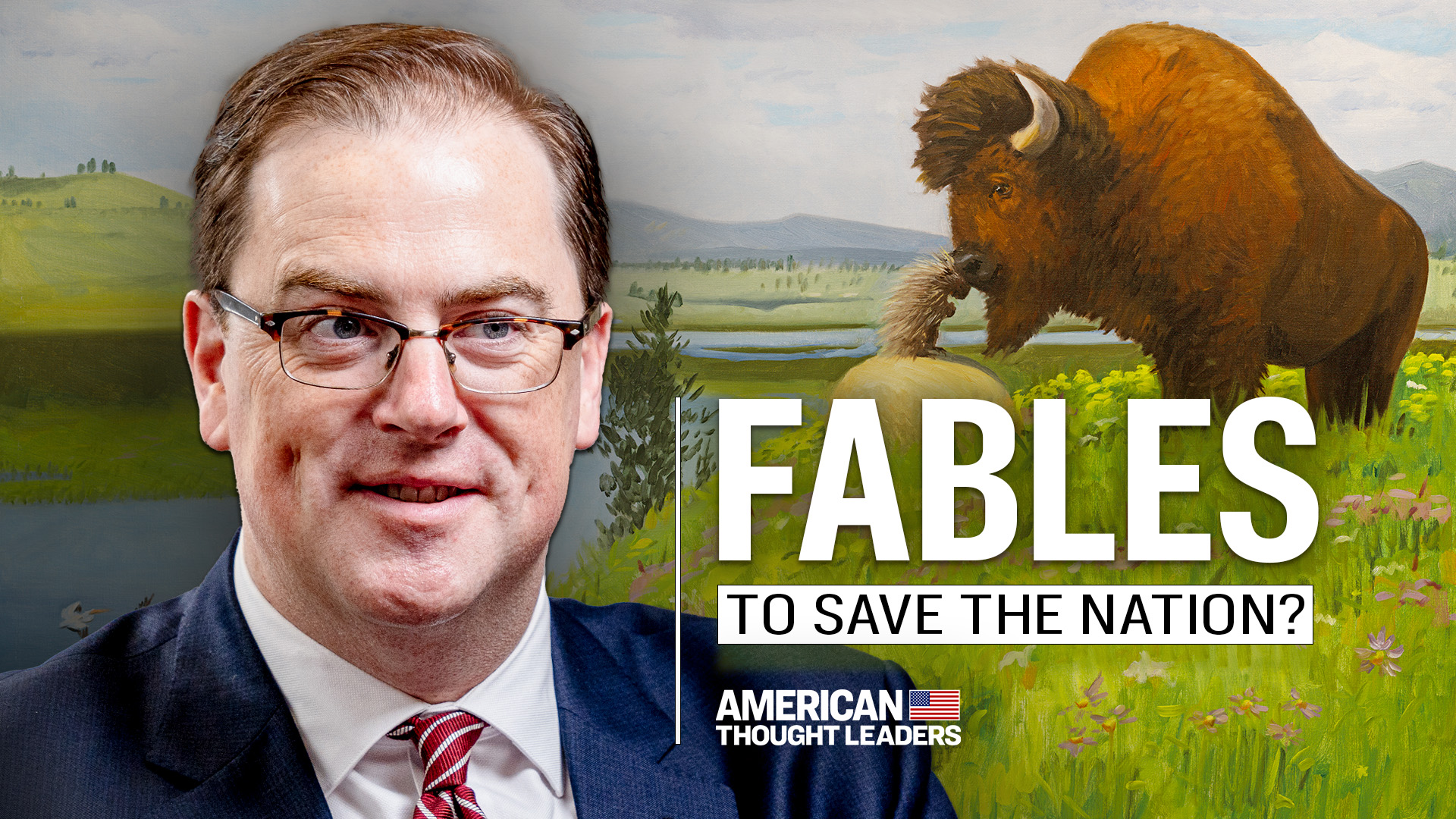

[RUSH TRANSCRIPT BELOW] There are few people who understand America’s history—both political and artistic—better than Matthew Mehan.
Mehan is an associate dean and associate professor of government for Hillsdale College’s Van Andel Graduate School of Government in Washington, as well as a best-selling author of children’s literature.
His recent book, “The American Book of Fables,” is a beautiful collection of fables celebrating the landscapes, virtues, and enduring principles that have shaped the American story.
In honor of the 250th anniversary of America’s founding, we discuss some of these timeless lessons on freedom, friendship, and the development of moral character.
On the importance of stories, he said, “American educators from the colonial period forward spent a great deal of effort to try to help people to have these virtues of civility, politeness, civic life, independence, rule of law, justice, truth telling, candor. In one sense, you can have a kind of ‘dark age’ version of these morals, but you have to have a much more adept, technologically advanced moral vocabulary and moral praxis, and that’s what fables and stories can do.”
Through adept storytelling, Mehan tackles important questions such as: What is true patriotism, and why is it a virtue? How ought we practice the art of civic friendship when there is so much to divide us? What was the Founders’ vision of American republicanism, and what practices ought we implement in our daily lives to foster love of country?
As Mehan argues, there is no better time than America’s semiquincentennial to reflect on the laws, the beauty, the places, the people, and the principles that gave rise to this great nation.
Views expressed in this video are opinions of the host and the guest, and do not necessarily reflect the views of The Epoch Times.
RUSH TRANSCRIPT
Jan Jekielek:
Matthew Mehan, such a pleasure to have you on American Thought Leaders.
Matthew Mehan:
Thanks for having me, Jan. This is wonderful.
Mr. Jekielek:
So perhaps one-and-a-half million people have come to America for the World Cup recently, and some of them are experiencing it for the first time. A meme has almost come out of these types of reactions. “My goodness, I had no idea this was what America was about. I’ve been lied to about America, lied to about America. Decades of anti-American propaganda obliterated in one summer,” is one of them. So, you know, aside from marveling at American food establishments like Buc-ee’s and so forth, they’re actually discovering something about the American disposition, something about the American spirit, and something that I think features deeply in your new book. Why don’t you tell me?
Mr. Mehan:
Yes, the American sense of hospitality, the American sense of friendliness, and the American sense of optimism. Those are three things that I try to push very hard throughout the book as a kind of celebration of our past, our founding, our history, but also our present, and to be sort of restored and strengthened. I love the fact that we are the first country since the Roman Republic that has our word for stranger as a positive word. So, howdy, stranger. The stranger is a friendly word in this country.
And I do think that seeing yourself as others see you is a huge gift. And that’s what we’re getting from the World Cup, even though I suspect some people put the World Cup here as a way to try to dilute our 250th anniversary with a kind of more international cosmopolitanism. But I think, insofar as anyone intended that, it’s totally backfired because it’s been actually a very stirring patriotic moment.
Mr. Jekielek:
It has been. And at the same time, it does highlight that what people have heard outside of America, about America, certainly recently or in recent decades, is a very different story, and almost a kind of nihilistic story, at least that’s the word that comes to my mind.
Mr. Mehan:
There is a lot of anti-American propaganda, I agree with that. But we’ve also presented ourselves in a pretty dark way through our arts. Our arts have not been very aligned with our character, our faith, our virtues, our way of life, our love of equality. Think of Game of Thrones or Breaking Bad, which is artistically excellent, but it is 40-plus hours of dark, horrible sort of meth underworld drug dealing, the fascination with antiheroes. We haven’t done a lot of sincere, straightforward, kind of Capra-esque, love of country, love of family, love of the good. We don’t do a lot of that art anymore.
And so I can understand why people would have a kind of strange, false impression from how we’ve put ourselves forward. I remember during 9/11 years ago when people said, oh, America is a paper tiger. It’s like, well, if you just watch, you know, sort of the sitcoms, you might think we’re sort of a vapid group of silly people.
But you need to go to, like, church on Sundays or Friday Night Lights football in Texas, right? Or a Fourth of July parade. You know, like, get a flavor for the real sort of what doesn’t get on camera very often. In my book, The American Book of Fables, that’s what we do. I traveled the country, I went all over, and I read through the history of the country to sort of get that, the local flavor, but also sort of the deep settler’s flavor, the settler’s spirit of the American character.
Mr. Jekielek:
Before I dive into that, I have to mention this. You know, on the flight back from London, I just came back from London, I watched the movie Casablanca. The shocking thing is perhaps that I'd never seen Casablanca before. My wife demanded it when she learned this. And of course, I fell in love with it. And patriotism is a virtue in Casablanca. American patriotism is a virtue in Casablanca.
Mr. Mehan:
Yes, this is something I’ve been speaking on for years, actually. As Associate Dean here at Hillsdale College in D.C., we also have the Kirby Center for Constitutional Studies and Citizenship, and so this has always been a focus for me. Patriotism is a really important virtue for a number of reasons. One, it’s just. People have sacrificed. They have built the country. They have given their lives. They have dedicated themselves to acts of heroism and suffering so that we could have. The Declaration of Independence, our Constitution, our independence from Britain, all of that, plus the settlement of the country, all of that kind of thing is just. But it’s also good for us. It’s good to do in itself, but it’s also good for us. Why?
Because if we do not have an attitude of gratitude, not to be all rhymey, but I am a children’s poet as well, if we don’t have that attitude of gratitude, you actually don’t have the motive force to continue to be another link in that chain of generous sacrifice and service to others. Because gratitude is actually the motive force of all duty. There’s not another. It’s a fundamental part of the natural law of human beings that if you are ungrateful and you don’t see that you’ve been given anything, you feel no duty to give back to others. So patriotism is of the utmost importance.
Mr. Jekielek:
Not that I want to make this interview an analysis of Casablanca, but isn’t this what happens? You have Rick, who’s basically neutral. He’s been kind of demoralized somehow, and anything goes, and it’s fine. And at some point, things look very dark, but he gets motivated, and he finally finds that gratitude. And then you’re trying to help Americans remember with this book. One of the things you’re trying to do is remember the amazing things, the amazing realities, the founders, the geography, all of it. But there’s something that has to happen to make that leap if you’re not there already.
Mr. Mehan:
Yes, part of it is imitation, right? He sees the patriotism of others, and he sees love of country or countries themselves—that which you love—threatened, right? Sort of the occupation. And so I do think that seeing, getting an outside view, can be very helpful. But I also think it’s important to think of America: if we’re not patriotic, then others can’t imitate us. They can’t see our way of life and imitate it. So our patriotism is actually the strength of others.
That’s a lesson I take from Casablanca: sort of what you see, the love of country in others, actually causes you to, wait a minute, they love their country, so I should love mine. In America’s case, I am an American exceptionalist. I think we have an amazing story. There’s so much to be thankful for. It’s just an embarrassment of riches we’ve been given from the previous generations and from a provident God with this beautiful land.
But yes, I think that there is a, you’re right, there’s a switch that can flip, and I think America 250, the semi-quincentennial, is a kind of key moment to try to flip that switch in a lot of people. That’s why I really wanted to sort of pile on to the festivities with a big book, because this is a kind of moment when everyone’s sort of thinking back, how should I love my country? What is my country? There’s a sort of reflection that anniversaries like this always beget, and that’s what I really wanted to insert a kind of narrative history.
And like you said, it’s a shared memory. That is what actually unites a people. They have a shared memory that they love of themselves and their history. Even if it’s adoptive, like if you’re an immigrant, you adopt the history, right? It’s your story now because you inherit the laws, the beauty, the place, the people, the sentiments, right? But that’s a shared memory of the past. And if you lose it, you’re in real trouble.
Mr. Jekielek:
It’s like the culture has forgotten the language of how all this works. These are things that we used to learn about. I guess we'd call it civics, right? I don’t think even a lot of people know what that word means today.
Mr. Mehan:
Civility, right? Civics, the civil life, politics, and politeness. These are words that are co-located for a reason, right? It’s like, how do you work well with others, right? The social virtues, as Cicero would put it. It’s civics, but it’s also, in a certain sense, almost a teaching about the humane, about what it is to be human. And I do think this is one of the reasons why I gravitated towards fables as a genre. People need moral technology, if you will. I know it’s a sort of novel phrase, tell the truth, be good.
There are some simple lessons, but at the same time, it’s like, well, but how? In what way? What’s the smart way to do that? How do I deploy these things? That kind of moral wisdom, that adroitness, it’s a theme throughout the book that starts in the very first lines about wit and wisdom. That’s a hard thing to learn.
And the American people, and frankly, I'd say American educators from the colonial period forward, spent a great deal of effort to try to help people to have these virtues of civility, politeness, civic life, but not just those, but also independence, rule of law, justice, truth-telling, candor. But in one sense, you can have a kind of dark age version of these morals. And you have to have a much more adept, technologically advanced moral vocabulary and moral praxis. And that’s what fables and stories can do.
Mr. Jekielek:
Well, and you also describe patriotism as a virtue. And I wonder, and this has been written about somewhat after World War II, looking at the horror that it began. You had Japan, Germany, Italy. It seems like people thought to themselves, maybe this patriotism is the problem.
Mr. Mehan:
Yes, I teach both political theory, literature, rhetoric, history, and a lot of different things.
Mr. Jekielek:
You studied Shakespeare extensively.
Mr. Mehan:
I did, yes. But I also teach Goethe, the sort of Germany’s national poet. And I have a particular read on Goethe, and I take him as a kind of nemesis of mine in that he is a national poet that gave a national character of what he referred to as streben, which is struggling, that you have to just struggle against all and that that’s what Germany was, right? So there are ways that people can tell a lie or tell a new novel tale and bond love of country to some completely foreign ideological plan. And I think streben is not far from kampf, right? Struggle, right?
And I do think that that sort of German romanticism of sort of always like just new challenge, but not necessarily concerned with human nature and with sort of resting in a certain sense on the Sabbath under the divine nature and nature’s God, which is just an incredible bulwark we have in the Declaration and in our own habits and life ways as a country, which we could lose. Different countries had bad poets who co-located false ideologies with love of country.
And so it’s kind of like the serpent wrapped inside the fruit tree, right? That love of country is good, but if you introduce ideological evils, moral evils, and wind them around love of country, you can use patriotism and hijack it. But that doesn’t mean you throw the baby out with the bathwater. You actually have to then do the work of purifying those sentiments of the heart, which is the poet’s job. That’s something that America has, I think, left off as a duty for a while, and it’s one I take very seriously.
Mr. Jekielek:
What is Nature’s God?
Mr. Mehan:
Nature’s God is a phrase from the Declaration of Independence, but that’s not what you were asking. But it’s important. Nature’s God, this famous formulation, it’s an account of the fact that we have causation, and we have solid spiritual causation. That is to say, there is divine mind that organizes the universe and that the universe is organized with nature, that these things are made. Now, there’s a debate in the academy right now. In 250, scholars are saying, Nature’s God in the Declaration was an expression of a deist account of the founding’s attitude towards religion and toward the divine.
Mr. Jekielek:
What does that mean, deist?
Mr. Mehan:
You’ve heard the sort of the stock version is a kind of clockmaker god that, yeah, there’s some kind of divine agency, but it’s not in any way providentially connected. It’s not deeply sort of shaping the nations. It has nothing to do with anything close to divine revelation or or the Christian religion, or the Trinity, or God as love, sort of, in him we live and move and have our being. None of those sorts of transcendent and eminent God views. It’s a distant sort of set something in motion.
So it’s a kind of desiccated last gasp of a kind of pagan philosophical account. Although the pagans would have thought deism was ridiculous. 99 percent of them would have rejected it out of hand as irrational. That phrase is generic, Nature’s God. It doesn’t say Jesus Christ, or it doesn’t say Adonai, or it doesn’t say anything that’s specific. It just says Nature’s God. But that is a kind of concession to the fact that there’s a lot of different ways that people prefer to refer to God. And there’s not full agreement.
But that doesn’t mean we therefore are upholding a deist god. We’re basically trying to use a general term. But the term also comes—it’s as deep as Antigone, Sophocles’ Antigone—from Greek Athens, from democratic Athens, where Antigone faces up to a tyrant and says, how dare you, Creon, not let me bury my brother? Even though, yes, he betrayed the city, there are things deeper than politics in human nature. And it’s the laws of Zeus in heaven and the laws under the earth, nature, right? The sort of up from the soil, the very way we are. And the divine, Zeus, the shining one, divine mind.
So it’s a very ancient version of, sort of, yes, it’s a title that can be used by pagans. It can be used by Christians. But when the Americans used it, they used it as a general agreement, right? A divine creator God that was basically a Trinitarian, kind of loosely agreed to, Christian understanding of religion, but decorously open-handed so that others can engage who might disagree.
But that’s very different than saying we are putting forward a deist God, because just a few lines later, even the deist advocates have to admit that. There’s a discussion of a creator, right? And there’s much more talk of a provident God foreseeing things and sort of being much more engaged. So it’s a complex phrase because it’s a politically negotiated document, but it has a deep and robust history and an active, provident, and even a creator God by the end.
Mr. Jekielek
So you very explicitly wrote The American Book of Fables as a, I'll simplify it here, I think, but, you know, a collection of stories and fables and myths that can be uniting for Americans to kind of build that, I think, you use the term moral imagination. What about for those people that, let’s say, don’t know what to believe about these types of questions that you just discussed?
Mr. Mehan:
So in one sense, the book—and this is what I love about literature—the book is just what it is. It’s clever tales, it’s beautiful stories, it’s images. And yes, it juxtaposes lines of the Declaration of Independence alongside nursery rhymes, fables, stories. And even the ones that seem to be more sort of decisive in character, they’re still songs and poems that can be sort of just enjoyed or set aside if you don’t believe in what it’s saying. But it’s more of a kind of suggestion. It’s a handshake, not a wagging finger or a clenched fist. And that’s what I love about art is it’s come and go as you please. I don’t think anyone is going to have a problem with the book in general.
They’re going to love lots of it because it’s generally natural truths about living together, about justice, about friendship, about honesty, about, you know, overcoming discomfort. Like, how do you deal with discomfort with courage, right? There are all kinds of basic human truths in the fable tradition and in these stories. And it’s also just, there are primary sources, so there’s just history. There are all these wonderful things.
So part of me says the whole purpose of a book like this is to start a dialogue with people who disagree and give them a sort of set of, do you all agree to this? No. How about this one? Yes. This? No. How about this? Yes. But you start to gather, right, a kind of collection of unifying threads for everyone.
And then the other thing that I do throughout the book is it’s about 13 regions. We travel in 13 chapters. And there’s a major focus on the national parks and the natural wonders of our country. And I get to sort of sing the beauty of this country. We have a whole chapter in Yellowstone and Glacier National Parks. We go to the Everglades, Biscayne Bay, Sequoia National Park, all these things.
And I think that is one where it’s like, who disagrees that Yosemite is beautiful? Those are things we all agree on. And I know that’s a very low baseline. But in a time when there are so many sharp disagreements, the book gives everybody a handhold to unify in some way as a starting point for a longer conversation.
Mr. Jekielek:
I really like how you describe it as, you know, you need a kind of a collection of threads, and some of which will make sense to some people and others will make sense to others. We kind of live in a society where we’re expected to wholly believe mantras of sorts. Does that make sense? I’m thinking of that in juxtaposition to your phrasing. We have to agree. We sort of, oh, yes, I can agree here. Here, I’m not sure. I’m going to keep an open mind, as opposed to, here’s the statement. You need to take it. And if you don’t, you’re the enemy.
Mr. Mehan:
Sort of in this house, we believe, right? It’s sort of almost kind of like a talisman. Like, if you don’t, don’t come in.
Mr. Jekielek:
Well, that certainly is, you know, certain ideologies prominent in U.S. society right now think like that.
Mr. Mehan:
There’s nothing wrong with thinking that there are things that everyone ought to believe. The question is, how do you maintain friendship over time with people who don’t fully ascribe to everything? That’s a trick, and that’s one of the things I put throughout is, how do you practice the art of friendship? Civic friendship is friendship, right? It’s the beginning of deeper friendship, but it’s friendship. This is something from Cicero that I’m always banging on about to my students. It’s like, you’re Barbara, and you are friends. It’s like, well, it’s a friendship of utility, says Aristotle.
But if you read Aristotle carefully, he says what Cicero says, which is, it’s also friendship, right? And insofar as it’s anything, it is friendship. So you need to build on it. And there’s an art to building and strengthening friendship. But at the end of friendship is common policy, shared sentiment. So if we get better at being friends, we’re going to get better at actually having not mantras, not gatekeeping, but sort of, don’t we all agree to this?
And that’s what the Declaration of Independence is in a certain sense, it is this sort of aspirational document. Everyone agreed to it. It was read out loud every July 4th and at other times for many, for hundreds of years. We just read it out loud at a wonderful event here with all of our alumni as a kind of throwback to yesteryear, hopefully as a new tradition for Hillsdale in D.C. There is the Declaration. There are these principles that we really want every American to hold. But how do you get them to hold it? That is a kind of deeper part of what it is to be an American and to be a wise and prudent civic friend to others.
Mr. Jekielek:
I was recently in London at the ARC [Alliance for Responsible Citizenship] conference, and one of the interviews that was done with Ayaan Hirsi Ali was a well-titled summary: The West is Throwing Away What Made It Great. It feels to me like you’re trying to bring all these ideas that made America great to the fore in maybe a quiet way.
Mr. Mehan:
In one sense, it’s very subtle, like water through the mountains, right? It doesn’t crash. It doesn’t bang. There’s not a lot of fire or fanfare. It’s just, here’s some stories, right? Here’s some beautiful images. Here’s these beautiful paintings and fables and nursery rhymes. But I do think it’s also extremely ambitious. This is not a small work. It’s 400 pages.
It’s designed to basically move the American imagination back towards these deep truths of our civilization and how we actually have a healthy, prosperous, powerful, humane, just, protected and protecting society, like all of those kinds of aspects that takes a lot. And it’s been drained out of us. And I think, for instance, people talk about how Homer created the Hellenic world. He basically gave them a unifying language and culture and sentiments and heroes. He shaped up their godhead.
Now, I’m a modern, like, I don’t, those are bad things to do, I think, right? That’s not my goal. I’m not going to be like the old poets that make up religions; that’s not okay. But I do still feel a burden to try to unite the country with language, story, and shared memory. That’s a hard thing to do. It actually, not to toot my own horn, but it takes training.
Mr. Jekielek:
It is very ambitious.
Mr. Mehan:
Yes, it’s great. And granted, this will probably fail. I’m not Homer, right? But it‘ll do some of this work and it’ll lay the groundwork for others to still do more of that work, because that is some of the quiet work we’ve left off and we’ve left to people who want to see the dissolution of America and the dissolution of our Western, natural rights way of life—this sort of great basket that carries the eggs of human happiness and the Christian religion and all these wonderful things that can be protected inside that nest. It’s been picked apart and ignored. And I think, yes, our laws, yes, our economics, yes, our politics, all sorts of, yes, medical ethics, which I know you’ve done a great deal with. But we also have to help the human heart. And that’s what the poets do.
Mr. Jekielek:
Well, I want to talk about King Scruffy Sosa, Lord of the Boars. And I got kind of captured, or the story captured my imagination, but I also wonder if it might be missing something. So I’m going to, please, actually, why don’t you read it?
Mr. Mehan:
Sure. The raccoon, the opossum, and the kingdom of the boars greatly adapted from Aesop. In the time of America’s founding, we praised less the creatures whose mouths were full of falsehoods and lies, and more greatly honored the truth-tellers among us. But in other times and places, the liar is praised for his clever lies, and the truth-teller is thought to be ugly and burdensome, as we can see from this fable.
A raccoon and opossum went through the Smoky Mountains together. The raccoon loved to lie, and the opossum always told the truth. One day on their travels, they strayed into the kingdom of the great boars. The king of the boars had them captured and brought before his throne, made of kudzu vines that covered an old stump on the hillside. He declared himself King Scruffy Sosa, Lord of the Boars, and he demanded of the lying raccoon what he thought of his court and royal guard of snorting boars, of his crown of emerald ash borer beetles and spongy moth wings, and of his carpeted throne of weedy kudzu at the foot of Crooked Ridge on Old Hess Creek.
The raccoon wiggled his fingers with excitement and praised the boar as the fairest king, nay, an emperor, that he had ever seen. The lying raccoon, from behind his masked eyes, invented extravagant praise for King Scruffy’s glorious court, his regal crown, and his imperious throne, which made all the boars blush with pleasure. King Scruffy Sosa then and there named him his great steward and head of all his household, effective immediately, all to the approving snorts of that court of boars.
When the king turned to the opossum to ask the same question, the opossum thought to himself, if lying had gotten such rewards for the raccoon, how much more would the truth bring him adulation and gifts? For one truth is worth more than all the lies that have ever been told. And then the opossum answered him truthfully, dear King Scruffy Sosa, you are a boar and a pig, an animal feared and disliked by all in these Smoky Mountains, except perhaps for your meat and the sport of driving you from these ridges, hollows, and gaps.
Your court is no different. Your crown is an abomination, and your throne is a pile of weeds, not fit to be burned. The king then commanded that the opossum be gored to death on the tusks of his personal guard. The poor opossum played dead, but it did not help him. Such was the anger of those boars.
Mr. Jekielek:
So it struck me, I love this story, and it struck me that there’s kind of a third animal that might be missing from the story. I don’t know if it’s missing from the story. Maybe it’s not the purpose of the story. But the third animal would be perhaps an advisor to the boar king who would be able to tell the truths in a way that the king might be able to accept some of them. Indeed, these people have been very important in history, right? So anyway, I’m curious, why is that person missing from the story? Or perhaps I’m missing the truth? Well, I don’t think I’m missing the truth.
Mr. Mehan:
No, so part of the power of persuasion is to allow someone to arrive at the truth themselves. So the process you’re describing is precisely the one that I want to create in a reader: where they killed the opossum. Like, that can’t be the right way to play it. But obviously, I don’t want to be like this lying raccoon. He’s disgusting. And these boars are gross.
By the way, sponge moths, emerald ash borer beetles, kudzu, and the boars themselves, those are all invasive species in the Smoky Mountains that the rangers fight to keep out because they’re actually, like, killing the natural things. I actually have a picture of chestnuts that are a native species that have been deeply hurt by a Chinese fungus that came and wiped them all out.
Mr. Jekielek:
Well, and so, that adds a lot of meaning to why the crown is an abomination, for example.
Mr. Mehan:
Right, and it obviously has a kind of nod to the American candor because there is actually something about a republic where we don’t have to flatter quite so much, or at least we think we don’t, right? And we shouldn’t flatter, but we think we can be less careful with the truth because we no longer have some king who can just kill us. We have free speech. We have natural rights. But nevertheless, this is not great. This is not a great way to be.
In fact, I have an image, a kind of curious image. It’s too long for this interview, but I can give a whole hour-long lecture just on this initial scutcheon here. It’s an image of the Declaration and the Constitution and sort of the American way of life, a commemorative image. But it’s just before I have a line from John Adams, a line from George Washington, and then a line from Matthew 10:16, from the Gospel of Matthew. John Adams says, we must use all our wit, vigilance, and virtue to avoid being deceived. We don’t threaten to bribe out of our freedom, right? Because there are clever people that will mess with us and subject us again to tyranny.
Then George Washington says, let us look to our national character and to things beyond the present period. No morning ever dawned more favorable than ours did, and no day was ever more clouded than the present. Wisdom and good examples are necessary at this time, right? So we have to be witty, says John Adams. We also have to be good and wise, have wit and wisdom. Ben Franklin said that was the goal of an American citizenry was to both marry wit and wisdom, which is a line from Shakespeare, the marriage of wit and wisdom.
All of that comes from a line that Shakespeare, Franklin, and the founders were all basically gathering up from and meditating upon, which is from Matthew 10:16. When Christ says, behold, I send you out as sheep in the midst of wolves, be ye therefore wise as serpents and innocent as doves. Well, how do you be innocent as the opossum who knows lying is evil and wrong? But how do you be shrewd and wise like that raccoon, but without becoming a liar and a flatterer and a disgusting fiend?
That trick is the trick of fables and moral technology. That is the adroit, witty, wise American citizen who doesn’t get taken advantage of, who can stand up for his rights, who can shift for himself. It’s a very important kind of virtue. Aristotle calls it a virtue, wittiness or wit. He calls it well-bred insolence. We say today, how do you take a liberty, right? Well, taking a liberty, we mean it sort of like, forgive me if I take a liberty, and you do something slightly out of character or a little rude.
But it actually means you’re clever enough to see an opportunity not to let someone concentrate power, boss you around, or subject you. It’s actually a really important part of American citizenship and our Republican way of life. And so that is a kind of—it’s there in absence, but it’s in presence in all kinds of other fables throughout. But I wanted to sort of cause a striking, arresting, we’re missing something here. It’s like, yes, keep reading.
Mr. Jekielek:
Well, it worked. Very good. You called this a scutcheon. It’s a word I’m not familiar with. What is that?
Mr. Mehan:
It’s basically an old, fancy medieval term for a shield or a coat of arms, a crest. Technically, it comes from ancient Greek, Roman, and Renaissance. It’s called a caduceus, and it’s got a lot of images that have to do with Greece and Rome and Christianity, Matthew 10:16 among them, but also the liberal arts. The exterior border of this image is actually the prow design on the USS Constitution, old iron sides.
And so the Constitution is basically that frame that’s protecting the Declaration and our principles and way of life. So I like to use kind of curious and arresting images. Most people won’t notice all of them, but it gives it a kind of texture and a liveliness. And for those who have a kind of deeper curiosity, the book has many layers for them to explore.
Mr. Jekielek:
I know there’s a checklist at the back for people that want to find all the hidden little Easter eggs and so forth.
Mr. Mehan:
Yes, and that’s just in the images. That’s just in the images, and it doesn’t come close to all of the embedded, different cultural material. I try to write like the great poets used to write, where you actually weave in all kinds of primary sources, sort of blended in.
Mr. Jekielek:
Thank you. Thank you for doing this.
Mr. Mehan:
You’re welcome. Thank you.
Mr. Jekielek:
I mean, for me, as someone who’s kind of on the path to becoming an American, this is a very useful tool.
Mr. Mehan:
That was my hope. I actually hope the State Department takes it up. I hope the State Department gives this as a gift to other embassies. Like, here, you want to learn about our national character, not just read a kind of rote history or memorize a declaration. This is the warp and woof, the principles mixed with the praxis of the American people.
Mr. Jekielek:
You provide stories for littles, middles, and bigs. Explain that.
Mr. Mehan:
So, in each section of the book, there’s a part of the Declaration that takes up a region of the country. And then we break up the Declaration sentence by sentence, phrase by phrase, sometimes word by word. For each of those subsections of each chapter, there are nursery rhymes for littles and little poems. I literally have an acorn seal that says for littles.
Then, in the next section, there are fables, some of them adapted from Aesop, like the one I just read, but greatly adapted and changed for my purposes. Some I’ve written from whole cloth for myself and from using U.S. history and various things, always including U.S. animals and regional animals from that region. That’s for middles, and I have a little sapling seal.
Then I have primary sources, more advanced poetry, and Socratic dialogues. Think Animal Farm meets Socratic dialogue. These are much more elaborate stories with humanity, which kids can read or have read to them, but sometimes it might go a little over their head, and parents need to kind of edit. But it’s sort of inviting the whole family to engage with the book. I wanted littles, middles, and bigs so the family could enjoy different sections and kids didn’t feel left out, but also so you could grow up with the book. So you can actually take the book through your whole life and enjoy it at deeper and deeper levels and read more and more of it.
I have a very bright sixth-grade son, and he is now 275 pages through, and he confessed to skipping one part of one letter of Washington because it got a little boring. And you’re like, that’s great! That’s exactly what I want! A middle schooler can read the whole thing, but it’s challenging. The whole family can enjoy parts of it together. And it has a very high upper register. It aspires to be a classic, if you want to use a term of art.
Mr. Jekielek:
And it’s a road trip book.
Mr. Mehan:
It is.
Mr. Jekielek:
It’s a road, and so you have a manatee named Hugh.
Mr. Mehan:
Yes.
Mr. Jekielek:
That’s, you know, on the road through America. Tell me the genesis of Hugh the Manatee.
Mr. Mehan:
So Hugh Manatee is a walking, talking dad joke, right? But it’s also part of the American experience. The Declaration of Independence makes normative claims about human nature; this is what we’re all entitled to, these unalienable natural rights, right? This is what we have. So if that’s the case, then I thought it was good to take up that old Ciceronian Republican term humanitas—what is human nature? How ought we to be treated?
That’s the base, sort of the basis of natural rights thinking: what is a human being? What is our human nature? How do we treat each other most humanely? So Hugh the Manatee was a kind of fun, kind of allegorical image, but also a delightful, humorous way of kicking off a discovery of our own human nature, but also seeing how it interacts with the land, the history, and the people and the principles of the Declaration.
So Hugh, the book begins in the Everglades and the mangroves during a hurricane that’s about to hit. And they have a congress of manatees. They get together at a real place called Deering Estate, and they decide what to do, right? And there are lots of bad ideas, but there are a few good ones and maybe some crazy ones.
One of them is, well, if this huge storm, if the pelicans are right, and this is the mother of all hurricanes, we might all be wiped out. So we should send someone off to try to get help for cleanup if we survive, but also to go and teach the tough and gentle ways of humanity, in case we don’t survive, right? Which is kind of like the immigration from Europe, people coming here to try to start over and live out religious liberty and sort of reconstitute natural rights and proper treatment, you know, fleeing from different forms of oppression and tyranny. That’s always been kind of the story.
But it also is a kind of nod to the Declaration. They passed the Declaration in Congress as the Brits were disembarking for the largest amphibious assault in the history of mankind prior to D-Day, right? So this is a major storm that they make these decisions during. So in Congress, Hugh leaves, and each region of the country he journeys to, he meets new animals, and each of them teaches different kinds of lessons. They have different kinds of character. But one of the things they are is they’re all different aspects of our human nature. So each of them is a kind of part, a constitutive part of humanity, of human nature.
And so it’s a kind of fun allegorical way to kind of teach people very indirectly about their own nature and what we are. And if we know what we are, we know how to live well with what we are. And so, for instance, he meets Cuddy, the cuddly porcupine in New England. And Cuddy is kind of an image of the affective part of our soul, the passions, sort of like the huggy bear, animal, mammalian side of us. We all want a hug and a warm, hot soup and a comfy bed, right? And we’re affective. We like to, you know, hug and kiss and be friends and slap each other on the back, right? We want to be close to each other. And he always wants a hug. And Hugh, oh, okay, I’m going to hug the porcupine.
And that becomes a kind of image of our affective side because our passions can also prick us. They can be painful if they get out of order, right? If we don’t treat them right and we don’t discipline them. So they can prick us like the quills of a porcupine. But also, the affective side of us is that we’re social animals, and we have to have friends, but our friends are always fallen.
Our friends are always prickly, right? And so hugging the porcupine becomes this sort of image of, no, this is the right thing to do. This is humanity. We have friends. They cause us pain, but that’s okay. We keep hugging them anyway, and we get closer and closer to one another in friendship and grow together. So that’s just one of the characters, and there are many others.
One of my favorites is Nicola, the beaver they meet in the southwest, in the Canyonlands. And he’s sort of the technological powers of man, our intellectual power to make tools and build. And like a beaver, he’s constantly building dams, whether or not he ought to, which is sort of a kind of like even the technological impulse needs to be properly governed and made ethical, which I know you appreciate very much.
And so there’s a kind of morality play with Nicola, who’s very useful. He’s the one who gets the cover road trip. He’s the one who gets the Ford F-250 hotwired and started, because he’s good with machines, right? So it’s a little madcap.
But he’s also an image of how you have to moralize technology. You can’t just build and build and build dams. You have to decide when a dam ought to be built, where it ought to be built. You have to consider the human good, humanity. So it’s one of being a wonderful engine to both explore the country, introduce all kinds of beautiful national parks, new wildlife, and tell the settlement of this country, almost the history of the country, chapter by chapter.
Mr. Jekielek:
As you were speaking about the porcupine, I was thinking back to this amazing painting of the porcupine communing with the bison. But tell me a bit about the paintings. I mean, they’re beautiful. There’s, of course, the cover with the F-250, right? The art is quite spectacular.
Mr. Mehan:
Yes. John Folley is my dear and now I think we can almost say old friend. He and I used to teach together at a boys’ prep school here in Washington, D.C., the Heights School. And we didn’t like the way the children’s book world was going. We didn’t like that they weren’t making things beautiful. They weren’t making things literally rich. They were getting uglier, crasser, more facile. And they didn’t have that quality that we really loved. We would actually go to used bookstores to buy old children’s books for our families.
But at a certain point, I kind of got sick of it. It’s actually sad that we’re going to used bookstores. Let’s make our own big, beautiful books. So John and I started, and we spent a year doing political cartoons. A couple of them got into some newspapers. One of them actually stopped a really bad treaty in the Senate because it got passed around to the Senate staff. And it was kind of like, oh, we don’t do that.
But every week we do one on the news just to practice getting my wit and wisdom—my opinions, my ideas—into his paintbrush, into his, well, at that point, pen and ink. And it actually was hard to do. And it was incredibly useful for us because then when we switched to our first children’s books, we had a vast ocean of experience to work with as to what would get what out of John and how to make sure we understood it. So it actually wound up being a kind of practice of the art of friendship to get all these beautiful illustrations.
Mr. Jekielek:
But wait, is that how that coat of arms was created at the beginning of the book?
Mr. Mehan:
Yes, precisely. John is a realist impressionist trained by Paul Ingbertson, who can trace his master apprentice line through the Boston School to the École des Beaux-Arts in Paris, all the way back, I kid you not, to Raphael’s workshop in Florence. So he is a classically trained realist impressionist who has something bold.
Mr. Jekielek:
Has it in the blood, so to speak.
Mr. Mehan:
Oh, yes, old and new. He’s amazing, and he does a lot with light, so he creates heft in his work. I won an NEH [National Endowment for the Humanities] grant, and part of that was doing research. But I also won an innovation prize from the Heritage Foundation, and we funded these 13 gorgeous, huge 3-foot by 5-foot oil paintings. We also did 40 watercolors.
Mr. Jekielek:
Tell me about this painting. I haven’t read this part of the book. I don’t know why the porcupine is communing with the bison.
Mr. Mehan:
On the Great Plains, in the section that’s just on the word liberty—life, liberty, and the pursuit of happiness—when they go to the Great Plains, Hugh Manatee is on a prairie schooner. He’s on a wagon, and he’s with his band of merry animals, and they come across a wounded buffalo who'd broken his leg in a gopher hole or a prairie dog hole, And there’s a prairie fire coming.
They have this conversation, trying to rescue him, trying to find a way to help him. They think they do, they almost do, but then things go wrong. They have to leave him to escape the flames. As far as they knew, spoiler alert, he may have been lost in the fire. And Cuddy, who’s particularly affective and loving and quick to bond and love with people, is very sad about that. It turns out that he was, in fact, rescued.
They reunite with Paul. who, as you know, that name Paul means small, and he’s anything but. They reunite with him and convince him to sort of go on the journey with them. This is Cuddy seeing him from afar. He leaps off a stagecoach that they’re traveling in in Yellowstone and runs up to greet him. And so it’s a kind of reunification.
Mr. Jekielek:
It’s a beautiful, beautiful painting.
Mr. Mehan:
Yes. John and I went to Yellowstone and went to this mountain, this little hilltop, really, and to paint. So a lot of the paintings, particularly in Glacier National Park and Yellowstone National Park, were on-location paintings that John got to do while we were out there.
Mr. Jekielek:
We have to find the ways to, so we can become inspired. And the American nature is, you know, second to none for this sort of thing.
Mr. Mehan:
When I went to Glacier National for research with John, the phrase from Shakespeare’s Hamlet kept coming to me. Hamlet says, the wonder-wounding stars. And these weren’t stars. These were gorgeous glacial mountains and waterfalls. But they were wonder-wounding waterfalls. I was like, oh, so beautiful. It just made you just say thank you.
And I don’t even care if you, you might not believe in God. You might be a dyed-in-the-wool atheist. Something in you is going to say thank you to somebody or something, right? And I’m not an atheist, so I knew who I was saying thank you to. But that is, I think, the universal response to that kind of beauty is gratitude, which, like I said before, we desperately need.
Mr. Jekielek:
Tell me about The Carpenter and the Roses.
Mr. Mehan:
It’s a gentle, quiet fable. It sits nestled in the very middle of the book. And it’s actually a kind of reinforcement of a motif that is throughout the book of roses, which garnish every page number in the book, and on the title pages of each chapter, the rose and the lattice. It’s actually an image of republican self-government that comes out of the early modern period. And the rose and the lattice is a kind of image of American republicanism, rightly understood.
Mr. Jekielek:
And it’s a smaller republicanism.
Mr. Mehan:
Correct. Exactly. Like how to have a rule of law republic, particularly one where the people are sovereign. A man and a woman, together build a ranch that overlooks a beautiful view of the Grand Canyon. And then they decide they want to plant roses on the sides of the ranch house. So they get cuttings from the Shady Lady, which is a real rose bush that grows in Tombstone, Arizona. It’s one of the oldest and biggest rose bushes in the country. And they plant it there.
They grow up, but they keep falling and getting trampled by the animals and just sort of falling into a morass. So he takes his father’s carpenter tools, nails and wood, and basically builds a lattice. And he and his wife weave the rose bushes, the roses up into this, and then it really takes off and it grows up over the roof, and they have a beautiful rose-covered house with aromatic, you know, sort of rose perfume every night as they sit after a hard day’s work, looking out over this beautiful view of the Grand Canyon.
The image that is in this that is republican is the idea that the people in a republic, the res publica, to use the old Latin, the public, the publica, they are natural. People are natural. They’re naturally families. They naturally make homes. They naturally start to shift for themselves, make businesses and take care of animals and property. That’s natural. But the laws of the country that protect them, and if the laws really care about their nature and their natural rights, they will be cleverly arranged such that they prop them up.
And so at the end of this process, when they build it, they’re sitting there bathing in the glorious sun, these roses. And they say to the carpenter, we told you it was not in our nature to grow so tall. To which the carpenter replied, perhaps it was in your nature to grow so tall with the help of a carpenter, right?
Sort of the idea of like, well, people aren’t naturally self-governing. They need a king. They need to be told what to do. It’s like, or they can self-govern if they have good laws that help prop them up and strengthen them as a people, right? It’s a sort of difference between a simple-minded version of what our nature is and a more complex version of understanding our nature, which is we’re artful and political creatures that can artfully make laws.
And thus, it is in our nature to self-govern if we do it with the right laws and attend to our human nature. It’s pretty nerdy stuff, but it’s also just a beautiful story that teaches you about that location and those roses. But there’s also a pun in there, which I think is part of the Christian depth of the American Republic, which is not overtly Christian. In that it is overtly Christian, the people were, but the public way of our law is nature’s God that we discussed earlier. That is, in a certain sense, a kind of gentle, open-handed way, an invitation.
And so the idea that you can, perhaps it’s in your nature to grow so tall with the help of a carpenter. That’s a reference to the framers of the Constitution, the founding fathers, and the republican government. It’s also a quiet and gentle sort of invitation to the carpenter, which is Christ. Like, we actually need religion. We need grace. We need help to really grow to our full potential. And I think that kind of encapsulates the gentle way that America is secular but also Christian in its way, or at least religious.
Mr. Jekielek:
As a kind of, I guess, advice, aside from, of course, I'll recommend people that have become, this has captured their imagination, absolutely get this book. It’s beautiful and wonderful, and it’s teaching me a lot as I go through. It’s going to take me a while before I’m reading the whole thing. As we are in the 250th anniversary of this great nation, what would be one practical habit that parents and children can implement, you know, basically to cultivate that, I guess, the basics, the civics?
Mr. Mehan:
So, I actually recommend one inside the book, which seems appropriate to represent now in interview. It sounds small, it sounds funny, almost trite, but in the end, I think it’s actually an extremely important thing to do. And that is basically to stop at the roadside markers. In fact, I have one. It’s an excerpt called Two Sleepers. And it’s basically a roadside marker that I stopped at with my family my first time ever vacationing in Vermont with them.
I came across 1781 near this spot by a blockhouse guarding Hazen Road, which was one of the military roads they set up during the Revolutionary War to be able to bring armies quickly along the frontier because the English had actually sent Indian raiding parties to scalp and kill the women and children while their husbands were away in the army, which is very wicked.
Two American scouts, Constant Bliss and Moses Sleeper, classic old Puritan New England names, were killed by Indians and buried where they fell. It said, lest we forget the pioneers, this memorial was erected in 1941. I stopped, we got out, and we looked at this and read the marker. You could see their minds going like, so people were just waiting at night on the road in case Indians came in order to try to defend the country and the frontier so that they could fight the War for Independence? Like, yes. And then they go, and people in 1941, that long after, built a memorial?
By the way, it was well-kept with little American flags and flowers that the locals were clearly still adorning every year. He’s like, yes, isn’t this beautiful? This is how you love and cherish the sacrifices of your ancestors in patriotism. So stopping at the roadside markers in America has done a great job. There are many of them all over the country. That’s a great window; it opens people up out of their screens, out of their small little universe of their desires as a child. It’s an incredible engine for fostering patriotism and a love of history.
Mr. Jekielek:
You’re just reminding me of a—it wasn’t technically a marker—it was a signpost when I was on a motorbike many years ago in Oregon. Or was it in Washington State, I think. You may know where this is. But there was a sign that said Stonehenge. So there’s a full-scale replica of what Stonehenge would have looked like when it was created. I believe it’s in Washington State, that I discovered when I—clearly I have to go to Stonehenge as there’s a sign—
Mr. Mehan:
There you go.
Mr. Jekielek:
Anyhow, and it actually does have some, I’m not going to go into, but it does have some actually quite profound meaning and why it was put in there and so forth. Let’s talk about some more profound meaning. The American Morning. Please read that for me as we finish up.
Mr. Mehan:
Yes, it’s a short poem, only 20 lines. It’s the benedictory poem at the very end of everything in all the stories, all the fables about when the founders in the Declaration pledged their lives, their fortunes, and their sacred honor. But it’s a five-beat line, 20 lines long, 250. And each line until the end, each line is a kind of encapsulated part of our history in lots of little subtle ways.
But also the title, American Morning, is a kind of, whither wilt thou go? Like, which way, Western man? Which way, America? Do you hear American mourning like sorrow and sadness at what has been lost or what has passed, or how we don’t get to be on the frontier or we didn’t get to fight World War II or we’re not as heroic or whatever?
Mr. Jekielek:
Or we’re in decline, right?
Mr. Mehan:
It’s a choice.
Mr. Jekielek:
That’s what I hear a lot, right?
Mr. Mehan:
Or do you say American mourning? No, we reorient ourselves, pun intended, to the east, to the rising sun, and be a hopeful people and recultivate the entire country again, which is what we’re actually called to do. That’s obvious. Our forefathers went west, and I actually have a joke: go west, young manatee. But then by the end, he gets to California, and it’s like, you need to go east. You have to recultivate this entire country, and then Europe, right? And then we have to face the east. We’ve got a lot of work to do to face the East, go East, right? There’s a triple pun there.
But so it’s a kind of invitation to a new American optimism to roll up our sleeves and get after it. American Morning. If we could till the earth as our fathers did and look on loam that providence long hid and drink from gin clear rivers overflowing through meadow traces full of bison lowing. If we could step beyond that blackest tillage and wander into hunting ground and village, and smoke the peace pipe, trading well for furs, and find a spring before we die of thirst?
If we could make a track without a rest, and end at peaceful waters in the west, and build the dams and raise the towers up, and from them ring the bells for all to sup, If we could dredge the harbor and port the air, and send our ships abroad to make things fair, and rise beyond the curvature of earth, and in one step both wax and wane man’s worth. If we could do what our fathers did before, then what on earth would we be grateful for? The sun now shines on us to play our part as holy as we orient our hearts.
So this is a watercolor of Grizzly 399, and that’s that fable or short story for Biggs in Yellowstone, or this is in Jackson Hole. Grizzly 399 and Backpacker 2020. It’s kind of about covid, but also about magnanimity and like, even when there are difficulties, you have to not count the costs. She’s actually a folk hero. She had quadruplets, triplets, triplets, twins. She’s the most successful Grizzly mom out there. And so I wanted to commemorate her. And there are a lot of things like that throughout.
This takes place at Glacier National. There’s Theodore the Moose. Teddy is a kind of nod to Teddy Roosevelt and the national parks. And I learned while I was out there, do you know moose can go down like eight feet into the water? They'll swim. And a major part of their diet is actually eating water plants deep below. This is Hugh Manitou’s Virgil the Black Bear.
Mr. Jekielek:
I was going to comment that he has reading glasses. He’s very educated.
Mr. Mehan:
Yes, he’s thoughtful. He can produce primary sources and read from them.
Mr. Jekielek:
Yes, and we don’t know where the book came from. No one knows where.
Mr. Mehan:
He’s sort of magical; it’s his magical power. But he actually has a debate with Virgil the Black Bear, named after Virgil the poet, about how we are going to tell tales in America. Are we going to talk about naiads and nymphs and, you know, sort of gods and fakery? Or are we going to do something more historical, more natural, more moral, which is kind of the American way. We don’t think—we know our founding. We don’t have... you know, kings talking to nymphs and, you know, being fed by sheep.
Mr. Jekielek:
Oh, the king snake, of course.
Mr. Mehan:
Yes, the king snake who eats other snakes, right? Sort of an image of tyranny. The hunter of men from the Bible, right? And this is actually a visual quote from a famous 1776 painting of the Philadelphia skyline with Christ’s Church and Independence Hall. And these are the two rattlesnakes, a kind of Gadsden flag reference, but also that Matthew 10:16, be wise as serpents, innocent as the dove, right? That you don’t fall for the trees.
Mr. Jekielek:
I actually read this one. The king snake is demanding that they stay and be their subjects. And they’re like, I think we’re going to move on.
Mr. Mehan:
Yes, we’re going to go to Philadelphia, Independence Hall.
Mr. Jekielek:
What’s going on here?
Mr. Mehan:
This is the Gila monster, right? Some jackrabbits and kit foxes. This is a kind of Aesop’s fable about a king who judges all cases, but he sleeps very often in his cave. And occasionally he eats a baby rabbit if no one’s watching, right? And eventually they start going to these clever foxes who are kind of like lawyers. And it’s a kind of notion of when a king is absent and like George doesn’t actually do his job, everyone will start to seek the governance of someone else.
Mr. Jekielek:
In this case, the law, right? The lawyers.
Mr. Mehan:
And so, it’s a sort of the slow transition of benign neglect under the kings of England towards republican rule of law in America. This is a famous story from Utah, the seagulls and the Mormon crickets. This is Sammy the Eagle, who’s actually a famous eagle that sits in the House of Representatives of Wisconsin. The regiment of Wisconsin soldiers brought a live eagle into battle with them during the Civil War. And afterwards, it was the mascot of the Congress, and then they stuffed it. And so it’s a reference.
Mr. Jekielek:
Over the Great Lakes.
Mr. Mehan:
Yes, it’s headed to the Apostle Islands of Wisconsin, where it meets Mishe-Nahma, King of Fishes, a kind of nod to Longfellow, and there’s a whole fable.
Mr. Jekielek:
Also very, very high up.
Mr. Mehan:
Yes, and then Shark and the Dolphins. It references a beautiful historic lighthouse off the Florida Keys. And it’s a famous Aesop fable about the wolf and the bulls, and I changed it to the bull shark and the four-spotted dolphins. And then this is one of my favorites, the cave fish. They’re actually called well angels because in the lead mine country of southern Missouri, you wanted these in your well because they were—they’re in the groundwater, right?
Mr. Jekielek:
So if they’re in your well, that means that you can drink the water.
Mr. Mehan:
There’s no lead poisoning. So these were actually a guarantee of your safety. So if you’re like, oh, I don’t want a fish in my well, it’s like, I'll think again. You might want to keep it down. Yes, John did a wonderful job with all of these.
Mr. Jekielek:
Well, Matthew Mehan, it’s such a pleasure to have had you on.
Mr. Mehan:
Thank you very much, Jan.
This interview was partially edited for clarity and brevity.