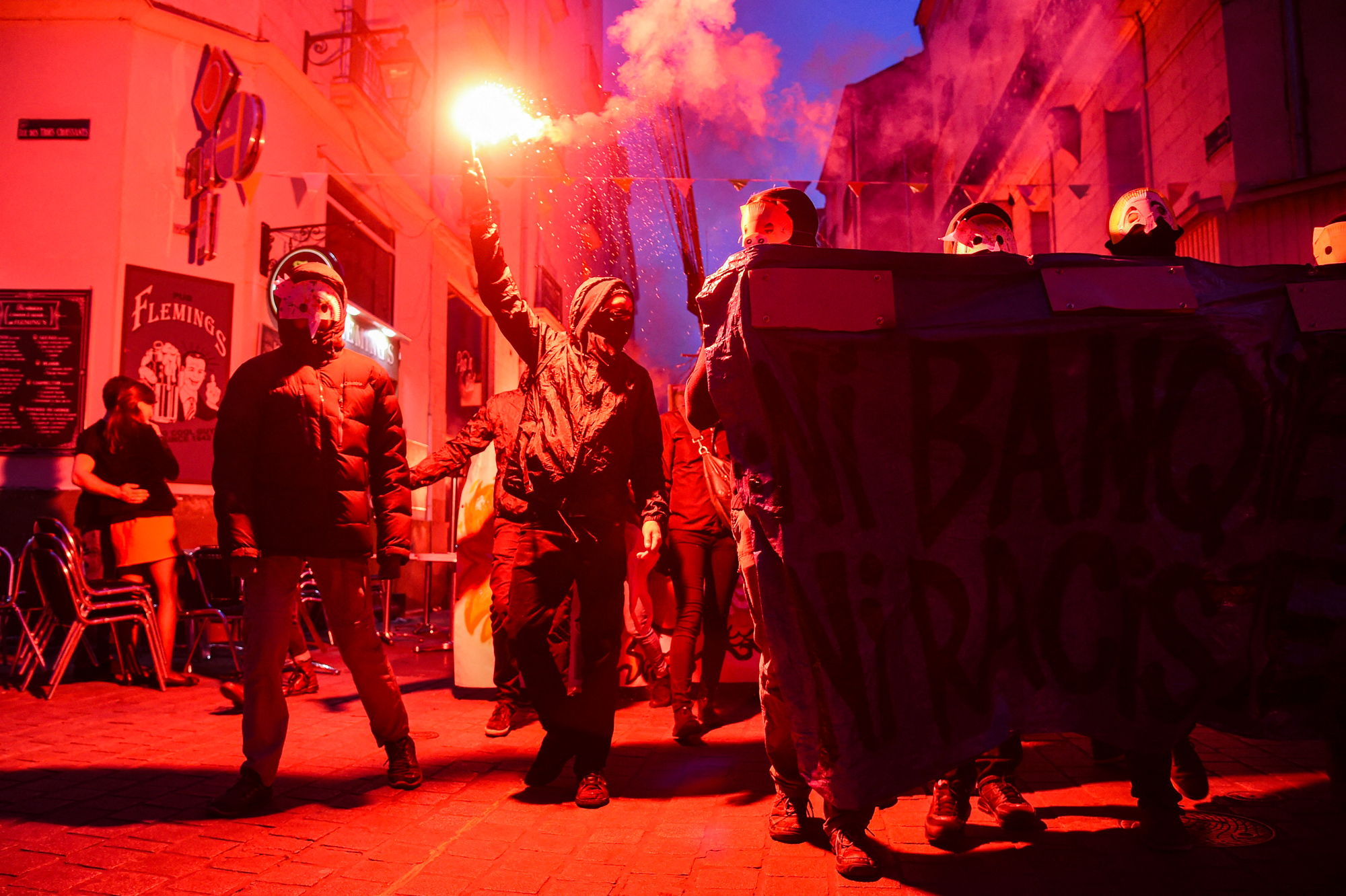

DALLAS—Individuals identified as North Texas Antifa members have testified in a landmark domestic terrorism case that social justice and anti-government ideology influenced their involvement with the group.
The trial in the U.S. District Court for the Northern District of Texas follows President Donald Trump’s executive order on Sept. 22, 2025, designating the Antifa far-left extremist group as a domestic terrorist organization.
The Fort Worth trial completed its second week in what is expected to be a three-week trial.
Members of Antifa, short for “anti-fascist,” have not faced terrorism-related charges until now, although they have been involved in organized protests across the country that have at times turned violent.
In the landmark case, the government alleges that an Antifa cell launched a coordinated attack against the Prairieland Detention Center housing illegal immigrants outside Dallas on July 4, 2025.
The prosecution claims that Benjamin Song ambushed law enforcement at the Immigration and Customs Enforcement (ICE) detention facility outside Dallas, firing 11 shots at police and detention officers and wounding one officer in the neck.
‘Charismatic’ Leader
Two cooperating government witnesses, Lynette Sharp and Seth Sikes, both pleaded guilty to one count of providing material support to terrorists and testified against Song.
Sharp alleged that Song admitted to shooting someone when she helped him evade law enforcement after the officer was shot.
Likewise, Sikes alleged that Song said, “Get to the rifles,” and testified that he heard gunshots coming from behind him, where Song was, and turned to see a muzzle flash.
Sharp met Song in 2022 and Sikes met him in 2024 while Song was teaching martial arts at a Fort Worth community center.
Both witnesses testified that they became friends with the defendants.
“I love them,” Sharp said on the stand, after wiping away tears.
Sikes testified that he and others trusted Song, whom he described as a “very charismatic person” that people would follow.
Cameron Arnold (also known as Autumn Hill), Zachary Evetts, Bradford Morris (also known as Meagan Morris), Maricela Rueda, and Song face the most serious charges of attempted murder, discharging a firearm during a crime of violence, and providing material support to terrorists.
Other defendants facing lesser charges include Savanna Batten, Elizabeth Soto, Ines Soto, and Daniel Rolando Sanchez-Estrada.
All have pleaded not guilty.
Protest Culture
Sharp and Sikes said group members considered themselves victims of society or those who wanted to protect “marginalized” people.
This ideology led them to become caught up in protest culture, offering a rare glimpse into the inner workings of protesters known as Antifa.
Antifa is modeled after a group that worked as the violent arm of the Communist Party of Germany in the 1930s. Some symbols from the original group are still used by the movement today, such as the logo and the raised-fist salute.
Song, who received an “other than honorable” discharge from the Army, recruited Sharp and Sikes to train with the Socialist Rifle Association, often described as a left-wing alternative to the National Rifle Association.
Sharp and Sikes said they learned gun safety and practiced marksmanship. Various defendants in the Antifa case frequently trained with AR-style weapons, they said.
They described practicing shooting together at an outdoor range in Ferris, Texas, before the July 2025 ICE protest, targeting images depicting the Ku Klux Klan.
Sharp labeled herself an anti-fascist.
Under cross-examination, she argued that socialism was not anti-American. Instead, she described it as the belief that some people can be wealthy but that no one should be poor. She distinguished it from communism, under which no one can be wealthy, she said.
She painted anarchy as a benign political ideology in which the community takes care of itself in the absence of a formal government.
Sharp and Sikes described themselves as gay rights supporters who slowly developed a relationship with Song, also known as “Champaign.”
They discussed wearing black bloc, which is all-black clothing, to protests, including face coverings that hid their identities.
Sharp testified that ideological beliefs related to LGBT and minority rights, along with opposition to ICE, fostered friendships among the defendants.
Some participants formed an “affinity group” that she said was organized by Song. She said group members would watch tactical YouTube videos on clearing a building occupied by adversaries.
Sikes, who comes from a military family, testified that he attended a Dallas No Kings protest against Trump’s immigration policies with Song. Sikes testified that he and the other defendants thought that ICE was too aggressive and strongly disagreed with its tactics.
He said Song was “not entirely friendly to police.”
Sikes told the jury that he was uncomfortable with Song’s belief that showing up to demonstrations with assault-style rifles could intimidate police and make them back off.
Sikes described his political beliefs as left-wing, aligning more closely with socialism, while noting that others identified more with anarchists. He said other beliefs in the group included democratic socialism, anarchy, and communism.
He referred to Antifa as an umbrella term encompassing various left-wing groups and said they referred to themselves as Antifa in a “tongue in cheek” fashion.
According to Sharp, the group believed that society was breaking down and that the federal government would eventually fail.
Karaoke and Anti-Capitalism
Group members began inviting Sharp to the “big gay house” where transgender defendants Morris and Hill lived with others.
They would hold karaoke nights and recite poetry on Thursday nights, Sharp said.
Sharp testified that she and other defendants attended Emma Goldman Book Club monthly meetings to discuss articles, book excerpts, and self-published materials known as zines with an anti-capitalist perspective.
Goldman, the book club’s namesake, was a Russian-born Jew and revolutionary who advanced an anti-capitalist, anarchist ideology in the United States in the early 1900s until she was deported.
At the discussions, minorities and women were deferred to when speaking, because white people already “took up too much space,” according to Sharp.
She described herself as anti-fascist, but denied being an Antifa member despite signing a plea deal with the government, which characterized anti-fascists as Antifa.
The group also discussed anarchy during their time together, she testified.
“Some people believed that was a solution,” she said. “Some people didn’t.”