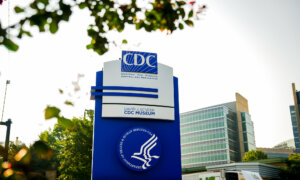
The Centers for Disease Control and Prevention will not publish a study on the effectiveness of COVID-19 vaccination, its top official confirmed late on April 22.
Dr. Jay Bhattacharya, who is serving as the CDC director while the Senate considers President Donald Trump’s nominee for the position, said the paper used a problematic methodology and would thus not be published in the CDC’s quasi-journal, the Morbidity and Mortality Weekly Report (MMWR).
“The study uses a test negative design that will not produce an unbiased estimate of efficacy (and it’s impossible to say which way the bias will go),” Bhattacharya said in a post on X. “MMWR should not be a place where such studies are published.”
Bhattacharya said the study belongs to the authors.
“They can release it as they see fit, just not in MMWR,” he added.
The authors of the study have not been identified publicly.
CDC, COVID-19 Vaccines
The CDC in 2025
stopped broadly recommending COVID-19 vaccination, based on advice from advisers selected by Health Secretary Robert F. Kennedy Jr. The advisers noted uncertainty about the benefits of the vaccines, including the strength and durability of protection.
Under a federal judge’s March 16 ruling in a case brought by health groups challenging those and other changes, the CDC has again begun recommending COVID-19 vaccination for virtually all children and adults.
“The COVID-19 vaccine helps protect you from severe illness, hospitalization, and death,” the CDC states on its website.
Two of the three COVID-19 vaccines available in the United States use messenger ribonucleic acid (mRNA) technology. Kennedy told a Senate panel on Wednesday that mRNA “does not work for respiratory illnesses.”
Test-Negative Studies
The CDC has, for years, utilized the test-negative design in studies attempting to determine the effectiveness of vaccines against influenza and COVID-19. The design features testing people who seek medical care for respiratory symptoms and comparing how many test positive for the disease with those who do not.
Researchers with the CDC and other institutions used the design in a study on the effectiveness of flu vaccination that was published by the MMWR on March 12, about three weeks after Bhattacharya was made the CDC’s top official on an interim basis.

A child receives a vaccine in Coral Gables, Fla., on Sept. 15, 2025. (Joe Raedle/Getty Images)
The researchers said the paper showed that receipt of an influenza vaccine in late 2025 and early 2026 “reduced the risk for influenza-associated outpatient visits and hospitalizations,” with an estimated effectiveness of around 40 percent for children and 30 percent for adults.
Limitations of the research included the inability to account for factors such as underlying medical conditions, the researchers said.
The most recent study on COVID-19 vaccine effectiveness published by the MMWR was released on Dec. 11, 2025. Using a test-negative design, the researchers said vaccination provided 76 percent protection, or 56 percent protection, depending on age, against COVID-19–associated emergency department or urgent care visits in children.
Dr. Eyal Shahar, professor emeritus of epidemiology at the University of Arizona’s Mel & Enid Zuckerman College of Public Health, told The Epoch Times in an email that drawbacks of the test-negative design include selection bias. As explained in a 2016 paper, the bias stems from the inability to adjust for differences in behavior between people who seek medical care and those who do not.
Bhattacharya shared a post on X that described test-negative studies as “garbage.”
MMWR
Rep. Bill Foster (D-Ill.) said in an April 22 post on X that “suppressing reports and hiding the data doesn’t change the facts: the COVID vaccine is safe and effective.”
Lawrence Gostin, director of the O’Neill Institute for National and Global Health Law at Georgetown University Law Center, was among those taking issue with the MMWR’s decision not to publish the study on COVID-19 vaccination.
Gostin wrote in a post on X that the move showed that Kennedy’s pledge to be radically transparent was “just a slogan.” He also said that Bhattacharya “sees method flaws but peer reviewers found the study rigorous,” which he said amounted to political interference.
Bhattacharya said in response that there were no peer reviews because the MMWR is not currently a peer-reviewed journal, but officials are working on changing that.
According to the CDC, MMWR differs from medical journals in part because most of its articles are not peer-reviewed. Instead, content “undergoes a rigorous multilevel clearance process before publication” to ensure it “comports with CDC policy,” because MMWR is “the official voice” of the CDC, the agency has said.
A spokesperson for the CDC told The Epoch Times in an email that “taking time to ensure analyses are methodologically sound and clearly communicated is always preferable to risking error.”
The official added, “The CDC does not make scientific determinations based on predetermined conclusions. We evaluate the weight of evidence using rigorous methods, communicate uncertainty and limitations, and subject our work to scientific scrutiny before publication. The CDC remains committed to timely publication and to transparency about the data and methods that underpin our conclusions. We will continue to communicate what the evidence shows about vaccine benefits and risks.”