
Electric vehicle drivers in California will no longer be allowed in the carpool lanes if they do not meet the minimum number of passengers to qualify for access.
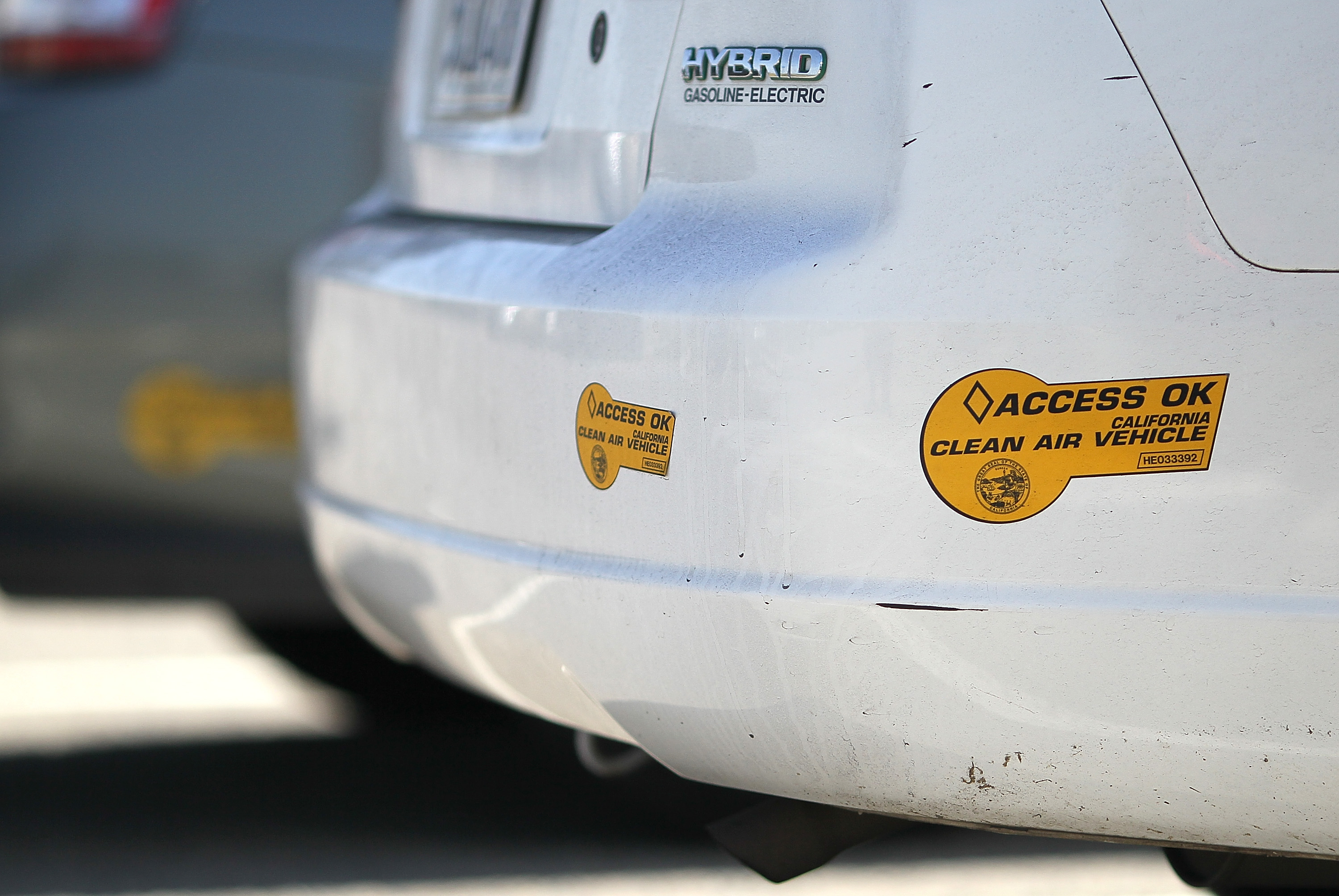
This comes as California’s clean air vehicle (CAV) decal program, which allowed solo electric vehicle drivers access to carpool lanes, ended on Sept. 30, affecting roughly 500,000 cars.
Beginning on Oct. 1, drivers with CAV decals who misuse carpool lanes will have a 60-day grace period before fines and citations start, according to the California Highway Patrol (CHP).
During this grace period, CHP officers will pull drivers over and inform them of the policy changes. Fines starting at $490 will begin on Dec. 1.
Most carpool lanes in California require two or more occupants in the vehicle, but some lanes may require more.
In the San Francisco Bay Area, sections of I-80, I-880, SR-237, and US-101/SR-85 require three or more occupants to qualify for carpool lane use.
In Southern California, carpool lane access on the El Monte Busway—a section of the I-10 freeway—requires three occupants during peak hours from 6 a.m. to 9 a.m. and 4 p.m. to 7 p.m.
CHP encourages drivers to always check for signs indicating the minimum number of occupants for carpool lane access.
Additionally, discounts on the seven state-owned toll bridges in the San Francisco Bay Area or on express lanes also came to an end for drivers who had CAV decals on their cars, according to the state’s FasTrak website.
These bridges include Antioch, Benicia-Martinez, Carquinez, Dumbarton, Oakland-Bay, Richmond-San Rafael, and San Mateo-Hayward. The Golden Gate Bridge was not part of the clean air decal program.
People driving in express lanes with a FasTrak CAV toll tag do not need to buy a new one. Their toll tags will automatically convert to function as a regular FasTrak Flex toll tag, according to the FasTrak website.
The California Department of Motor Vehicles (DMV) says drivers are not required to remove their decals, but the decals will no longer be valid.
The California CAV decal program came to an end due to the federal authorization expiring. Assembly Bill 544, passed in 2017, allowed the program to run through Sept. 30, 2025, and request a waiver from the U.S. Environmental Protection Agency (EPA) for establishing emission standards that differ from federal standards.
State lawmakers passed Assembly Bill 2678 last year to extend the program until Jan. 1, 2027, contingent on federal authorization. However, Congress passed and President Donald Trump signed three resolutions earlier this year to block California’s vehicle emissions mandates and rescind previous EPA waivers on emissions standards, putting an end to the CAV decal program.
The state’s Air Resources Board, which oversaw the decal program and determined which vehicles qualified, said the program served as “a strong motivator for many to purchase zero-emission vehicles,” with over 1.2 million people receiving decals over the years.
However, the board noted that the benefits of the program have dropped in recent years as more drivers switch to electric vehicles.
California’s clean air decal program first launched in 1999 as an incentive for drivers to switch to “cleaner vehicles,” which included early electric, hybrid, and compressed natural gas cars. Over the years, battery-electric, fuel cell electric, and plug-in hybrid-electric cars joined the list of eligible vehicles for the decal program.
“As these cars become more common, the environmental benefit of giving them solo access to the carpool lane is reduced. Looking ahead, reserving these lanes primarily for carpools may offer greater overall benefits in terms of both congestion relief and air quality,” the board wrote on its website.