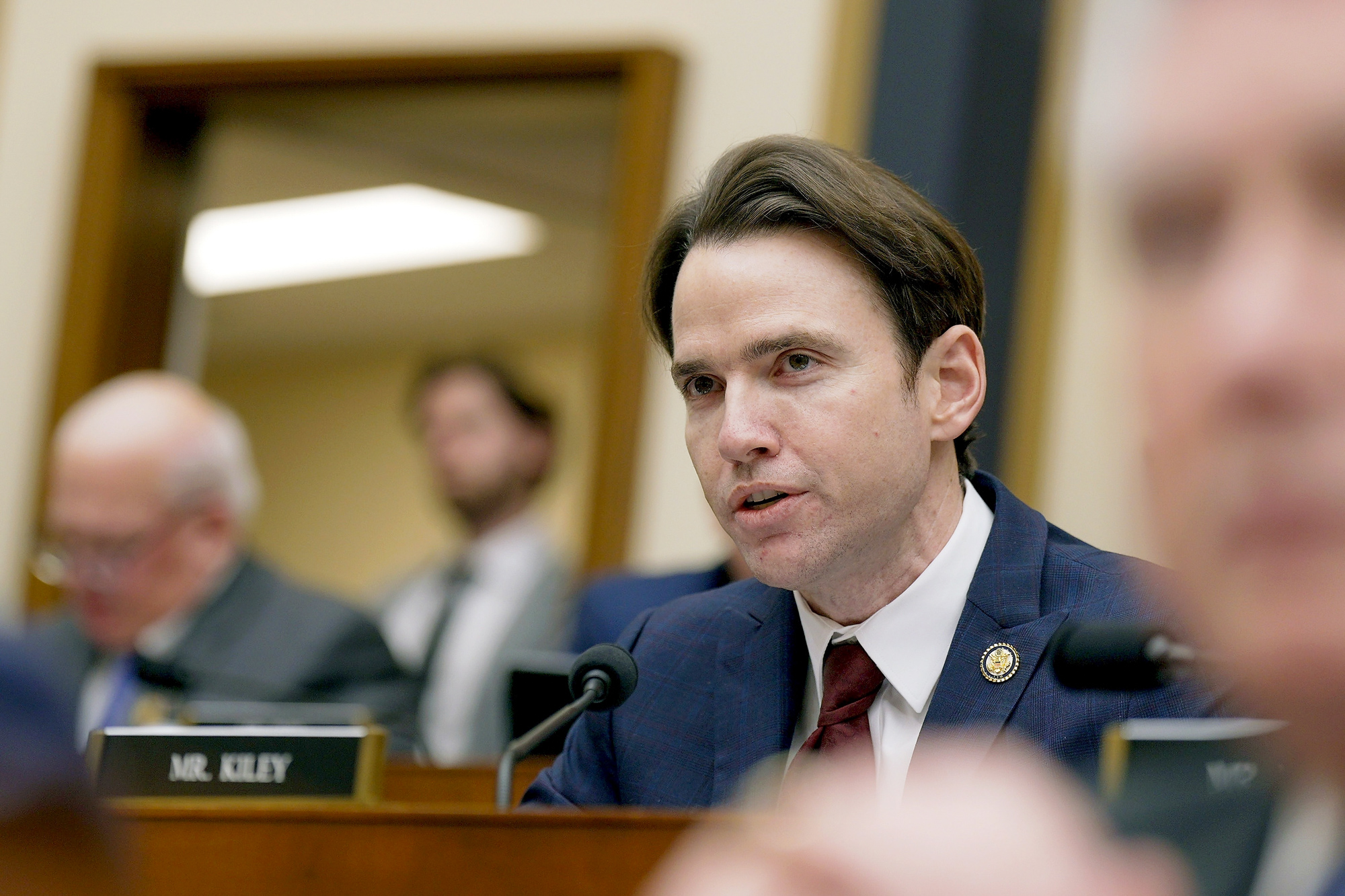

Rep. Kevin Kiley (I-Calif.) announced on March 9 that he was no longer a registered Republican and would instead serve as an independent.
Kiley, who would be the only independent in the House, said on a press call with reporters he would ask the clerk of the chamber to reflect his independent status on the official roster. He said he would continue to caucus with Republicans, meaning the switch could have a limited impact on the GOP’s narrow majority in the House of Representatives.
Kiley’s move came at a time when 34 House Republicans have announced they are not running for reelection. With Kiley’s change in party affiliation, the House now has 217 Republicans and 214 Democrats. Speaker Mike Johnson (R-La.) can afford only one defection on party-line votes.
Kiley has represented California’s Third Congressional District since 2023. His switch to independent came as he faced a difficult reelection campaign after California redrew its congressional map in a way that favored Democrats.
Kiley told reporters he intended to remain on his current committee assignments, which include the Judiciary Committee, the Education and Workforce Committee, and the Transportation and Infrastructure Committee.
He told reporters he did not discuss his decision with House GOP leadership.
The California lawmaker has occasionally broken with his party on key votes. In February, he was one of six Republicans who voted to rescind tariffs imposed by President Donald Trump on Canada. He also voted to override two of Trump’s vetoes. In November, Kiley introduced legislation to temporarily extend health care tax credits under the Affordable Care Act, though he later voted against a clean three-year extension backed by Democrats.
Kiley filed for reelection as “No Party Preference,” California’s designation for candidates without party affiliation.
“As an elected representative, I’ve always seen my role as being an independent voice for our community, holding politicians in Sacramento and Washington accountable to serve my constituents,” he said in a March 6 post on X. “I answer to you, not party leaders. That’s the kind of representation I believe the newly-drawn Sixth District deserves.”
When asked by a reporter what party he would caucus with if reelected in November, Kiley said, “I’m going to do whatever is serves my constituents and so you know that’s a decision that I’ll make at the time.”
In announcing his reelection bid, Kiley criticized the broader political climate on Capitol Hill.
“It is no secret I’ve been frustrated, at times disgusted, by the hyper-partisanship in Congress. In the last year it’s led to the longest government shutdown in U.S. history, a massive increase in healthcare costs, and of course, a pointless redistricting war,” he said.
He also called out both Republicans and Democrats for being complicit in what he called “the epidemic of gerrymandering.”
The redistricting in California followed a similar effort in Texas aimed at benefiting Republicans. Republican state legislators in Texas redrew the state’s congressional map to add five seats that favor Republicans.