
Scientists at the University of California, Irvine, are working on a portable device to “smell the world” and sniff out explosives, narcotics, and dangerous chemicals, the institution reported Sept. 19.
A team from the university’s engineering complex is trying to fuse nature’s olfactory precision with tiny electronics, according to electrical engineering and computer science professor Peter Burke.
The team aims to create a handheld device that can instantly sniff out explosive residue at a crime scene, harmful airborne chemicals after an industrial spill, or illegal drugs before they enter the postal system.
The goal is to create an “electronic nose” that reacts to trace amounts of chemical substances—even if they differ by a single carbon atom.
“The combination of these … technological advances and the result of millions of years of the evolution of olfactory receptor proteins is enabling the goal of single-molecule sensing with specificity toward analytes that differ by as little as one carbon atom,” Burke said.
The electronic nose could transform public safety, manufacturing, environmental protection, and medical diagnostics, according to the university.
The project started picking up steam after Burke and collaborator Francesco Tombola were granted $450,000 by the National Science Foundation in 2022. The funding allowed the team to start making strides in producing the ultra-sensitive chemical sensors.
The approach is still in its conceptual stage, but has now been patented, according to the university.
Future sensors could be developed to have massive parallel sensor arrays that include chips with hundreds of district odor-detecting elements.
Sangjun Noh, a doctoral candidate in Burke’s lab, has taken the electronic nose project beyond the lab to explore real-world impacts.
Noh has held more than 12 customer interviews with researchers, lab managers, and safety officers. He has since identified a strong need for real-time chemical sensing to enhance laboratory safety and prevent contamination, the university added.

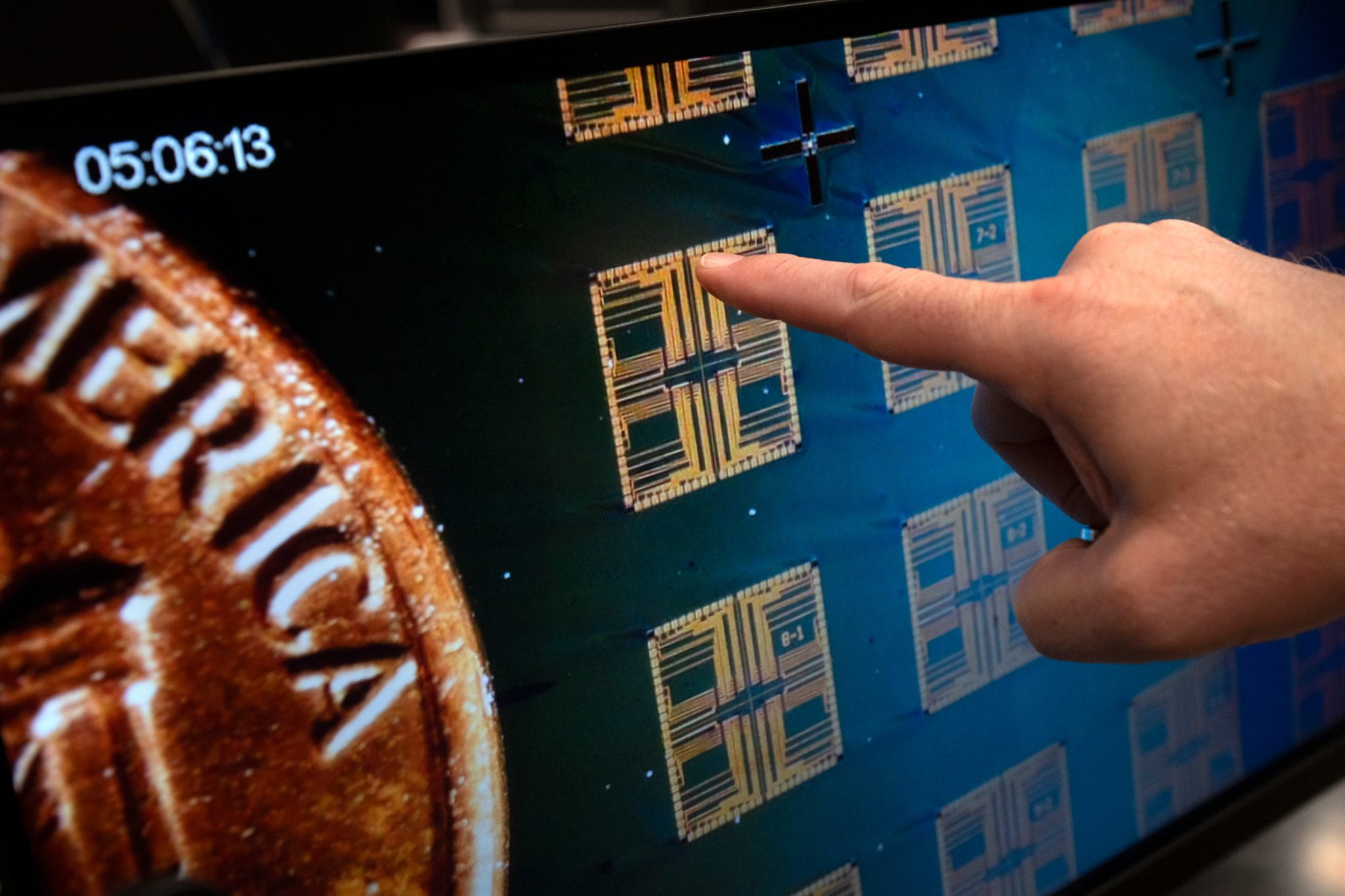
UCI electrical engineering and computer science professor Peter Burke (R) and graduate student Sangjun Noh are working on a handheld "electronic nose." (Steve Zylius / UC Irvine)
“These insights also revealed potential national security applications, such as detecting explosives and hazardous chemicals,” UC Irvine reported.
The technology must still move from concept to deployable systems. This means scientists must integrate many sensors onto one chip and ensure stability under real-world conditions. The devices must also be affordable and scalable, according to the team.
“This project not only showcases cutting-edge science—it taps into deep evolutionary design,” UC Irvine stated.