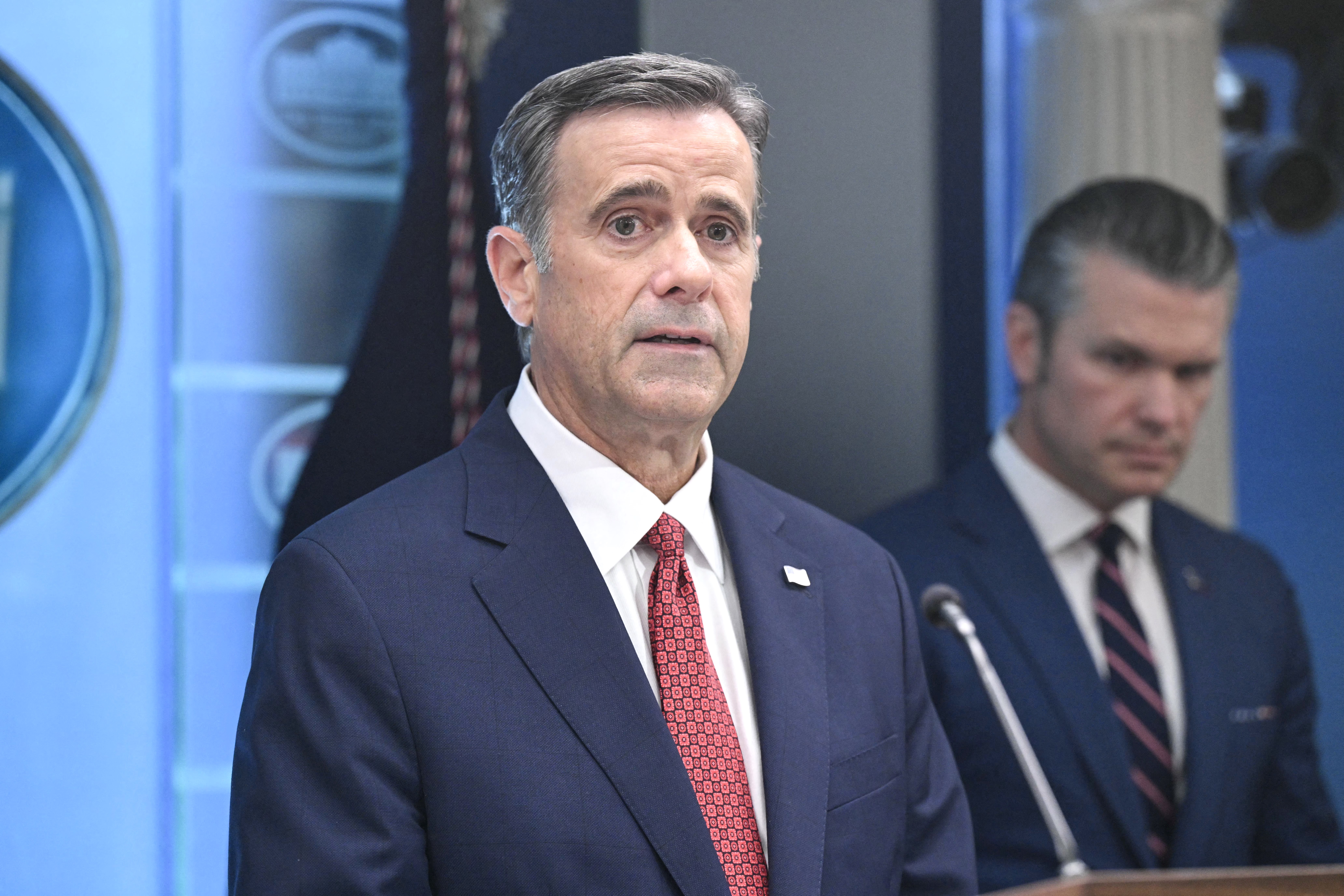
CIA Director John Ratcliffe said in a press briefing on April 6 that the agency used classified capabilities over the weekend to locate and rescue a U.S. weapons system officer who was shot down deep behind enemy lines in Iran.
Although he said he could not discuss these methods in detail, Ratcliffe explained that the CIA has “unique” capabilities, which only President Donald Trump can deploy.
“We deployed both human assets and exquisite technologies—that no other intelligence service in the world possesses—to a daunting challenge, comparable to hunting for a grain of sand in the middle of a desert,” Ratcliffe said.
Trump and War Secretary Pete Hegseth joined him.
On Saturday morning, the CIA achieved its primary objective in finding and confirming the soldier was still alive, Ratcliffe said.
“[Ratcliffe] did a phenomenal job that night,” Trump said before introducing Ratcliffe to give more details about the mission.
Finding the injured U.S. service member, whose identity has not yet been released, was like finding a needle in a haystack, Trump said, for which the CIA was mostly responsible.
The soldier stuck to his training after being shot down, and while bleeding profusely, Trump said, he scaled cliff faces and embedded himself in treacherous mountain terrain to avoid detection.
It was a race against the clock, Ratcliffe said.
Meanwhile, the CIA was tasked with executing a deception campaign to misdirect Iranian forces trying to track him down.
The CIA director began his comments by touting “flawless” military operations and intelligence under the Trump administration, such as Operation Midnight Hammer in June 2025 to take out key Iranian nuclear facilities.
Others included the overnight mission to capture Venezuelan leader Nicolás Maduro earlier this year and strikes against drug cartels in the Pacific and Caribbean to stem the flow of illegal drugs into the United States.
Now, the same methods used in previous military operations are being used every day in Operation Epic Fury against Iran and were used in the rescue mission of the downed airman, Ratcliffe told reporters.
“It is the unique tradition of the U.S. armed forces that we leave no man or woman behind,” Ratcliffe said.
“This was a no-fail mission. That was the spirit in which the president put us to work, and we were determined not to let him down, or our airman down.”
Once there was confirmation that the airman was alive, the information was relayed to Hegseth and Trump. Then, the execution phase of the rescue operation commenced.
“America’s best and bravest was alive and concealed in a mountain crevice still invisible to the enemy, but not to the CIA,” the director said.
Trump told reporters that he was briefed on the dangers and potential cost of U.S. military equipment and lives in conducting the mission, but he approved it anyway, saying he thought “it was worth it.”
“The Iranians were embarrassed and ultimately humiliated by the success of this audacious rescue mission,” Ratcliffe said.
The CIA director credited Trump with having the courage to approve this mission. The agency’s capabilities would be wasted without a president like him, Ratcliffe said.
“The confidence of CIA’s officers is boosted by the knowledge that their work is informing a president who is not afraid to make the hardest decisions when the stakes are highest,” Ratcliffe said.
“To the American people, your confidence should be boosted by knowing that the security of the nation is in the hands of a president who is willing to take on problems that have confounded both sides of the political aisle for nearly half a century.”