
California’s high-speed rail project connecting Los Angeles to San Francisco is now estimated to cost $126 billion, a rail authority board member said in an interview released by CBS’s “60 Minutes” on April 5.
But the High-Speed Rail Authority, according to its 2026 Business Plan issued in February, forecasts $39.3 billion in capital funding through 2045, a shortfall of about $87 billion.
“It is a big gap to fill, [but] we have an understanding of how to get there and to fill that gap,” board member Anthony Williams said.
A California High-Speed Rail Authority spokesperson told The Epoch Times that this $126 billion estimate is down by $1.6 billion from its 2024 projections.
The project, approved by voters in 2008, was supposed to connect San Francisco to Los Angeles by high-speed rail for about $33 billion, with a completion date of 2020.
In the authority’s latest plan, the first phase of the project is estimated to have a similar price tag of about $31.6 billion, but it will connect Merced and Bakersfield instead of San Francisco and Los Angeles.
“We’re now in 2026,” state Rep. Vince Fong of Bakersfield, a Republican, said in the interview. “There are no trains. There’s no track laid. It was a complete bait and switch. The business plan that was put out in 2008 was very theoretical. You know, ‘This is what we think is going to happen.’ And it became very clear that they didn’t have the specifics worked out.”
Toks Omishakin, who became California’s secretary of transportation in 2022, admitted that mistakes had been made and that a lot of criticism of the project is “very fair.”
“I don’t think the voters fully understood, and neither did we, in the public sector, what it was going to take to actually get this project delivered,” he said.
Williams admitted that when construction started, there was not enough financing to complete the rail line.
“It wasn’t [enough funding],“ he said. ”Let’s be real. We had a lot to learn. We had a lot of growth to do. It’s arguable whether ... we should have been clearer about that.”
In July 2025, the Federal Railroad Administration terminated approximately $4 billion in unspent federal funding for the project.
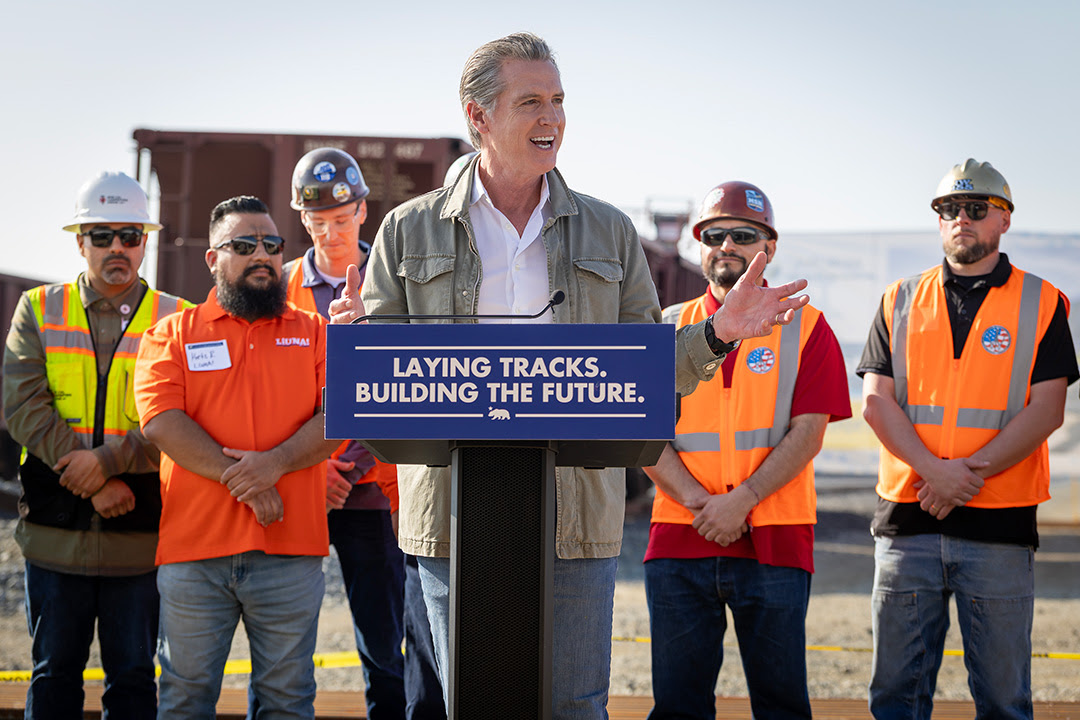
“This is California’s fault,” said U.S. Transportation Secretary Sean P. Duffy.
“Gov. [Gavin] Newsom and the complicit Democrats have enabled this waste for years. Federal dollars are not a blank check—they come with a promise to deliver results. After over a decade of failures, [California High-Speed Rail Authority’s] mismanagement and incompetence has proven it cannot build its train to nowhere on time or on budget.
“It’s time for this boondoggle to die.”
In order to help fund the project, the authority said, it plans to lease the land for utility and technology infrastructure, including data centers and solar farms.
The authority’s spokesperson told The Epoch Times that it will begin installing the high-speed rail in the Central Valley later this year.
“[The] work is underway, and it’s not stopping despite opposition and obstruction by the federal government,” the spokesperson said.
The authority’s inspector general issued a report in February 2025 noting issues with the project, including the fact that the agency would likely not complete the Merced to Bakersfield portion by the intended year of 2033.
Omishakin said officials believe that the Merced to Bakersfield line can be done without federal funding.
“This initial segment, we believe so,“ he said. ”The ultimate 494 miles of building this out without the federal government’s help will be challenging. There’s no doubt about that.”
Lou Thompson, who was a member of the California High-Speed Rail Authority’s Peer Review Group until 2024, said the project cannot, and should not, be done without federal funding, since a lot of the benefits are public.
“A lot of the benefits of the project, the reason why you build a project, is public,“ he said. ”Pollution reduction, congestion reduction, improved safety, comfort, reliability—all of those things are public benefits.”