
Commentary
Of California’s 58 counties, a dozen have county seats that share their names, including San Diego, San Francisco, and Los Angeles. These county seats are the hubs of the county. It’s where you go to obtain a birth certificate or attend a Board of Supervisors meeting.
How are these cities, and therefore, these counties doing financially? Obtaining their annual comprehensive financial reports (ACFR) and dividing the city’s population into the unrestricted net position (UNP) for Governmental Activities, a per capita is derived which allows for a ranking.
For this series, a hard look at the county seats for 2020 was provided first. For the eight county seats that were unincorporated, the entire county was considered (*). For 2021, nine county seats moved up or down the ranking five positions or more, when compared year-over-year, during the first full year of Governor Newsom’s COVID lockdown. While forty-nine of California’s major cities stayed roughly in place, what made these nine others move so dramatically?
Let’s go from the top to the bottom. Santa Rosa in Sonoma County moved up 12 places. It had $88.5 million in revenues in excess of expenditures, transferred $1.8 million into restricted assets and appropriated $7.0 million into its net investment in capital assets. Combined, it improved the city’s unrestricted net deficit by $79.7 million.
In comparing the statement of activities with the prior year, revenues from grants not restricted to specific programs increased by $88.8 million. This provides the explanation. But searching the document on the website did not provide the details. In fact, searching the word “grant” resulted in no results, even though it is used throughout the 222 pages of the ACFR. It may be time for a software update for Santa Rosa. But these grants were prevalent during this fiscal year.
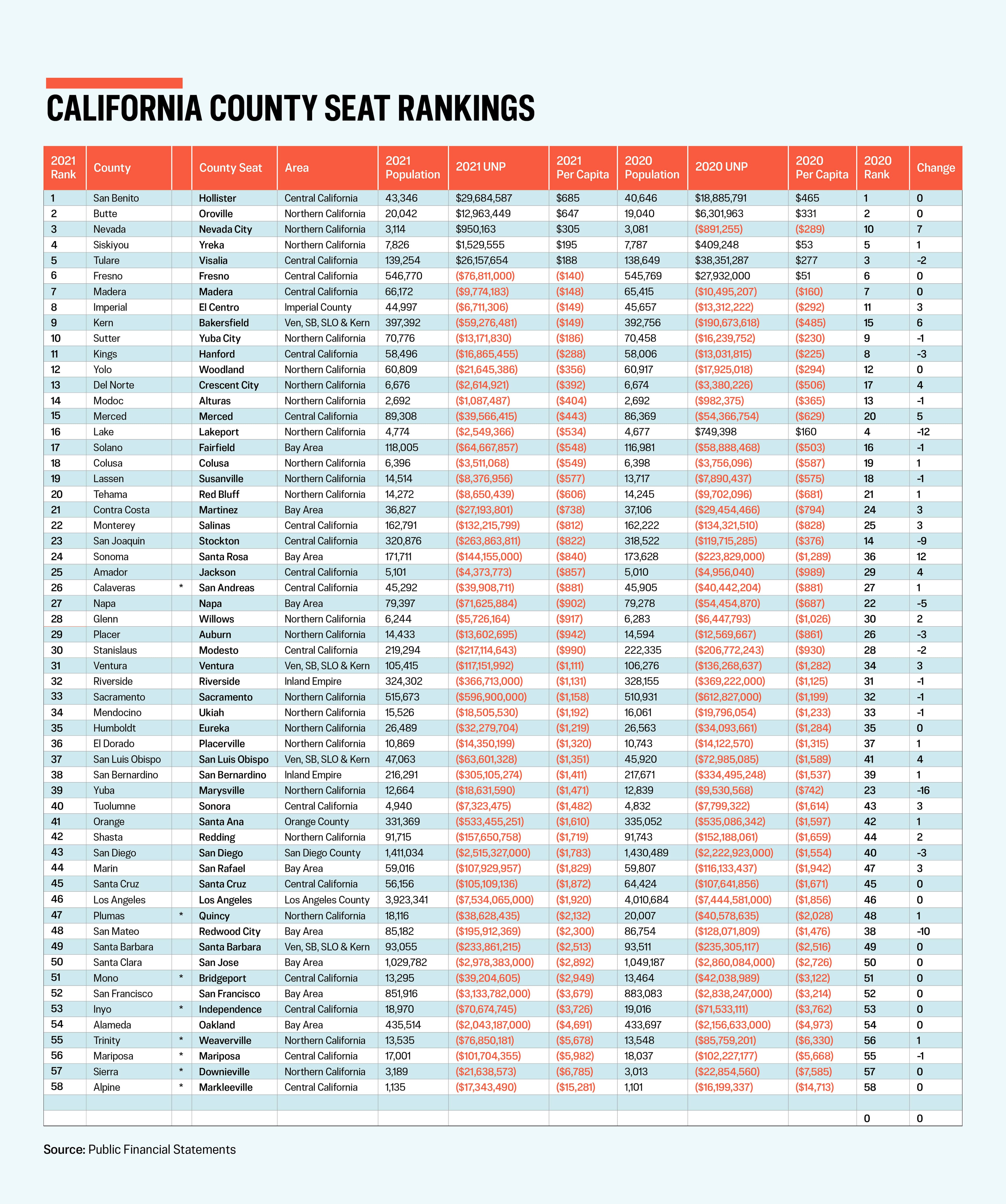
Nevada City in Nevada County had an unrestricted net deficit of $891,255 for the fiscal year ended 2020. In 2021, it had revenues in excess of expenditures of $1,216,684 and transferred $624,734 from restricted assets, combined the $1,841,418 turned it into a positive unrestricted net position of $950,163. Other taxes increased by $1,432,610 over the prior year, but no explanation was provided for the 367 percent increase. Perhaps it too is an American Rescue Plan Act (ARPA) grant. It moved up seven places.
Bakersfield in Kern County had revenues in excess of expenditures of $137.9 million, transferred $0.2 million into restricted assets and $6 million into its net investment in capital assets. The combination found the unrestricted net deficit being reduced by $131.4 million. Who knows where the $0.3 million rounding error came from.
The city found its General Government Operating Grants and Contributions increase over the previous year by $95.6 million. Fortunately, keying in “grant” in the search resulted in 85 hits. The management discussion mentions the “ARPA grant of $94.5 million” (American Rescue Plan Act) “to address the negative impact of COVID-19.” The city moved up six places.
The city of Merced in Merced County had revenues in excess of expenditures of $17.3 million, reduced its net investment in capital assets by $8.8 million as a result of depreciation exceeding new acquisitions, and transferred $11.5 million into restricted assets. The net result was a $14.8 million reduction to its unrestricted net deficit. The disclosures announced that the ARPA and Coronavirus Aid, Relief and Economic Security (CARES) Act distributions was the same amount, $14.8 million. This explains the positive movement to the button and moved the city up five positions.
One would think the ARPA and CARES Act revenues would assist all 58 county seats. But this did not appear to be the case. The city of Napa had expenditures in excess of revenues of $12.7 million, transferred $13 million into restricted assets, and had a reduction to its net investment in capital assets of $13.9 million. Combined, the unrestricted net deficit increased by $11.8 million. Even though it received $7.6 million in ARPA funds, dropping it five places.
Stockton in San Joaquin County has certainly garnered considerable attention since it is one of the few cities in California that has recently filed for Chapter 9 bankruptcy. It had revenues in excess of expenditures of $83.2 million, appropriated $8.1 million for its net investment in capital assets, and transferred $219.3 million into restricted assets, with $152.1 million for “Long-term loans” and $73.4 million for “Housing.” This resulted in an increase of $144.2 million in its unrestricted net deficit and dropped it ten places. There was no reference regarding ARPA or CARES grants in the ACFR. But moving an unprecedented massive amount into restricted assets caused the city to drop nine places.
Redwood City in San Mateo County had revenues in excess of expenditures of $41.6 million, which included $1.1 million in one-time CARES and $9.2 million in ARPA funding. It appropriated $34.1 million for its net investment in capital assets and also transferred a large amount to restricted assets, $99.8 million. Throw in a Governmental Accounting Standards Board 84 restatement of $24.4 million related to the city’s Section 115 Trust Fund (used for unfunded actuarial accrued pension liability funding efforts), and the net result was a $67.9 million increase to its unrestricted net deficit. It also dropped 10 places.
Lakeport in Lake County had $1.9 million in revenues in excess of expenditures, appropriated $1.0 million for its net investment in capital assets, and transferred a significant $2.9 million into restricted assets. There was no mention of ARPA or CARES grants. Combined, its unrestricted net deficit increased by $2.0 million, dropping it 12 places.
Marysville in Yuba County had expenditures in excess of revenues of $7.3 million and increased its net investment in capital assets by $1.8 million, causing the unrestricted net deficit to increase by $9.1 million. There was also no mention of ARPA or CARES grants. But it was enough to drop the city 16 places.
Federal relief during 2021 and transfers into restricted funds were the big stories for 2021. The coronavirus impacts would also be felt in 2022. But having only five county seats in positive territory indicates the fiscal stress California’s cities and counties are under.